

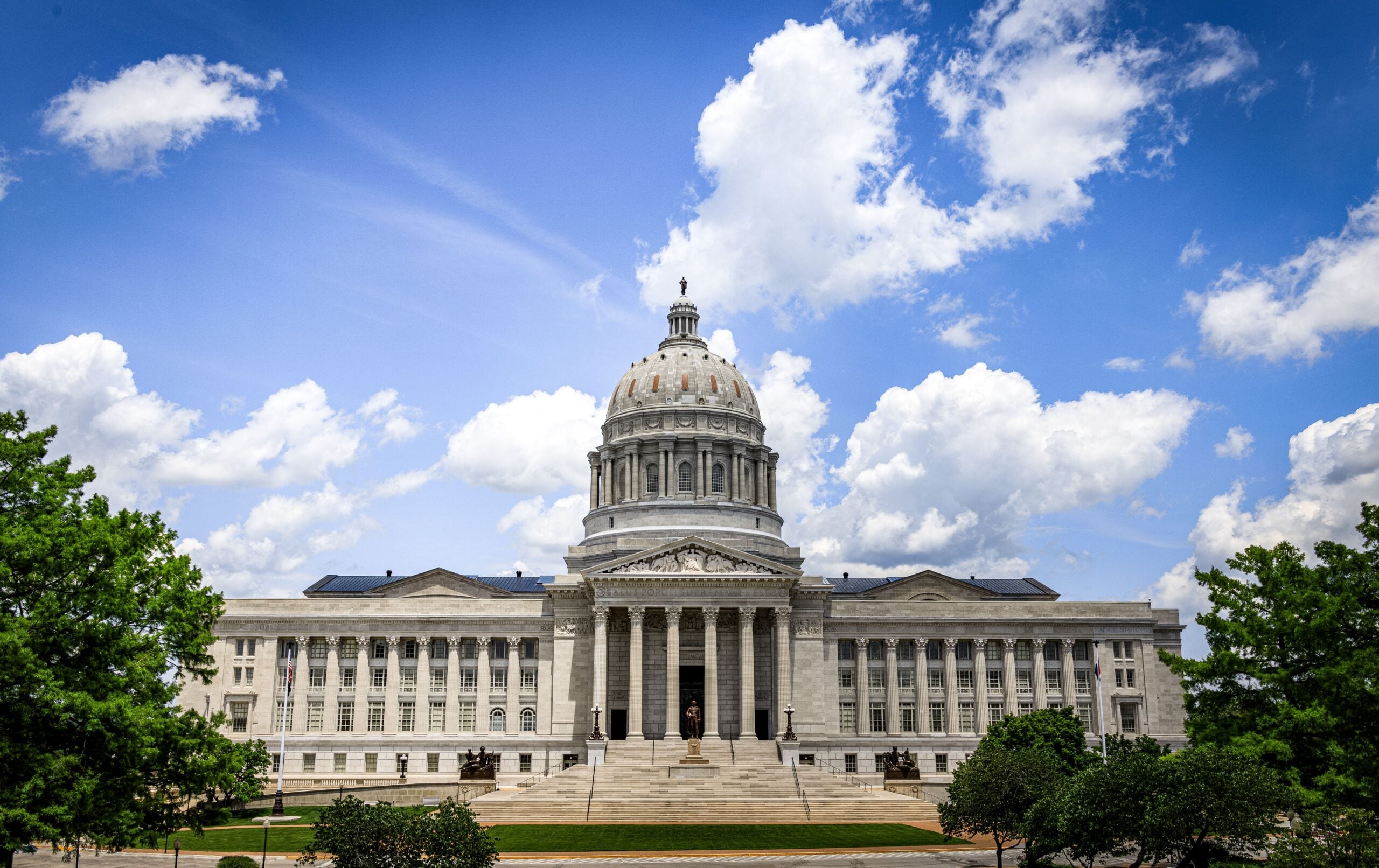
Missouri Attorney General Catherine Hanaway’s office has issued cease-and-desist letters to six online prediction market operators offering sports-related “event contracts,” joining a growing list of states pursuing similar enforcement actions.
Missouri’s Cease-and-Desist Letters
On September 18, 2026, the Missouri Attorney General’s Office announced that it had sent cease-and-desist letters to six online prediction market operators: Polymarket, Kalshi, Crypto.com, Novig, Underdog, and Robinhood. The letters assert that these companies are facilitating unlicensed sports wagering under Missouri law by offering sports-related “event contracts” that allow users to trade on the outcome of sporting events.
According to the Missouri Attorney General’s Office, the letters ground this position in Missouri’s 2024 voter-approved Amendment 2, which legalized and regulated sports betting under the oversight of the Missouri Gaming Commission and launched the licensed market on December 1, 2025. That framework permits wagering through licensed mobile, online, and in-person channels, subject to a 10% tax on sports betting gross receipts, and requires age verification to prevent anyone under 21 from placing a sports wager. The Missouri Attorney General’s Office stated that five of the six companies either permit underage users to access their products or lack adequate safeguards to prevent Missourians under 21 from participating.
In a statement, Attorney General Hanaway said: “Missourians voted for a safe, well-regulated sports wagering market that supports public education and addresses problem gambling. Companies cannot repackage sports bets as ‘event contracts’ to avoid Missouri law. We will enforce the rules voters approved and protect consumers.” She added that “[a]ny company that wants to offer sports wagering in Missouri must be licensed by the Missouri Gaming Commission, pay the required taxes and fees, and ensure no one under 21 can place a bet.”
The letters address a core legal argument that prediction market operators have raised elsewhere: that their event contracts are “swaps” regulated exclusively by the federal Commodity Exchange Act (CEA) and the Commodity Futures Trading Commission (CFTC), which would preempt state gambling regulation. Attorney General Hanaway’s letters reject that position, stating that “[f]ederal law does not preempt state law in this area, and sports ‘event contracts’ do not qualify as ‘swaps’ governed by the federal Commodity Exchange Act, as frequently claimed by illegal online sportsbooks.” The letters call on the six companies to comply with Missouri law without delay, and state that failure to do so will result in enforcement action.
A Broader Multistate Enforcement Pattern
Missouri’s action follows a series of similar cease-and-desist letters, lawsuits, and criminal charges brought by other states against prediction market operators over the past eighteen months, reflecting a broader split among the states over how far their gambling laws reach when it comes to these platforms.
State gaming regulators in Nevada, Illinois, Montana, Arizona, Connecticut, Maryland, and Ohio issued cease-and-desist letters to Kalshi, Polymarket, or both between March 2025 and January 2026. The Maryland Lottery and Gaming Control Commission’s April 7, 2025 letter to Kalshi stated that purchasing its sports-related contracts “is indistinguishable from the act of placing a sports wager,” and the Ohio Casino Control Commission’s March 31, 2025 letter similarly concluded that Kalshi was “operating online sports gaming” without the license Ohio law requires. New Jersey’s Division of Gaming Enforcement, part of the state’s Department of Law and Public Safety, sent Kalshi a cease-and-desist letter in March 2025 asserting that its sports-related event contracts constituted unauthorized sports wagering under the New Jersey Sports Wagering Act, including contracts tied to New Jersey collegiate sporting events that the state constitution separately bars wagering on altogether.
Beyond administrative cease-and-desist letters, several attorneys general have pursued litigation directly. In August 2026, Connecticut Attorney General William Tong, together with the Department of Consumer Protection and the Governor’s office, filed suit against Kalshi seeking a court injunction to block the platform from offering unlicensed sports wagers to Connecticut residents. The lawsuit followed a December 2025 cease-and-desist order from the Department of Consumer Protection’s Gaming Division directed at Kalshi and two other platforms. Tong stated that “[s]ports event contracts are no different than sports betting and are not magically shielded by federal law from Connecticut’s commonsense consumer protection laws.”
Massachusetts Attorney General Andrea Joy Campbell likewise filed suit against Kalshi in Suffolk Superior Court, alleging that the company promoted and accepted online sports wagers from Massachusetts customers without obtaining a license from the Massachusetts Gaming Commission, as state law requires. The complaint alleges that Kalshi allowed users between the ages of 18 and 21 to wager, below the state’s legal sports wagering age of 21, and that the company’s responsible-gambling safeguards fell short of what licensed operators must provide. As part of the filing, the Attorney General’s Office asked the court to order Kalshi to cease sports wagering operations in Massachusetts while the case is pending.
Michigan Attorney General Dana Nessel has likewise pursued litigation directly. In March 2026, Nessel sued KalshiEx, LLC, alleging that its event-contract trading platform enables unlicensed sports betting in violation of Michigan’s Lawful Sports Betting Act without approval from the Michigan Gaming Control Board. A June 2026 temporary restraining order halted Kalshi’s Michigan operations and advertising, and on September 2, 2026, Attorney General Nessel secured a preliminary injunction requiring Kalshi to maintain geofencing to block Michigan residents from its sports-related event contracts, with violations subject to a $500,000-per-day penalty.
Arizona Attorney General Kris Mayes filed 20 criminal misdemeanor charges in March 2026 against Kalshi entities for alleged violations of state betting, wagering, and election-wagering laws. Nevada Attorney General Aaron Ford has also been active on this issue, co-leading a coalition of 37 states and the District of Columbia.
Alongside this enforcement wave, a growing number of state legislatures have enacted or proposed their own prediction market laws, with approaches ranging from outright prohibition to taxation, licensing, and market-integrity rules. Minnesota became the first state to enact an outright ban in May 2026 (prompting a CFTC suit to block it), while Kentucky, North Carolina, and New Jersey have taken taxation-first approaches, Illinois and Ohio have pursued sports-specific licensing, and Tennessee, California, New York, and Pennsylvania have proposed integrity- or disclosure-focused measures. We covered this legislative patchwork in a previous update this summer.
Current Litigation Status: A Split Landscape
These enforcement actions have generated dozens of court proceedings testing whether the CEA gives the CFTC exclusive authority over sports-related event contracts or whether states retain their own authority to regulate them as sports wagering. Courts in Nevada, Michigan, Ohio, Iowa, and Connecticut have ruled for state regulators at the preliminary injunction stage, while a federal appellate court has ruled for Kalshi in New Jersey; outcomes so far differ by jurisdiction.
Nevada and Michigan are the two states where preliminary injunctions against Kalshi remain in effect: a Nevada state court granted the Nevada Gaming Control Board a preliminary injunction against Kalshi, Polymarket, and Coinbase, with the court describing sports betting and sports-contract trading as “indistinguishable,” and Michigan’s preliminary injunction against Kalshi, discussed above, remains in effect. Nevada’s case has also produced a federal circuit-level ruling for the state: on August 28, 2026, the U.S. Court of Appeals for the Ninth Circuit, in KalshiEX, LLC v. Assad, affirmed the district court’s dissolution of Kalshi’s preliminary injunction as to its sports event contracts, holding that Kalshi had not shown a likelihood that the CEA preempts Nevada’s gaming regulations, and remanded only the separate question of Kalshi’s election contracts for further proceedings. Like the Sixth Circuit’s later Ohio ruling, the Ninth Circuit concluded that sports event contracts are not “swaps” within the CEA’s statutory definition and rejected Kalshi’s express, conflict, and field preemption arguments. Federal courts in Ohio and Iowa have likewise ruled for state regulators at the preliminary injunction stage, concluding that event contracts do not meet the legal definition of a “swap” under the CEA, and on September 25, 2026, the U.S. Court of Appeals for the Sixth Circuit affirmed the Ohio ruling on that basis while also vacating a Kalshi-favorable injunction from a federal trial court in Tennessee. In Connecticut, a federal court denied Kalshi’s request for a preliminary injunction against the state, and later denied a similar emergency request while Kalshi’s appeal to the U.S. Court of Appeals for the Second Circuit is pending.
New Jersey reached a different outcome. A federal district court granted Kalshi’s motion for a preliminary injunction against the New Jersey Division of Gaming Enforcement, and in April 2026 the U.S. Court of Appeals for the Third Circuit affirmed that ruling 2-1, holding that Kalshi’s sports-related event contracts are “swaps traded on a [federally-licensed exchange]” subject to the CFTC’s exclusive jurisdiction, such that the CEA preempts New Jersey’s gambling laws as applied to those contracts. In Arizona, the CFTC has separately sued the state to block its enforcement efforts, with Kalshi’s motion to dismiss the related criminal charges still pending.
The result, for now, is a circuit split: the Third Circuit has sided with Kalshi on preemption, while the Sixth and Ninth Circuits have ruled for the states on the merits. With Missouri’s action adding to the roster of active state enforcement efforts—joining Michigan, Nevada, Ohio, Iowa, Connecticut, New Jersey, Maryland, and Arizona, among others—and further appellate proceedings pending in the Second and Fourth Circuits, companies operating prediction markets with sports-related contracts may want to evaluate their state-by-state compliance posture closely as the landscape remains unsettled.
Key Takeaways
Missouri’s cease-and-desist letters add it to a growing list of states that have sent similar letters to prediction market operators, including Nevada, Illinois, Montana, Arizona, Connecticut, Maryland, Ohio, and New Jersey, as well as to the broader roster of states—among them Michigan, Massachusetts, and Iowa—that have pursued lawsuits or criminal charges on the same underlying theory. The central legal question in these disputes—whether the CEA gives the CFTC exclusive authority over these contracts, or whether states retain their traditional authority to regulate sports wagering—remains unresolved at the appellate level, with the Third Circuit siding with Kalshi and the Sixth and Ninth Circuits siding with the states. Given this unsettled and jurisdiction-specific landscape, companies operating prediction markets with sports-related contracts may wish to evaluate their compliance posture on a state-by-state basis and monitor further developments in pending appeals.
If you have questions about how these developments might affect your business, contact Jeff Le Riche or Kip Randall.