

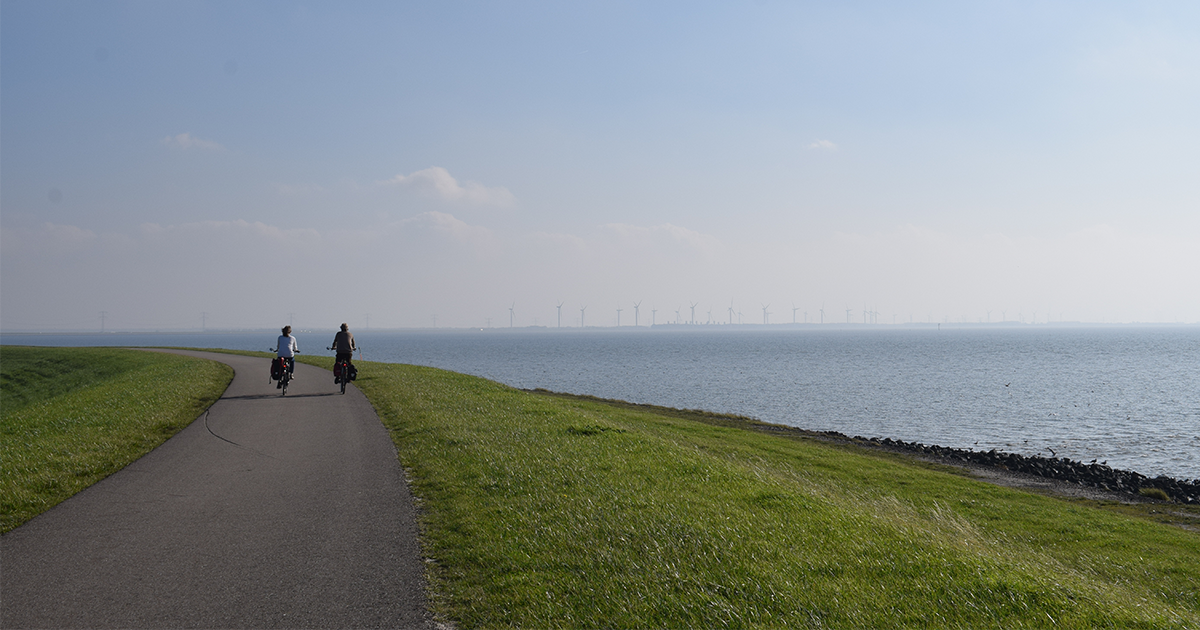
In my last post, I wrote about how the Netherlands went from roughly 3,500 water authorities to 21. Structure matters. But throughout this NAFSMA trip, our Dutch hosts kept pointing to something that doesn’t show up on an organizational chart. They called it the Dutch Way. As they described it, it has three parts: speak directly, reach decisions together through compromise, and keep the relationships between people warm.
It would be easy to treat this as a pleasant cultural aside. I think it’s more than that. I think it’s a big part of why Dutch flood protection works.
It started with the dikes. The Dutch have a name for their consensus-driven style of governance: the poldermodel (polder model). A polder is a tract of low land reclaimed from the water and protected by dikes (levees). The name is no accident. The cooperation needed among all ranks of society to keep polders intact is what gave the polder model its name. One popular explanation traces it to the late Middle Ages, when communities sharing a polder had to agree on who would maintain the dikes and pumps, because otherwise everyone would flood. They kept cooperating on the dikes even when neighboring cities were at war with each other. Some historians think that story oversimplifies things. But the lesson holds either way: when everyone lives behind the same levee, no one can afford to walk away from the table.
Directness. The Dutch are famously blunt, and in flood protection that is a feature, not a bug. A frank statement of risk, such as “this dike does not meet the standard” or “this neighborhood will flood in this scenario,” is the starting point for doing something about it. Interestingly, the U.S. Army Corps of Engineers says much the same thing in its own training materials. The Corps’ risk communication guidance notes that telling the public a flood will cover 20 miles and spread at a given velocity means far less than telling them which neighborhoods will be affected and should be ready to evacuate. The Corps has also been candid about its own shortcomings. Its dam and levee safety programs have acknowledged that their communications too often focus on what the agency wants to say, rather than on prompting action and collaboration.
Consensus through compromise. Consensus in the Dutch sense does not mean everyone gets what they want. It means everyone with a stake stays at the table until there is an answer they can all live with. The Corps has tools built on this idea. Shared Vision Planning, developed by the Corps during the National Drought Study of 1989–1993, combines a systems approach to water management, a public-involvement method called “Circles of Influence,” and computer models of the system that stakeholders build together. The Corps’ guidance also describes good risk communication as multidirectional among agencies, the public, and stakeholders, and as covering the periods before, during, and after an event. The policy is there. The question is whether we practice it.
Warmth. This is the part that surprised me most, and it may matter most. The directness works because it happens between people who know and trust each other. Hard conversations about a failing levee go very differently when the people having them have shared a meal, a boat ride, or a long afternoon on a dike. Relationships built before the flood are what hold during the flood.
What this means for the United States. We have a lot of the Dutch structure: levees, floodwalls, pump stations, and a century of federal flood control projects. What we often lack is the Dutch way. Too often, we talk around the residual risk that remains behind a levee rather than naming it. The many parties who share a flood risk rarely sit down together until there is a permit to fight over or a disaster to recover from. Those parties include local levee and drainage districts, cities, counties, farmers, businesses, environmental groups, and state and federal agencies. And we tend to build relationships during emergencies rather than before them.
We already have evidence that the Dutch Way travels. After Katrina, the Dutch Dialogues brought Dutch and American engineers, planners, and designers together in New Orleans. Three workshops held there from 2008 to 2010 led directly to the Greater New Orleans Urban Water Plan and to the city’s successful $141 million National Disaster Resilience Competition award for the Gentilly Resilience District. Since then, the same approach has been taken to communities across the country, including Hampton Roads, New York, Bridgeport, St. Louis, Tampa Bay, Los Angeles, and Charleston.
The Dutch Way isn’t magic, and it isn’t uniquely Dutch. It’s what happens when people who share a levee decide to speak plainly, decide together, and treat each other as neighbors. That can happen along the Mississippi, the Sacramento, or the Atlantic coast just as easily as along the Rhine.