

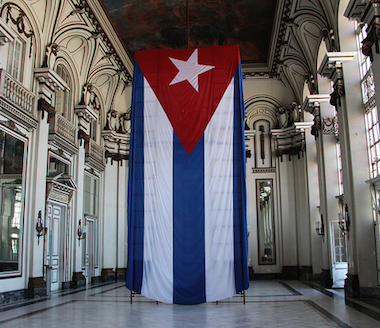
It seems like just yesterday we were speculating about what kind of big steps President Obama would take now that he’s in the homestretch of his presidency. And now here we are, watching as Obama welcomes Cuba back into the fold.
It won’t happen overnight; for now it’s just an ease of the restrictions against Cuba, but there’s hope for more. There’s a very good chance that Obama’s proposed changes are likely just the beginning of changes to U.S. policy against Cuba–that is, if Congress will play ball.

The embargo, which has been in place since the early 1960s, isn’t gone. Only Congress can lift the economic all-encompassing economic sanctions against Cuba, and there will still be restrictions on U.S. citizens traveling to the island. What the U.S. is broadly committing to is reestablishing diplomatic relations, and the President has already instructed Secretary of State John Kerry to initiate discussions between the two countries to this end, with the State Department also reviewing Cuba’s presence on the State Sponsor of Terrorism List. They’ve also committed to collaborating against things like narcotics and human trafficking, while working to facilitate greater financial remittances and re-establishing the U.S. embassy in Havana.
As Jennifer Diaz notes on the Customs & International Trade Law Blog, the state of the law regarding business is still contingent on a couple things, including proper licensing:
Currently, the Cuban Assets Control Regulations “prohibit any person subject to U.S. jurisdiction from dealing in any “property” in which Cuba or a Cuban national has or has had any interest.” The definition of “property” is very broadly defined and includes such things as contracts and services. “Importing from Cuba requires dealing in property in which Cuba or a Cuban national has an interest, and is therefore prohibited.” Currently, “with certain exceptions, no products, technology, or services may be exported from the United States to Cuba or a Cuban national, either directly or through third countries, such as Canada or Mexico, without a license from OFAC.” Currently, it is a violation of the Cuban Assets Control Regulations to sign a contract with a foreign firm if the contract terms include Cuba-related provisions, even if those provisions are contingent upon the lifting of the embargo.
Exactly how the licensing goes into effect will depend on the Treasury Department’s Office of Foreign Assets Control (OFAC), who will probably roll out in the next few weeks. As Scott Maberry of Sheppard Mullin noted in an interview with LXBN TV, the divisive move won’t amount to much on a global scale (“a few billion dollars in the first period”), but it is still the beginning of a new era for many U.S. industries.
“We’ve got clients who we are helping to move into Cuba, as soon as they can. They are banking and financial services, tourism and hospitality, telecommunications. And this is going to be a big one, both for manufacturers of handsets and stuff like that—where we expect there’s going to be a high demand— but there’s also infrastructure equipment, software, and that kind of technology. There’s going to be a large appetite for that, I believe, in Cuba very soon. And I think those are the things the President is emphasizing,” said Maberry.
Steve Augustino, blogger at Telecom Law Monitor, agrees, noting that in the longterm, opening the door for telecommunications could considerably alter and update the Cuba telecommunication world:
While today’s announcement is only an initial step in easing restrictions, the move could potentially pave the way to a significant liberalization of trade and travel between the two countries. The announcement outlines a substantial easing of restrictions on telecommunications products and services. In particular, the action will enable authorization for the export of certain communications devices, software, and services to Cuba for the establishment and updating of communications systems, and authorization to establish telecommunications infrastructure in Cuba to provide telecommunications and internet services in Cuba. These changes could have a significant impact on international telecommunications services.
But perhaps one of the most interesting longterm changes from this policy alteration will be in the culture of Cuba. As Nicholas O’Donnell writes in his post on the Art Law Report, opening up relations between Cuba and the U.S. could bring a whole new world of artwork to life:
I expect the upshot of this to be a wave of interest in visiting the arts in Cuba, and coupled with increased economic freedom (for Americans, who are prohibited currently from spending U.S. dollars in Cuba, but who face challenges exchanging U.S. dollars for Cuban pesos even when there legally), of investment in the arts. Plenty of Americans travel to Cuba through third countries unconcerned about the risk that their visit will be detected upon their return to the U.S., but most people are not going to put themselves in that kind of jeopardy. And educational visits have flourished in the last decade, but are still cumbersome compared to other travel and usually have few slots relative to participants’ interest.
This will likely now change, even compared to the recent levels of exchange described by Rangel, above. Contemporary art in particular is nothing if not focused on the new, and I’m sure that the mere fact of previous unavailability will spike the cache of Cuban art if more people are able to go see and/or buy it.
For now, we’ll just have to wait and see whether Congress decides this is something it’s willing to work on. But with some Congressional members already speaking out against the policy shift, it’s clear that no one will be buying up Cuban cigars just yet.