


As reported in A jury rules a handwritten will found under Aretha Franklin’s couch cushion is valid:
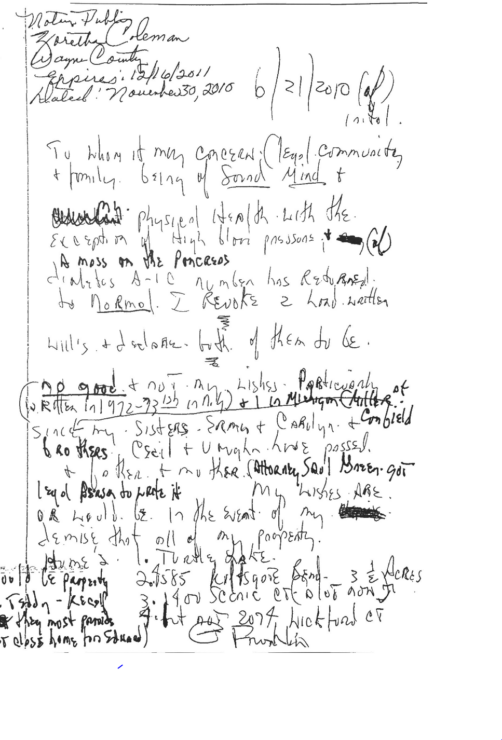
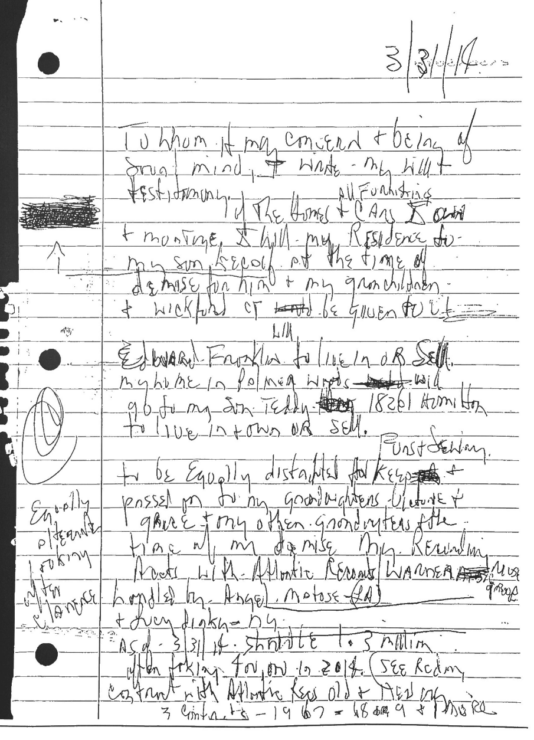
A jury in Michigan has ruled that a [2014] note handwritten by the late soul singer Aretha Franklin is valid as her will, according to The Associated Press. In 2019, Franklin’s niece found three handwritten documents around the singer’s home in suburban Detroit. One, dated 2014, was found underneath a couch cushion. Two of Franklin’s sons, Kecalf and Edward Franklin, argued through their lawyers that they wanted the latter note to override a separate will written in 2010.
Link to This litigation would have never happened in Florida This litigation would have never happened in Florida
Why? Because neither handwritten document was attested to by two witnesses. Some jurisdictions, including Michigan, will accept un-witnessed wills if they’re handwritten (holographic). Not Florida. If Aretha Franklin had died a resident of this state both un-witnessed wills would have been automatically rejected as a matter of law. She would have died intestate, which means her children would have split her estate equally by default.
Link to This case is a prime example of the benefits of “channeling” This case is a prime example of the benefits of “channeling”
Most of us would be hard pressed to look at Ms. Franklin’s handwritten 2010 “will” or her handwritten 2014 “will”, both of which are barely legible — with crossed-out words and scribblings in the margins — and say with certainty, yeah, that’s a will. Fortunately, we rarely (if ever) have that problem in Florida. Why? Think: channeling.
One of the benefits of requiring execution formalities to be scrupulously complied with for a will to be legally enforced in Florida — such as the two-attesting-witnesses requirement of F.S. 732.502(1) — is that these requirements have the side effect of standardizing what most Florida wills look like. As a result, Florida wills are generally going to follow a standard format that’s easily identifiable.
Academics call this “channeling.” Here’s how the channeling effect is described in Wills Formalities in the Twenty-First Century:
The statutory requirements for formal wills serve useful ends. They take the vast array of testamentary things and channel them into a form that is readily recognizable as a will, thus easing the transfer of property at death. By imposing a standard form on testamentary writings, they enable probate courts to identify documents as wills solely on the basis of readily ascertainable formal criteria, thereby permitting probate to proceed in the vast majority of cases as a routine, bureaucratic process.
Because wills in Florida have to follow strict execution formalities and be attested by two witnesses, most are going to follow a standard format that’s easily identifiable. And that means you’re not going to find yourself pondering whether mom’s barely legible hand written notes with crossed-out words and scribblings in the margins that she hid under the sofa cushions years before she died is her will — which is basically what happened in the Aretha Franklin case.
Link to Was the family acrimony caused by this will contest worth it? Was the family acrimony caused by this will contest worth it?
The primary economic difference between the two competing wills appears to be who gets Ms. Franklin’s main home in Bloomfield Hills, valued at $1.1 million when she died. But both wills apparently equally split the estate’s music catalog. And that’s where almost all of the value of this estate lies. According to celebritynetworth.com:
Aretha’s royalty income in the years after her death has been $3-4 million per year. The value of her catalog and royalty income would likely push her actual net worth at death closer to $50 – $80 million.
A $1.1 million house is a rounding error compared to a $50 – $80 million music catalog. If the value of the catalog is split equally among the brothers under both wills, was a family fight over the house — with all the stress and acrimony that accompanies any will contest — really worth it?
By the way, if Ms. Franklin’s estate generates the royalty income that’s currently estimated she’ll be typical for artists of her stature — many of whom generate huge sums of wealth long after they’ve died, as gleefully reported by Forbes in its annual list of the highest paid dead celebrities. Here’s an excerpt from its 2022 list, as reported in The Highest-Paid Dead Celebrities Of 2022—A Writer Earns Half-A-Billion From The Great Beyond:
Seems not even the boneyard is immune from inflation. The 13 departed artists, athletes and entertainers on this year’s list of the top-earning dead celebrities earned a record $1.6 billion, making it a 72% increase over last year’s total. It’s by far the biggest 12-month haul since we started tracking graveyard earnings in 2001 – and, for the first time ever, the top five made more than $100 million each. …
Overall, the music of yesteryear is seen by investors as a reliable income stream. Nearly $700 million of the $1.6 billion in total earnings came from the estates of the nine musicians on the list, including David Bowie ($250 million), Michael Jackson ($75 million) and “Hallelujah” songwriter Leonard Cohen ($55 million). Some of those earnings came from one-time sales. The estate of Toto drummer Jeff Porcaro, for instance, sold his publishing and recording royalties for $25 million in November 2021. Others, like Beatles John Lennon and George Harrison remain mainstays on the list due to their annual recurring royalty streams.