


The Financial Crimes Enforcement Network (“FinCEN”) has published a Small Entity Compliance Guide (the “Guide”) for beneficial ownership information (“BOI”) reporting under the Corporate Transparency Act (“CTA”), as well as updated FAQs regarding CTA compliance.
The Guide contains six chapters and an appendix. It is 56 pages long. It appears to be useful to its apparent target audience, which is small businesses confronting relatively simple issues under the CTA. The Guide is relatively clear, simply-worded and contains helpful infographics. However, what neither the Guide nor the updated FAQs does is provide any real insights into how to interpret the BOI reporting regulations. Rather, they reiterate the existing BOI regulatory requirements. Thus, anyone looking for insights into nuanced CTA issues will be disappointed.
The CTA takes effect on January 1, 2024. On that date, FinCEN needs to have implemented a working data base to accept millions of reports by newly-formed companies required to report BOI under the CTA, as well as reports by the even greater population of existing reporting companies, which must report their BOI by January 1, 2025. This is a logistically daunting task, because FinCEN estimates that over 30 million entities will need to register by the 2025 date. Perhaps one of the most interesting things about the Guidance is that it clearly asserts that the January 1, 2024 date is good, and that the CTA BOI database will be functioning by then.
That claim is debatable. FinCEN still needs to issue important and basic regulations implementing the CTA, including final rules regarding access to the data base, and proposed rules regarding how the existing Customer Due Diligence (“CDD”) Rule applicable to banks and other financial institutions might be amended – and presumably, expanded – to align with the different and often broader requirements of the CTA. Further, FinCEN’s notice and request for comment regarding FinCEN’s proposed form to collect and report BOI to FinCEN was criticized roundly. Given the backlash, FinCEN now is revising the proposed reporting form.
Similarly, on June 7, 2023 four members of the U.S. House of Representatives (the Chairpersons of the House Committee on Financial Services; the House Committee on Small Business; the House Subcommittee on National Security, Illicit Finance, and International Financial Institutions; and the House Subcommittee on Financial Services and General Government) sent a letter directed to Janet Yellen, Secretary of the Treasury, and Himamauli Das, Former Acting Director of FinCEN, regarding the status of the implementation of the CTA. The letter, fairly or not, stresses the need for transparency by FinCEN, and implies that January 1, 2024 may not be a viable date.
The fact that FinCEN devoted its limited resources to producing a 56-page publication which repeats but does not explicate current regulatory requirements for BOI reporting is unusual, given FinCEN’s many other pressing demands – such as finishing the rest of the regulations under the CTA. However, it is possible that the Guide is a reaction to demands placed upon FinCEN by certain members of Congress, who are pushing for clarity for affected businesses.
Link to The Guide: Reporting Company The Guide: Reporting Company
With the above caveats in mind, we now summarize the Guide. As noted, the Guide does not appear to provide additional substantive insight. Rather, it attempts to render existing regulatory requirements more accessible. For example, the Guide includes the following chart regarding the definition of a “reporting company” required to comply with the CTA:
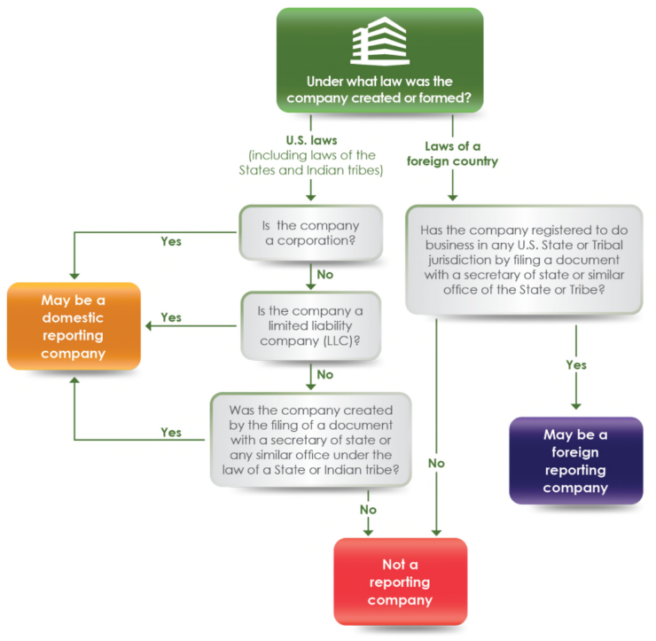
The nuanced question to which this seemingly simple chart references, but does not expand upon, is precisely when an entity “may” be a reporting company covered by the CTA. However, the Guidance later provides a relatively useful set of questions for entities to consider as to whether they qualify as one of the 23 entities which the CTA explicitly exempts from its coverage.
Link to The Guide: Substantial Control The Guide: Substantial Control
The Guide also offers the following graphic regarding the issue of “substantial control” under the CTA. This is one of the thorniest issues under the CTA, given the incredible breadth of the term.
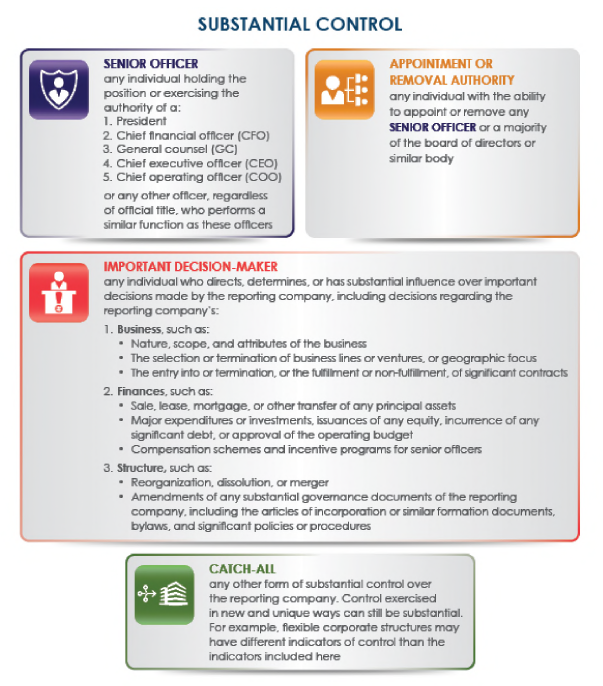
Many notable commentators have bemoaned the breadth of the vague “substantial control” prong under the CTA, in contrast to the CDD Rule, which requires entities to identify only a single “control person.” For example, Jim Richards has suggested, satirically, that his favorite bartender could qualify under the CTA as a beneficial owner of his AML consulting company, given his “substantial influence” over “important decisions” being made by Mr. Richards.
Link to The Guide: Ownership The Guide: Ownership
Similarly, the Guide provides this graphic regarding the “ownership” prong of beneficial ownership. Although the ownership interest is cabined concretely to a 25% interest, similar to the CDD Rule, the below graphic illustrates how expansively such interests may be considered:
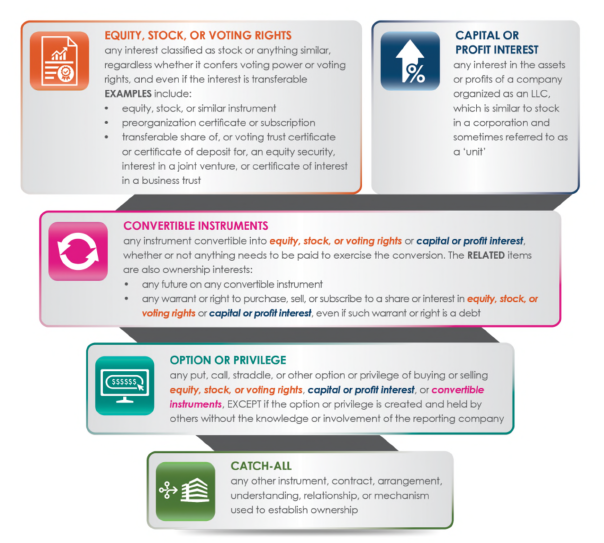
Similar to the issue of companies exempted from the definition of reporting companies, the Guide also contains a series of yes-or-no questions regarding ownership interests under the CTA.
Link to The FAQs The FAQs
FinCEN has updated its FAQs on the CTA, first published in March 2023. Unfortunately, like the Guide, the updated FAQs provide no additional analysis, but rather regurgitate the existing CTA regulatory requirements. They note that the regulations regarding access to the CTA database are still forthcoming, and that FinCEN is still revising the actual CTA reporting form. The FAQs do not mention the regulations regarding alignment with the CDD Rule which FinCEN still needs to propose.
Having said that, FAQ D.6 is notable for certain professionals. It asks, “Is my accountant or lawyer considered a beneficial owner?” Here is the answer, which echoes language from the federal register regarding the final rule:
Accountants and lawyers generally do not qualify as beneficial owners, but that may depend on the work being performed.
Accountants and lawyers who provide general accounting or legal services are not considered beneficial owners because ordinary, arms-length advisory or other third-party professional services to a reporting company are not considered to be “substantial control” (see Question D.2). In addition, a lawyer or accountant who is designated as an agent of the reporting company may quality for the “nominee, intermediary, custodian, or agent” exception from the beneficial owner definition.
However, an individual who holds the position of general counsel in a reporting company is a “senior officer” of that company and is therefore a beneficial owner. FinCEN’s Small Entity Compliance Guide includes a checklist to help determine whether an individual qualifies for an exception.
Likewise, FAQ E.3 asks, “Is my accountant or lawyer considered a company applicant?” Again, the below language echoes verbiage from the federal register:
An accountant or lawyer could be a company applicant, depending on their role in filing the document that creates or registers a reporting company. In many cases, company applicants may work for a business formation service or law firm.
An accountant or lawyer may be a company applicant if they directly filed the document that created or registered the reporting company. If more than one person is involved in the filing of the creation or registration document, an accountant or lawyer may be a company applicant if they are primarily responsible for directing or controlling the filing.
For example, an attorney at a law firm that offers business formation services may be primarily responsible for overseeing preparation and filing of a reporting company’s incorporation documents. A paralegal at the law firm may directly file the incorporation documents at the attorney’s request. Under those circumstances, the attorney and the paralegal are both company applicants for the reporting company.
The FAQ E.3 response re-emphasizes how the CTA can pull lawyers and other professionals directly into its reporting requirements, even if they are not beneficial owners themselves.
If you would like to remain updated on these issues, please click here to subscribe to Money Laundering Watch. Please click here to find out about Ballard Spahr’s Anti-Money Laundering Team.
Link to Related Posts Related Posts

Closing the Gate: House Adopts ENABLERS Act Amendment to 2023 NDAA
July 21, 2022

Corporate Transparency Act of 2019 Broadens Beneficial Ownership Reporting
March 28, 2019

Use of Tainted Assets to Pay Attorney Fees: A Primer on the Pitfalls
September 4, 2018Search…SEARCHYour website url
Link to STAY CONNECTED STAY CONNECTED
Link to TOPICS TOPICS
Topics Select Category 18 USC 1956 18 USC 1957 31 USC 5324 Administrative Procedures Act AMLA of 2020 Anti-Money Laundering (AML) Art and Antiquities ATMs Attorney Client Privilege Attorney Liability Bank Bank Fraud Bank Secrecy Act (BSA) Basel AML Index Beneficial Ownership BIS Bling Blockchain Analytics Bribery Broker Dealer BSA AML Reform Bulk Cash Smuggling Casino Check Casher Civil Liability to Private Parties Civil Penalty Commodity Futures Trading Commission (CFTC) Compliance Program Conference of State Bank Supervisors (CSBS) Conspiracy Consumer Financial Protection Bureau Corporate Transparency Act Correspondent Bank Accounts COVID-19 Credit Union Criminal Enforcement Currency and Monetary Instrument Report (CMIR) Currency Transaction Report (CTR) Customer Due Diligence Cybersecurity De-Risking Dealers in Jewels, Precious Metals or Stones Deferred Prosecution Agreement DeFi Department of Justice (DOJ) Department of State Elder Abuse Electronic Funds Transfer Environmental Crime ESG European Union Examination Export Controls Extraterritorial Application of US Law FBAR Federal Deposit Insurance Corporation Federal Reserve FFIEC Fifth Amendment Financial Action Task Force (FATF) Financial Crimes Enforcement Network (FinCEN) FINRA Fintech Foreign Account Tax Compliance Act (FATCA) Foreign Corrupt Practices Act (FCPA) Forfeiture Form 8300 Fourth Amendment Freedom of the Press Geographic Targeting Order (GTO) Gold and Precious Metals Grand Jury Investigation Human Trafficking Identity Theft Illegal Wildlife Trade Independent Testing Individual Liability Information Sharing Intent to Conceal Intent to Evade a Reporting Requirement Intent to Promote Internal Investigations Internal Revenue Service (IRS) International Tax Evasion Investment Advisors Investor Suits Kingpin Act Know Your Customer (KYC) Marijuana Industry Mixers Money Services Business Money Transmitter Mortgage Banking MSB Mutual Legal Assistance Treaty (MLAT) Narcotics Financing National Credit Union Administration New York Department of Financial Services (NYDFS) NFTs Nonbank Lender Not-For-Profits Office of Foreign Assets Control (OFAC) Office of the Comptroller of the Currency (OCC) Offshore Account Organization for Economic Cooperation and Development (OECD) PANA Panama Papers Pandora Papers Paycheck Protection Program payment processors Plea Agreement Prepaid Account Provider Proceeds Racketeer Influenced and Corrupt Organizations Act (RICO) ransomware Real Estate Record Keeping Report of Foreign Bank and Financial Accounts Risk Assessment Section 311 of USA Patriot Act Securities and Exchange Commission (SEC) Sentencing Sexual Exploitation Specified Unlawful Activity State Enforcement Structuring Suspicious Activity Report (SAR) Tax Fraud Technological Innovation Terrorism Financing Third-Party Relationships Title Insurance Tracing Trade Based Money Laundering Training Transaction Monitoring Travel Rule Trusts Uncategorized Undercover Investigations USA PATRIOT Act Virtual Currency Voluntary Disclosure Whistleblower
Link to ARCHIVES ARCHIVES
Archives Select Month September 2023 August 2023 July 2023 June 2023 May 2023 April 2023 March 2023 February 2023 January 2023 December 2022 November 2022 October 2022 September 2022 August 2022 July 2022 June 2022 May 2022 April 2022 March 2022 February 2022 January 2022 December 2021 November 2021 October 2021 September 2021 August 2021 July 2021 June 2021 May 2021 April 2021 March 2021 February 2021 January 2021 December 2020 November 2020 October 2020 September 2020 August 2020 July 2020 June 2020 May 2020 April 2020 March 2020 February 2020 January 2020 December 2019 November 2019 October 2019 September 2019 August 2019 July 2019 June 2019 May 2019 April 2019 March 2019 February 2019 January 2019 December 2018 November 2018 October 2018 September 2018 August 2018 July 2018 June 2018 May 2018 April 2018 March 2018 February 2018 January 2018 December 2017 November 2017 October 2017 September 2017 August 2017 July 2017 June 2017 May 2017 April 2017 March 2017 February 2017 January 2017
Link to LINKS TO OTHER RESOURCES LINKS TO OTHER RESOURCES
- Ballard Spahr Anti-Money Laundering Services
- Corporate Transparency Act Beneficial Ownership Reporting Rule
- Federal Financial Institutions Examination Council – Bank Secrecy Act/Anti-Money Laundering Examination Manual
- Federal Tax Crimes
- Financial Crimes Enforcement Network
- FINRA Rule 3310 Anti-Money Laundering Compliance Program
- Illicit Edge
- IRS BSA Examination Techniques for Bank Secrecy Act Industries
- IRS Money Services Business (MSB) Information Center
- Money Laundering Bulletin
- New York Department of Financial Services BSA/AML and OFAC Regulations
- Office of Foreign Assets Control
- Office of the Comptroller of the Currency BSA Webpage
- SEC Anti-Money Laundering Source Tool for Broker-Dealers
- The Financial Action Task Force
- U.S. Department of Justice – Asset Forfeiture and Money Laundering
- U.S. Department of Justice U.S. Attorneys Manual – Title 9: Criminal Money Laundering
Link to RECENT POSTS RECENT POSTS
- FinCEN Issues Small Entity Compliance Guide for Corporate Transparency Act
- FinCEN Analysis Reveals Patterns and Trends in Suspected Evasion of Russia-Related Export Controls
- “Pig Butchering”: FinCEN Issues Alert on Virtual Currency Scam
- Switzerland Proposes Due Diligence for Attorneys and Broader Beneficial Owner Reporting Laws
- All Roads Lead to Roman: Alleged Tornado Cash Co-Founders Roman Storm Arrested and Roman Semenov Sanctioned, Days After Treasury Defeats Lawsuit Challenging OFAC
Link to Money Laundering Watch Money Laundering Watch
by the White Collar Defense/Internal Investigations Group at Ballard Spahr LLP
Link to CONTACT CONTACT
Peter D. Hardy
215.864.8838
RSS LinkedIn Twitter YouTubeDisclaimerPrivacy Policy
Link to ABOUT ABOUT
Ballard Spahr’s Anti-Money Laundering Team represents a broad range of financial institutions. We help clients establish and refine AML policies and procedures; prepare for and respond to regulatory exams; conduct due diligence for lending and acquisitions; and conduct internal investigations and respond to administrative, civil or criminal investigations, government enforcement actions, and related civil ligation by private parties.Copyright © 2023, Ballard Spahr LLP All Rights Reserved.