

Just two weeks before the September 30, 2017 registration deadline for U.S. tobacco product manufacturing establishments, on Friday, September 15, 2017, the U.S. Food and Drug Administration (FDA) published a Revised Guidance for Industry on Registration and Product Listing for Owners and Operators of Domestic Tobacco Product Establishments .See our original Client Alert summarizing the registration requirements here.
Has the Deadline Changed?
No. Registrations and product listings are still due by September 30, 2017 for U.S. manufacturing establishments. This applies to deemed tobacco products marketed as of August 8, 2016, the effective date of the Deeming Regulation.
How Do I Register?
FDA strongly encourages electronic submission of establishment registrations and product listings through the FDA Unified Registration and Listing System (FURLS) which can be accessed here. FURLS is only used to register an establishment and submit a product listing. Do not confuse this with the CTP Portal, which you can use to submit other regulatory document (e.g.,ingredient reports, health document submissions, etc.) To obtain a FURLS account and to view more instructions and webinars see here. Alternatively, you may file your Establishment Registration manually by filling out and Form FDA 3741a and mailing all of the necessary materials to CTP’s Document Control Center.
View FDA’s latest Webinar “Using the Tobacco Registration and Listing Module of FURLS – Tips and Recent Enhancements” here (published September 18, 2017).
Who Registers their Establishments and Submits Product Listing Information?
The revised guidance clarifies that owners and operators of domestic U.S. establishments engaged in manufacturing regulated tobacco products are required to register and provide a product list to FDA. This requirement does not extend to foreign establishments (e.g., e-vapor device manufacturers in China) or U.S. importers, distributors or retailers who merely distribute and sell products, but are not engaged in any manufacturing activity (e.g., manufacture, preparation, compounding, or processing, including bottling, packaging and labeling). FDA also encourages establishment owners to act as the agent for all operators and to register all establishments it owns and to submit the associated product listing, in order to reduce redundant submissions. If you have any questions about how to best structure your registration and product listing for your particular business, please let us know.
What Products Need to be Listed?
Registration Information The following information is needed to register manufacturing establishments:
- The name and full address of each establishment engaged in manufacturing the registrant owns or operates, as of the date of registration.
- The name and places of business of the owner or operator. In the case of a partnership, include the name of each partner. In the case of a corporation, include the name of each corporate officer and director, and the State of incorporation.
Optional information includes an email address and a Data Universal Numbering System (D-U-N-S) number or other unique identifier (codes) for the place of business of the owner, the place of business of the operator, and the location of the establishment.
Product Listing Information
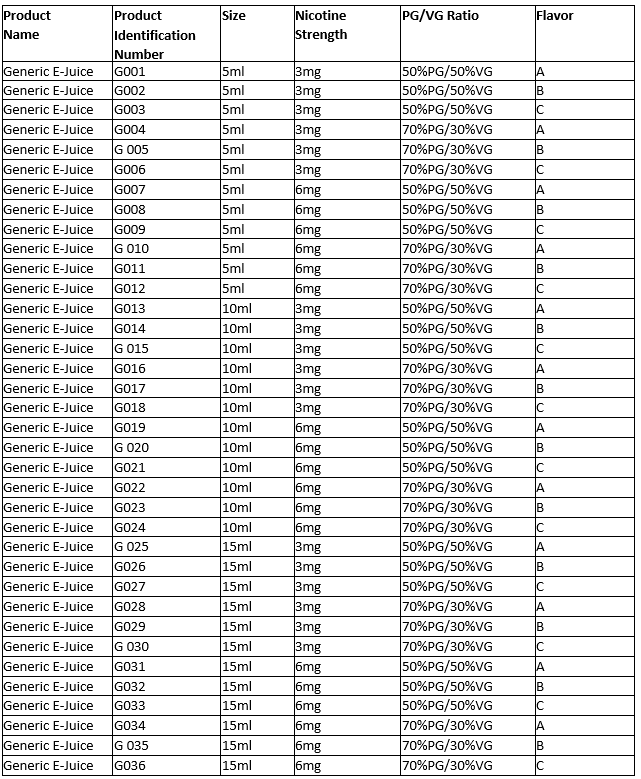
For the product list, FDA’s template product listing spreadsheet (available in FURLS) should be used, particularly if you are processing the registration online through FURLS. The spreadsheet identifies the information that must be submitted for each product, e.g., product identification number (SKU), intended use (consumer use), product category (ENDS), subcategory (e-liquid), open/closed system, flavor, and advertising, labeling and consumer information. Please note that each unique product must be identified on your product list including, for example, e-liquids under the same brand or flavor that vary in terms of package (e.g., bottle) size, nicotine strength and/or Propylene Glycol (PG)/Vegetable Glycerin (VG) ratio.
Do I need to submit labels for all my product variations?
In addition, the product listing must include labeling information, but FDA’s revised guidance clarifies that e-liquid manufacturers in particular need not submit labels for all product variations. Specifically, the guidance states (on page 9):
However, FDA recognizes that product listing for some tobacco products may result in numerous labeling submissions that the manufacturer must prepare and submit. For example, variations in package size, nicotine strength, Propylene Glycol (PG)/Vegetable Glycerin (VG) ratio, and flavor can result in thousands of individual product labeling submissions.
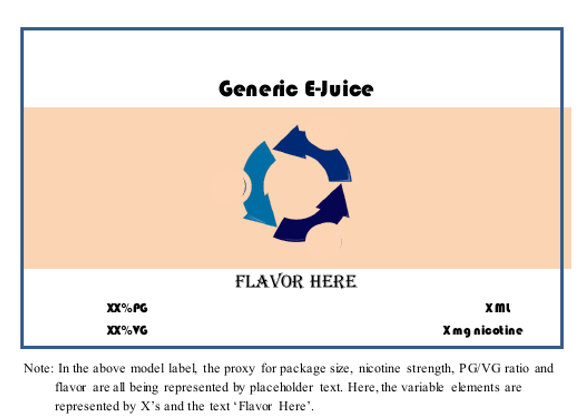
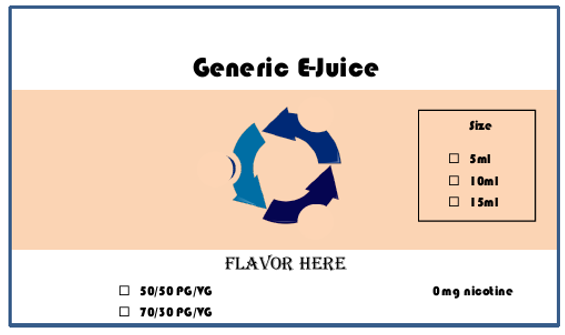
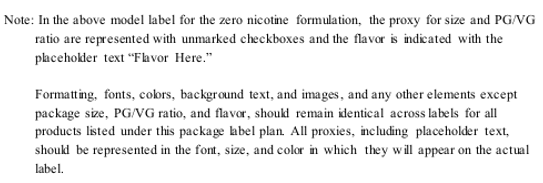
In order to reduce the amount of uploaded labeling submissions, FDA does not, at this time, intend to enforce the requirements that owners and operators submit the labeling for each individual listed tobacco product if the registrant submits the information that represents the labeling for a selected line of products. In deciding whether a registrant’s submitted information falls within this compliance policy, FDA may consider whether the tobacco products’ labeling is essentially identical (e.g., the same formatting, fonts, colors, background text, and images) and whether the variations are limited to package size, nicotine strength, PG/VG ratio, and flavor. However, we recommend that zero nicotine formulas of a product, or product line, be grouped separately from products with nicotine.
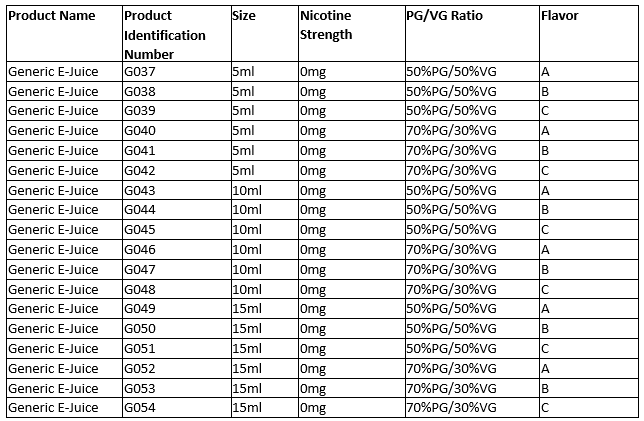
Rather, as described in Appendix A to the revised guidance, registrants may submit a separate “package label plan”, which is a model/generic product label with placeholder text for the specific variations, along with a “product variation index” which lists all the variations for a specific product, e.g. package size, nicotine strength, PG/VG ratio and flavor. The product variation index must list all combinations of the variations that will be using the model label. The examples from FDA’s revised guidance are copied below.
The Package Label Plans, including the Model/Generic Labels and Product Variation Indices can be uploaded in FURLS by creating a single PDF containing the label and the index. Once uploaded into FURLS you will be given the option of associating the file with all applicable products.
 What about advertisements and “consumer information”?
Finally, we note that despite previously implying that this information was optional, FDA’s revised guidance states that if product advertising exists, a representative sampling of such advertisements must be provided with the product listing. FDA interprets “a representative sampling of advertisements” to mean typical advertising material that reflects the full range of promotional statements made for the tobacco product. For example, if more than one magazine advertisement is used, but the promotional content is essentially identical, only one need be submitted.
FDA’s revised guidance further notes that, in addition, the product listing must include “a copy of all consumer information” to the extent the information is not advertising and has not already been provided as a form of product labeling. Consumer information does not include information directed at wholesalers, distributors or retailers where such information is not available to consumers (e.g., product specifications intended for manufacturing purposes, photos of components or parts not intended for individual sale, or communications between companies), but may include items like consumer brochures.
If you are interested in obtaining additional guidance on this topic contact Azim Chowdhury (202.434.4230, chowdhury@khlaw.com) or Ben Wolf (202-434-4103, wolf@khlaw.com). For more information on our Tobacco and E-vapor Practice in general, visit www.khlaw.com/evapor. Follow Keller and Heckman Tobacco and E-Vapor Partner Azim Chowdhury on Twitter.