

The Federal Communications Commission (FCC) licenses television stations. Does that make it Disney’s human resources department? The agency seems to think so, invoking a “public interest” mandate to investigate the company’s diversity policies—a mandate whose meaning seems to change with
Truth on the Market Blogs
Latest from Truth on the Market
How to Profit From a Cartel Without Joining One
Adam Smith warned that people in the same trade rarely meet without the conversation turning to a scheme to raise prices. Antitrust enforcers on both sides of the Atlantic now suspect they can skip the meeting—a shared shareholder may do
Fin-Syn Is a Rerun Washington Should Skip

Some of Hollywood’s most high-powered producers and agents have a pitch for Washington. Make streaming services spend half their original-content budgets buying from independent U.S. producers. Producers and talent agencies would get guaranteed business. Viewers, on the other hand,
Every Click You Make: Article 6(5)’s Search for a Limiting Principle
When does a “directions” button become a competition-law violation? When it points to Google Maps, according to the European Commission. A law meant to police search rankings is becoming a license to police the whole page.
On July 23, the
Brussels Rules Without the Brussels Perks
Brussels’ latest competition guidelines should probably come with a warning label. Countries borrowing them risk importing dubious economics, remedies designed for Europe’s very specific institutional problems, and a trade fight with Washington.
On Sept. 3, after a three-year process, the
‘The Value of the Ability to Deal with Disequilibria,’ by Theodore Schultz
The most valuable skill in the age of artificial intelligence (AI) may not be coding, prompt engineering, or any of the other competencies appearing in job listings. It may be the ability to figure out which skills will be valuable
We Measured Europe’s Browser Revolution. Bring a Magnifying Glass.
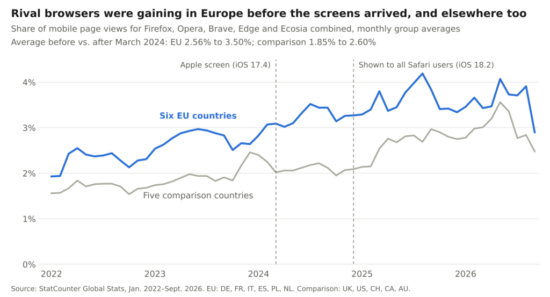
Europe’s browser revolution appears to have left most browsers exactly where it found them. The European Commission is celebrating a “surge” in alternatives. The browsing data suggest a ripple.
In April, the Commission reviewed the Digital Markets Act (DMA) and
Doom, Meet Duty: AI’s Warnings Come With Legal Baggage
Predicting the end of humanity is one way to get a headline. For artificial intelligence (AI) developers, it may also be one way to hand a future plaintiff evidence.
Developers have become some of the loudest voices warning about their
A Nobel Prize for Thinking Ahead: Hall and Woodford’s Great Expectations

Suppose you get a $1,000 payment. How much do you spend? Before answering, we’d want to know a few things: Is this a one-time payment? The first of many? Can you borrow? Do you already have savings?
This year’s Nobel
The World Wants Cures. America Gets the Check.
Everyone wants the next medical breakthrough. Few want the bill. The United States pays a disproportionate share of the cost of pharmaceutical innovation, while other wealthy countries hold down medicine prices and count on the research to keep coming.
Yet