

For much of the last decade, international lawyers have approached artificial intelligence (AI) primarily, if at all, as an object of legal regulation. The central questions have become familiar: How should international law regulate AI? Which existing legal rules apply
Latest from EJIL: Talk! - Page 2
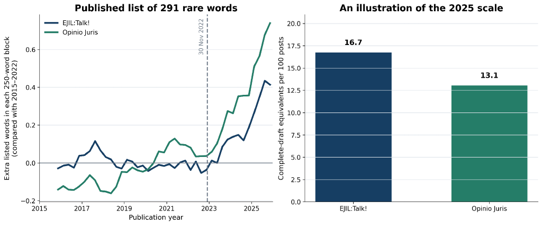
Can We See Generative AI in International Law Blogging?
Gen AI and its Contributions
In July 2026 EJIL published its ecosystem-wide generative artificial intelligence (Gen AI) policy. The policy is carefully worded and wisely narrow. While it also addresses a series of concerns which would merit discussion individually, such
879 Cases Struck Out in Lebedeva: An Unfortunate Swan Song for Russia at the European Court
In Lebedeva and others v. Russia, the European Court of Human Rights (“the Court”) issued a short judgment with sweeping effects – striking out 879 potentially meritorious applications alleging Russia’s human rights violations. Many of these cases concern harrowing
A Map Is Not a Memorial: Brazil’s Former DOPS and the Legal Content of Non-Recurrence
Twenty-six years after Minas Gerais enacted a law creating a Human Rights Memorial in the building that housed the state’s Department of Political and Social Order (DOPS), a political police body central to dictatorship-era repression, the site has still not
Access to the Logbook: How Autonomous Ships Complicate the Flag State’s Ability to Fulfill its Article 94 UNCLOS Obligation
On 1 July 2026, the IMO’s non-mandatory International Code of Safety for Maritime Autonomous Surface Ships took effect. The Code provides guidelines for maritime autonomous surface ships (MASS), or ships that, to various extents, operate independently of direct human control
A Reckoning in the Emperor’s Court: Jamaica’s Reparations Petition to the Privy Council
On 7 September 2026, Jamaica, which remains a Commonwealth Country with King Charles III as its head of state, will formally present a petition to the King with three questions about the legality of transatlantic chattel slavery and the UK’s
Two Weeks in Review: 24 August—4 September 2026
The last two weeks have covered a lot of ground, from the collapse of the Central American Court of Justice to Russian policies of population transfer in Ukraine and the place of diplomatic assurances concerning safe third country return. It
Announcements: Law of Neutrality and the Prohibition of Aggression Symposium; New Technologies and International Legal Accountability Conference; CfP Protection of Liberty at Sea
1. The Law of Neutrality and the Prohibition of Aggression: Framing an Old Debate in the Light of Recent State Practice Symposium. On 18 September 2026, from 3pm to 5pm (CET), Bocconi University will host in hybrid format the seminar
Nuclear Liability Beyond Earth: Who Pays for an Incident on the Lunar Surface?
Lunar exploration during the 20th century sought to reach, explore and, in some cases, return from the Moon, rather than to serve as successive stages in the construction of permanent lunar infrastructure. Today, lunar missions are mostly about establishing the
The Rise and Second Demise of the Central American Court of Justice
In May 2026, the Central American Court of Justice (CACJ) quietly ceased operations following Honduras’ withdrawal—a development that attracted little attention despite marking the end of one of the world’s earliest permanent international courts. Although the CACJ never succeeded in