

In Rosenfeld v. Zoning Board of Appeals of Mendon (pdf), the Massachusetts Appeals Court considered the plaintiff abutters’ challenge to the defendant zoning board’s issuance of a special permit authorizing the construction of an equestrian facility on a 46-acre parcel in a residential zone. As proposed, the facility would feature stables, an indoor training arena, a trainer’s residence, a 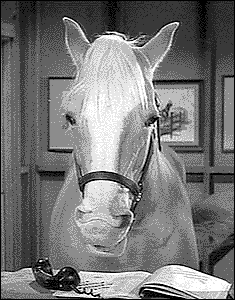 fenced pasture, outdoor training areas, and riding trails. The plaintiffs argued that the trial court erred in (1) treating two previously-issued, never-exercised variances as having lapsed, which made certain conditions imposed by those variances irrelevant, and (2) ruling that the plaintiffs are without standing to enforce a restrictive covenant in the landowner’s deed prohibiting the construction of more than one dwelling on the property and prohibiting the creation of a road or driveway to access rear portions of the property.
The Appeals Court quickly brushed aside the plaintiffs’ first argument, noting that, under settled Massachusetts law, equestrian facilities are essentially exempt from zoning under M.G.L. c. 40A, § 3. This independent basis for the proposed use means that the prior variances were unnecessary, and any conditions they purported to impose would become operative only if the variances were actually exercised by the landowner.
Turning to the plaintiffs’ second argument, the Appeals Court found they had picked a winner. The court ruled that under M.G.L. c. 184, § 27(a)(2) (pdf), an adjoining landowner does have standing to enforce a deed restriction that governs his neighbor’s land, even if the deed doesn’t expressly identify the adjoining land as being benefited by the restriction. This issue was recognized but not decided by the Supreme Judicial Court (SJC) in its 2006 decision in Brear v. Fagan (pdf). As the SJC observed at that time (see footnote 5), due to a lack of punctuation, the statute can be read as requiring that an intent to benefit adjoining land be stated explicitly in the restriction. Another plausible reading of the statute, however, is that this requirement applies only to non-adjoining land. After carefully parsing the statute, the Appeals Court decided that the latter interpretation is correct. As a result, the court reversed the trial court’s judgment of no standing, and remanded the case for a determination of the effect of the deed restriction on the landowner’s proposed equestrian facility.
Coincidentally, just 10 days before the Appeals Court issued Rosenfeld, the Land Court issued a decision in Spencer v. Slavin (pdf) in which it considered the same issue and reached the opposite conclusion.