

 CONTRIBUTED BY
Rachel M. Perkins
rachel.perkins@dlapiper.com
Startups and public companies alike often use equity to help attract, retain and incentivize talented employees and other service providers. The different forms of awards have proliferated in the past several years, though, leading to a confusing “alphabet soup” of jargon that often frustrates both the recipients of grants and the company itself. Many angel and venture capital investors continue to prefer seeing stock options and restricted stock awards in their portfolio private companies, as these are the most common and simplest to administer. Other forms of awards can also be challenging for startups because there is no public market to easily set a contemporaneous per share stock price or provide liquidity for the award recipients. However, while stock options—both nonstatutory (NSO) and incentive (ISO)—and restricted stock awards (RSAs) remain the most popular and most recommended form of equity compensation, other forms—such as restricted stock units (RSUs) and stock appreciation rights (SARs)—are gaining popularity in certain markets, and we are being asked more and more frequently about these alternatives.
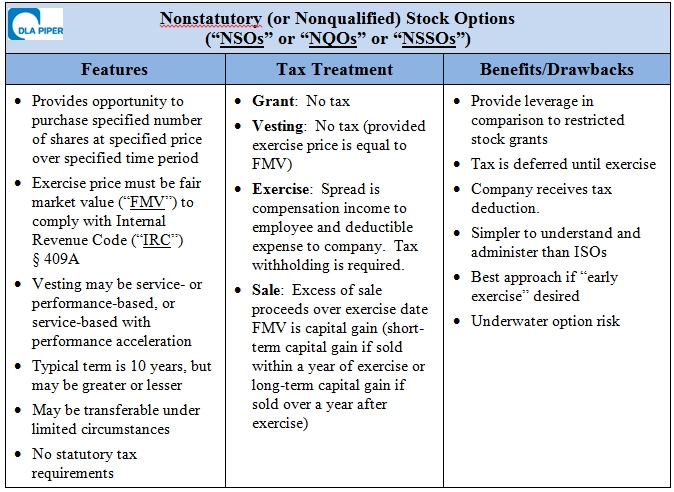
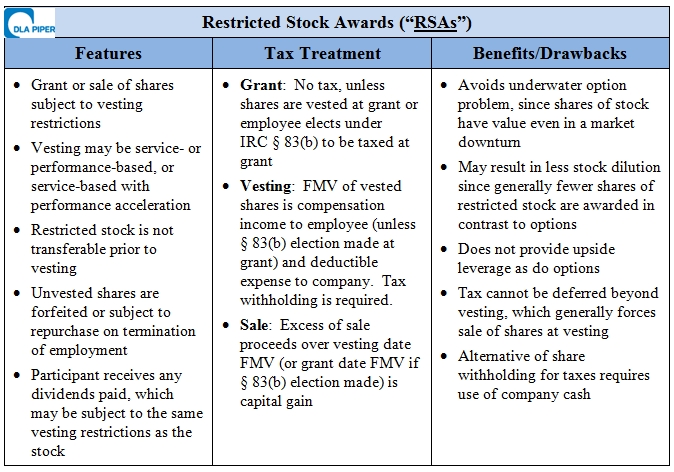
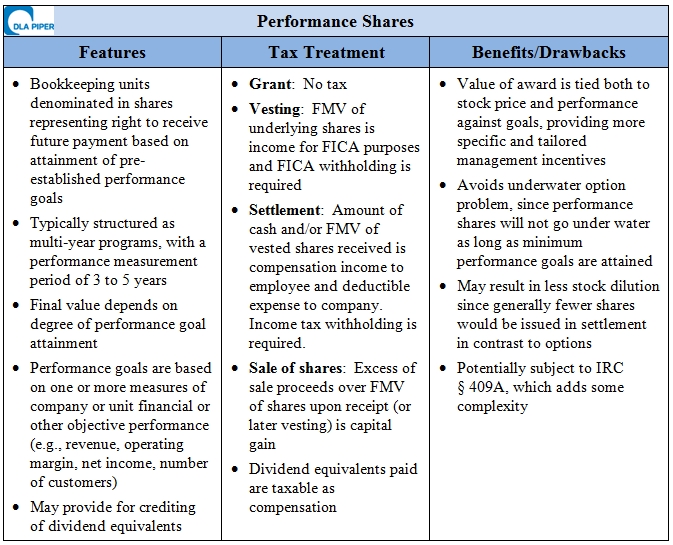
Adding to our previous discussions of adopting your first equity incentive plan, NSOs vs. ISOs and options for issuing employee equity in LLCs, we have put together the below quick reference charts, which are intended as high-level summaries of the most common equity incentive awards as well as some of the other less common awards available. The following charts highlight some of the key features and tax consequences of each type of award, as well as some of the potential drawbacks associated with each:
Nonstatutory (or Nonqualified) Stock Options (“NSOs” or “NQOs” or “NSSOs”)
Incentive Stock Options (“ISOs”)

Restricted Stock Awards (“RSAs”)
Stock Appreciation Rights (“SARs”)

Restricted Stock Units (“RSUs”)

Performance Shares
Performance Units

Tax, securities and other regulations governing equity incentive plans are highly complex and subject to change, so companies considering adopting or amending such plans or making grants under an existing plan and employees receiving grants should consult with their attorneys and/or tax advisors before taking definitive action.