

 We begin our analysis by selecting the parameters of the data library. Since this research is intended primarily as a tool for civil appellate practice in full-service firms like mine, we limit the scope of the cases we study in order to ensure that trends elsewhere in the law do not obscure the Court’s decision-making in the areas of the law we are interested in. We begin by excluding all criminal cases, as well as matters which are only technically civil, such as habeas corpus cases and civil commitments. We also exclude all attorney disciplinary matters and juvenile cases; such practices tend to be pursued by subject-matter specialists (and not by large law firms engaged in a general civil practice.) We focus on the period of 2000 through the present simply because gaps begin to appear in the data available online once we reach the late 1990s. Our chosen period of study encompasses the entire career on the Illinois Supreme Court of every current Justice but one – Justice Charles E. Freeman.
The result is a data library of 620 civil cases decided between January 1, 2000 and December 31, 2014. These opinions were reviewed and coded for forty-eight different data points:
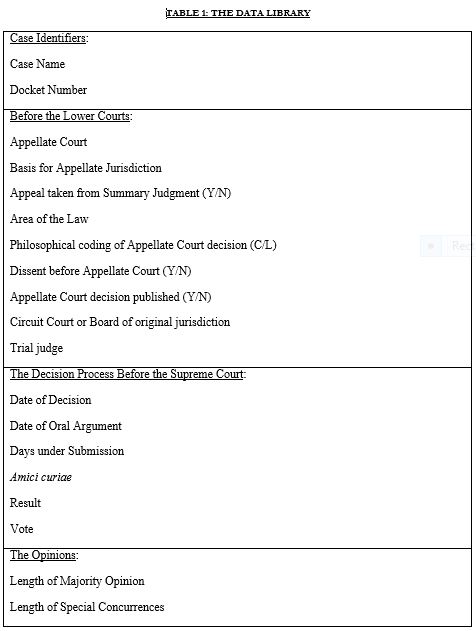
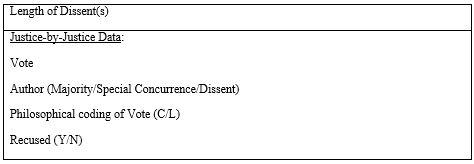
The following Justices are included for all or part of their tenures.[1] The Justices are arranged in the Table by individual seats on the Court, showing each Justice’s replacement as he or she left the Court, and therefore the philosophical evolution of the Court during the period of our study. We also include the political party identification of each Justice (in Illinois, Justices must seek election and retention in partisan elections):

The Illinois Supreme Court has been closely divided by party identification throughout our period of study. The Court’s Republican wing lost one member in 2000 with the election of Democrat Thomas L. Kilbride, shifting the balance from four Democrats and three Republicans to five Democrats and two Republicans. The party balance remained there for four years until late 2004, when Republican Lloyd A. Karmeier replaced Democrat Phillip J. Rarick, and the Court has been split 4-3 ever since.
Image courtesy of Flickr by rh2ox (no changes).
[1] The Illinois Constitution provides that the Chief Justice is selected by the members of the Court to serve a single three year term. Six members of the Court have served as Chief Justice during some portion of the period we study – Justices Harrison, McMorrow, Thomas, Fitzgerald, Kilbride and Garman. We refer to each as “Chief Justice” when discussing the period of his or her tenure, and as “Justice” at all other times.