

Superannuation is what Australia calls its retirement system, and they are doing something right.
According to the 2014 Melbourne Mercer Global Pension Index (8o-page report if downloaded), an annual study that ranks national retirement systems based on the relative importance of adequacy, sustainability, and integrity, Australia only trails Denmark graded A, and tied with the Netherlands graded B. The United States? Grouped with France, Poland, South Africa, Austria, and Brazil with a grade of C.
The subtitle of the Study, by the way, is “Including Trust and Transparency in Pensions”. Apparently an issue not unique to the U.S.
So what makes the Australian system so different, and according to the Mercer Study, better than ours? We’ll get the details when our friend, Paul Secunda, returns from Australia.
Paul, a professor of law at Marquette and director of the Law School’s labor and employment law program, recently earned a Senior Fulbright Scholar Award. He’ll spend the Fall 2015 semester in Australia as a Senior Fellow at Melbourne University Law School teaching and doing research focused on the country’s national pension program.
No doubt that he’ll bring back valuable ideas on how to improve our retirement system. But in the meantime, here’s my take on the difference between a grade of B and a C. It’s foresight.
In 1992, the Australian government introduced a major reform package addressing Australia’s retirement income policies. The concern was that increased in pension payments due to demographic shifts would place an unaffordable strain on the Australian economy.
Through a tripartite agreement between the government, employers and the trade unions, the country adopted a “three pillars” approach to retirement income consisting of:
- A safety net consisting of a means-tested Government age pension system
- Private savings generated through compulsory contributions to Superannuation
- Voluntary savings through superannuation and other investments
Now can you imagine our government, employers, and the unions all agreeing on a national retirement income policy? That’s not a political question, it’s a hopeful one.
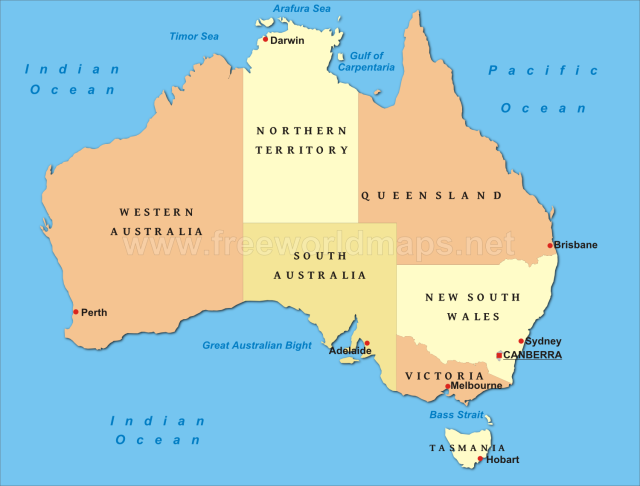
Picture Credit: Physical map of Australia, Lambert equal-area projection courtesy of FreeWorldMaps.net.