

Funny story. A condominium association I represent is located in such a way that I could see their amenities – a small swimming pool and tennis courts – from my office window. One summer, the association was involved in some pretty contentious litigation over a serious, ongoing covenant violation. We were conducting depositions in my conference room and, during a break, the manager and I stepped into my office. I happened to glance out the window and noticed a dog running around on the pool deck. I pointed it out to the manager, he made a phone call, and we went back into the deposition. Later that day, the manager sent me this photo, which the dog’s owner had sent him by way of apology.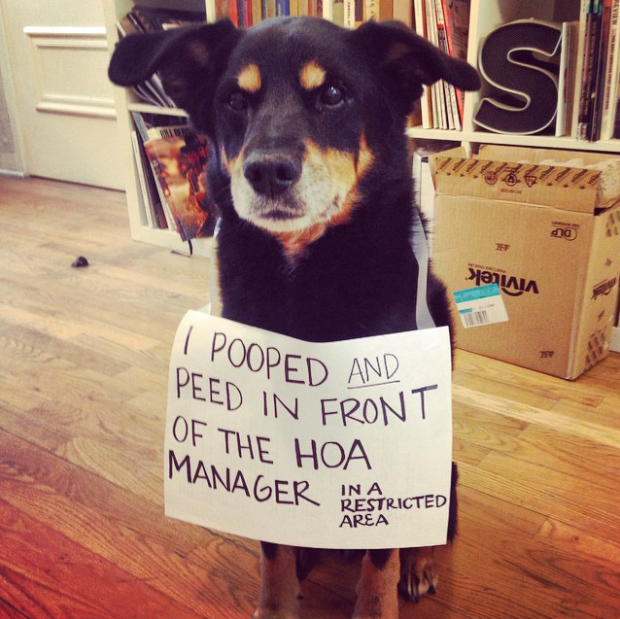
On one hand, I found it ironic that while we were embroiled in litigation over a “major” covenant violation, a “minor” violation occurred right in front of our eyes. On the other hand, rules are rules and the association’s response to violations should be consistent, whether it is a minor infraction or a repeated and flagrant violation.
Behind every rule, there should be a reason. The goal of covenant enforcement is not to punish the offender, but to prevent future violations. Yet, when people are accused of committing an offense, it is often human nature to deny the allegation and attempt to prove your innocence. Everyone who has ever gotten a parking ticket knows that your first reaction is to say “That’s not fair.” It might not be fair when you get a parking ticket five minutes after the meter expires, but rules are rules and there is a reason why they need to be enforced.
Upon receipt of a covenant violation notice, most owners in community associations will not immediately roll over, expose their belly and beg for forgiveness, like our furry friend in the picture. But that does not mean the association should not enforce its rules. As long as those rules are reasonable and enforced in good faith, the covenant violation process should be adhered to.
Are your association’s rules reasonable and do they make sense for your association? If not, it may be time for a review and rewrite.