


We previously reported that on January 11, 2018, Celltrion, Inc., Celltrion Healthcare, Co. Ltd. (collectively “Celltrion”), Teva Pharmaceuticals International GmbH, and Teva Pharmaceuticals USA (collectively “Teva”) filed suit seeking declaratory judgment that thirty-eight patents relating to Herceptin® (trastuzumab) are non-infringed, invalid, or unenforceable. That same day, Celltrion and Teva also filed a suit seeking declaratory judgment that thirty-seven patents relating to Rituxan® (rituximab) are non-infringed and invalid. Many of the patents named in this suit overlap with those named in the Herceptin®-related action.
Celltrion and Teva’s rituximab suit names Genentech, Inc., Biogen Inc., Hoffmann-La Roche Inc., and City of Hope as defendants. According to Celltrion and Teva, a substantial controversy of “sufficient immediacy and reality to warrant the issuance of a declaratory judgment” exists between the parties due to Celltrion’s filing of an application under the BPCIA that seeks approval to market a rituximab biosimilar product. Teva is Celltrion’s exclusive partner for the selling and distribution of the rituximab biosimilar in the United States.
According to the complaint, the FDA accepted Celltrion’s biosimilar application on June 27, 2017, and since that time the parties have been engaged in the so-called “patent dance” portion of the BPCIA. In particular, on July 17, 2017, Celltrion produced its biosimilar application to Genentech as well as “other detailed information regarding the manufacturing processes used to make [the rituximab biosimilar].” On September 14, 2017, Genentech then provided a list of forty patents that it believed could be reasonably asserted against Celltrion’s proposed biosimilar. The parties exchanged detailed statements asserting the factual and legal basis for their respective positions on infringement and validity of the patents identified by Genentech. On January 11, 2018, Celltrion notified Genentech that it wished to litigate all of the patents Genentech identified on its list, and filed a declaratory judgment action.
A summary chart identifying the patents-in-suit, the patents that overlap with the previously reported Herceptin®-related suit, and Celltrion’s requested relief for each patent is provided below:
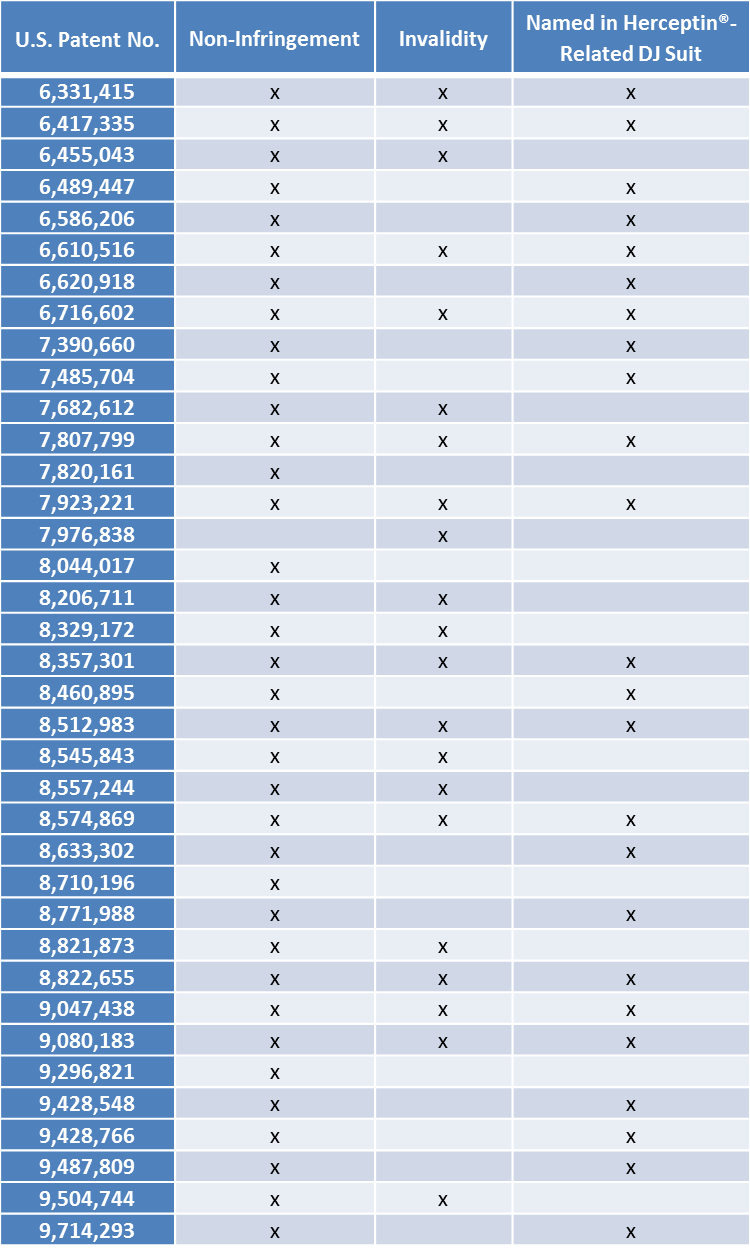
As we previously reported, Celltrion filed a petition for inter partes review (“IPR”) of the ʼ838 patent, but institution was denied. Similarly, institution of review of the ʼ172 patent, the ʼ244 patent, the ʼ612 patent, and the ʼ711 patent was also denied. However, review of the ʼ161 patent and the ʼ821 patent was instituted by the PTAB.
Rituximab is an anti-CD20 chimeric murine/human monoclonal antibody approved for the treatment of non-Hodgkin’s lymphoma, chronic lyphocytic leukemia, rheumatoid arthritis, granulomatosis with polyangitis, and microscopic polyangitis.
We will continue to keep you updated on future developments.