

 Citing growing scientific evidence, specialist glove supplier Eagle Protect has discontinued selling vinyl gloves.
Vinyl gloves, also called PVC gloves, contain a heavy chlorine content. PVC is a widely produced synthetic plastic polymer. The rigid form of PVC is used to make pipes.
California-based Eagle Protect is not alone. China stopped manufacturing the gloves last year due to severe pollution. Factories have reopened if they can meet the new pollution standards. Japan banned their use in food service in 2001 because of documented adverse effects on health, Eagle Protect company officials said. In the United States, Kaiser Permanente also switched from vinyl gloves to nitrile because of the same concerns.
And, the European Union in 2008 banned the use in food safety products of at least one material used in making vinyl gloves out of concern the chemical could leach into food and be ingested. Sweden proposed restrictions on PVC use in 1995 and is working toward discontinuing it entirely.
In banning production of the gloves, China noted that factories use coal-fired boilers during manufacturing to keep costs down, resulting in increased pollution and negative environmental effects.
The problem
Manufacturing PVC releases dioxins into the atmosphere, as does burning or disposing of them in landfills. Exposure to dioxins has been shown by some researchers to cause reproductive, developmental and other health problems. At least one dioxin is classified as a carcinogen.
Vinyl gloves can also contain phthalates, which have been shown to leach from the gloves into the human body and leach into and evaporate into food, particularly fatty food. Some phthalates have been found to adversely affect human health and are on California’s list of known carcinogens.
In addition, studies have proven vinyl gloves have an increased permeability to bacteria and virus, and in some cases begin leaking as soon as they are donned. New research also shows vinyl gloves are an ineffective barrier during food handling and have three times the cross-contamination potential of quality nitrile gloves.
While vinyl gloves are less expensive than nitrile, the economics go beyond per-unit cost, according to Eagle Protect. But many glove supply companies and procurement managers don’t see it as such, failing to factor in food safety aspects, human health implications and environmental concerns.
The new pollution laws in China could affect vinyl glove cost, causing businesses and consumers to buy nitrile gloves instead.
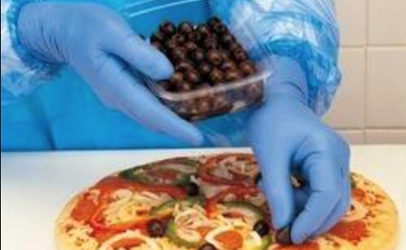 The rundown on gloves
Latex gloves are made out of rubber and are biodegradable, but some people are allergic.
Nitrile gloves are made out of a synthetic rubber, and are an ideal alternative when latex allergies are of concern. They are also more resistant to chemicals that can compromise gloves made of other materials.
Vinyl gloves are a popular choice for the food industry and situations in which high levels of durability and protection are less of a priority. They are the less expensive option.
CDC recommendations
The Centers for Disease Control has no direct guidelines regarding what kind of gloves should be used in handling food and has not studied vinyl versus other kinds of gloves, according to Brittany Behm, a public affairs specialist in CDC’s Division of Foodborne, Waterborne, and Environmental Diseases.
The agency does recommend handwashing and wearing gloves when making food. Based on studies, the FDA notes that workers are more likely to wear gloves in chain restaurants, suggesting that use may be partially determined by restaurant managers.
Use of PVC in health care
Out of concern for toxic chemicals in products, health-care institutions around the world, including U.S.-based Kaiser Permanente, have opted for nitrile gloves rather than vinyl. Kaiser, the nation’s largest integrated health care delivery program and user of more than 50 million gloves a year, also has moved away from tubing made from PVC.
(To sign up for a free subscription to Food Safety News, click here.)