

On February 8, 2018, the California Public Utilities Commission (“CPUC”) adopted a new procurement process in a decision which suggested that 2,000 MW of new battery energy storage resources may be needed in California by 2030. This means an additional 2,000 MW of storage on top of the existing 1,325 MW that is already required.

The new integrated resource planning process included modelling to explore the optimal energy resource portfolio designed to meet a greenhouse gas emissions planning target at the lowest possible cost while maintaining system reliability. This portfolio will be updated every two years. Each utility will need to file a procurement plan that either aligns with the optimal portfolio or explains the reasons for deviating from the optimal portfolio.

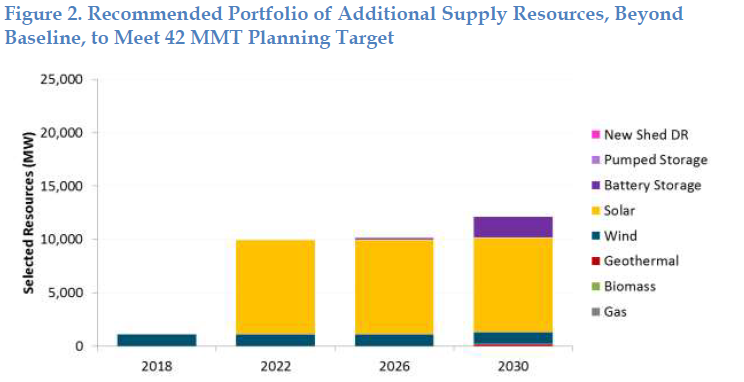
Here is an illustration of the new resources called for by the decision:
Here are the key things to keep in mind:

First, this calls for additional resources, on top of what is required by existing programs. This means grid planners see the need for an additional 2,000 MW of new battery energy by 2030 to allow the state to meet its policy goals. As shown, this also anticipates the need for substantial quantities of new utility-scale solar resources (9,000 MW) and in-state wind resources (1,100 MW).

Second, this refers to the need for battery energy storage resources, as distinguished from other types of energy storage technologies. In California, the largest source of energy storage other than batteries is in the form of pumped hydroelectric energy storage.

Third, this portfolio will change over time, as each two year cycle will revisit the models and adjust the optimal resource mix. However, the portfolio shown here represents a snapshot of what resource planners see as the future of California’s energy mix as of today. And as you can see, this points to a future that is heavily reliant on new battery storage resources.

Photo of Seth Hilton Seth Hilton

Seth Hilton, a partner in Stoel Rives’ Energy Development group, focuses his practice on energy regulation and litigation, representing clients before a variety of energy regulatory agencies in California, including the California Public Utilities Commission and California Energy Commission, as well as…

Seth Hilton, a partner in Stoel Rives’ Energy Development group, focuses his practice on energy regulation and litigation, representing clients before a variety of energy regulatory agencies in California, including the California Public Utilities Commission and California Energy Commission, as well as in stakeholder proceedings at the California Independent System Operator. His clients include developers of thermal and renewable generation, energy storage developers, transmission developers, energy service providers, and investor-owned and publicly-owned utilities. Seth also represents energy clients in state and federal court and has significant experience in a wide variety of complex commercial litigation.

Click here for Seth Hilton’s full bio.

Photo of Brian Orion Brian Orion

Brian Orion is an attorney in Stoel Rives’ Energy Development group. He assists clients in the wind, solar, energy storage, electric vehicle, and similar industries. His services involve preparation of project development agreements, handling mergers and acquisitions, assisting with equity and debt financings…

Brian Orion is an attorney in Stoel Rives’ Energy Development group. He assists clients in the wind, solar, energy storage, electric vehicle, and similar industries. His services involve preparation of project development agreements, handling mergers and acquisitions, assisting with equity and debt financings, and other transactional matters. He serves as Strategic Advisor to the Smart Energy Enterprise Development Zone (SEEDZ) Initiative, a project of Joint Venture Silicon Valley. In 2009, he co-founded the UC Hastings Cleantech Roundtable, a forum for discussing hot topics in the area of renewable energy and clean technology law, held annually at the University of California, Hastings College of the Law.