

 Just a year ago, the first poultry products processed in China from raw chicken raised and slaughtered in Chile entered the United States — a mere 110 pounds of cooked breaded chicken. But a congressional food safety expert says two of three new Chinese poultry processing plants eligible since late 2017 to export products to the United States are located in provinces never subjected to equivalency auditing by USDA’s Food Safety and Inspection Service (FSIS).
Congresswoman Rosa L. DeLauro, D-CT, sent a letter Friday to Secretary of Agriculture Sonny Perdue expressing concerns about the situation. She is a senior member of the Agriculture Appropriations Subcommittee and chairs the Congressional Food Safety Caucus.
“For years, China has dealt with issues caused by the deficiencies of a fragmented food safety system,” DeLauro wrote. “Most recently, researchers have identified multiple antibiotic-resistant genes being carried by the country’s commercial chicken flock.
“I strongly believe FSIS must be much more proactive and thorough when it comes to evaluation of other countries’ food safety systems, which is why I am alarmed by the recent release of emails that show FSIS taking a stunningly passive approach in approving three new Chinese poultry processing as eligible to export to the United States.”
DeLauro is referring to emails between China’s Certification and Accreditation Administration (CNCA) and FSIS officials in 2017 that discussed whether China maintains oversight of all its establishments regardless of provincial location.
“Local CQI’s (China’s Inspection and Quarantine) and animal husbandry and veterinary departments take individual responsibility for supervision and conduct official oversight on all poultry establishments including those two potential poultry export establishments…” CNCA said in a Dec 10, 2017, email to FSIS.
The email exchange seems to show that FSIS accepted the response from China’s Certification and Accreditation Administration and moved forward with the certification of the new plants, DeLauro contends.
“Not only is it inappropriate for FSIS to accept a ‘simple confirmation’ of China’s food safety oversight procedures through email, but the exchange also raises serious questions about whether the inspection and oversight processes occurring in the newly certified poultry plants are equivalent to those of the United States,” DeLauro wrote to Perdue.
China is not currently permitted to export poultry products to the U.S. if the birds are raised and slaughtered in the People’s Republic of China (PRC). The poultry processing plants that have been approved to process chickens for the U.S. market must obtain raw poultry from “approved sources.”
DeLauro’s July 20 letter to Perdue follows a July 11 facsimile to the secretary by Food and Water Watch (F&WW), a Washington D.C.-based activist group on the same subject. Its work using the Freedom of Information Act (FOIA) to dig the emails out of FSIS appears to have helped frame DeLauro’s questions to Perdue.
“Should equivalency be granted to the slaughter system, the PRC would be eligible to export its own poultry to the U.S,” F&WW told Perdue. The group’s letter suggests “trade considerations” may have prompted the FSIS actions.
For her part, DeLauro is asking Perdue to answer these questions by Aug. 31:
-
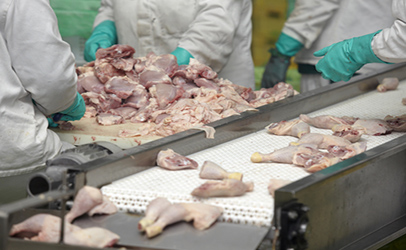
Photo illustration Does USDA believe that granting equivalency to the entire Chinese poultry processing system based on a small business of audits in a limited amount of Chinese provinces was a responsible decision? If so, how does the department justify the determination?
- The email exchange between FSIS and CVCA officials reveals that FSIS believed only Shandong and Anhui Provinces maintained government oversight of certified establishments, “based on the previous correspondence.” What was the previous correspondence? Previously what documentation had been given to FSIS to validate government oversight in Shandong and Anhui Provinces? Does FSIS still believe that only Shandong and Anhui Providences maintain government oversight of certified establishments? Why or why not?
- The email exchange also shows an FSIS official questioning whether establishments identified with the numbers 4100/03078 and 3500/03066 have adequate AQSIQ oversight. CNCA replied by saying that the “local CIQs and animal husbandry and veterinary departments take individual responsibility for supervision.” Does FSIS believe that this local oversight is equivalent to the United States? If so, why does FSIS believe this? Has FSIS ever audited local CIQs? If not, what is FSIS’s justification for not doing so.
- Were any of these newly certified Chinese poultry processing plants recently inspected by the CNCA, or similar authority? Has FSIS requested documentation and details from any such inspections? If not, what is FSIS’s justification for not doing so.?
- Per FSIS policy, each country eligible to export products to the United States should be identified, by performance, as adequate, average, or well-performing to determine the frequency at which FSIS will conduct Ongoing Equivalence Verification Audits. Countries classified as “adequately performing” would be audited every year, “average performing” countries every two years, and “well-performing” countries every three years.
China is ranked as “adequate” by FSIS, meaning it should get annual audits. DeLauro says most recent audit of China was in July 2016. Her final questions are: “Were on-site audits conducted in China in 2017 and 2018? If not, why?” If so when will these audit reports be publicly available? Is there an on-site audit planning for China in 2019? If not, why?
(To sign up for a free subscription to Food Safety News, click here.)