

 On 4 July 2018, Russian IP Court rendered a landmark judgment in case No. A40-132026/2017.
Under the merits of the case, LLC Azbuka Vkusa (trademark holder) sued LLC Registrator R01 (prominent domain registrar) seeking to cease delegation of the disputed domain name. It was apparent that the claimant’s trademark AZBUKA VKUSA was infringed in the domain name azbuka-vkusa-nim.ru and website content.
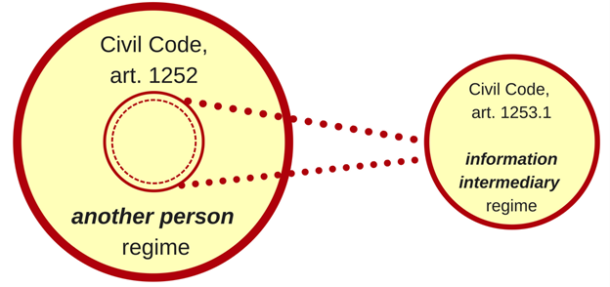
The inferior courts of the first and appeal instances satisfied the claims. The courts ignored the registrar’s position that the regime of information intermediaries [Civil Code, art. 1253.1] cannot apply to registrar (that is still debatable in Russian doctrine and case law).
In its turn, the IP Court noted that the issue of whether registrars meet the standard of information intermediaries is of no legal significance in such disputes.
Instead of the specific regime of information intermediaries, courts have to examine if registrars fall under the general regime of persons capable to cease an infringement or a threat thereof [Civil Code, art. 1252(1)(2)].
As a defense, the registrar also referred to the mandatory Terms and Conditions of Domain Name Registration in .RU and .РФ. The document contains an exhaustive list of the grounds when registrars have to cease delegation of domain names. Since trademark infringements are not in the list, registrars are legally deprived of the right to cease delegation.
The IP Court strongly criticized this argument noting that this industrial standard in no way can undermine the trademark holder’s right to demand ceasing an infringement [Civil Code, art. 1252(1)(2)].
Therefore, a fierce dispute on classification of registrars as information intermediary in fact has taken a back seat.
Now removal of illegal content can be achieved with less effort if a domain registrar is evidence to be a person capable to cease an infringement in the court.
Important for trademark holders:
- to sue a domain registrar, one does not have to prove the status of information intermediary, a mere reference to capability of ceasing an infringement [Civil Code, art. 1252(1)(2)] shall suffice
Important for domain registrars:
- if sued for a trademark infringement, a domain registrar is entitled to claim damages (e.g., expenses for legal services) against a domain administrator (Terms and Conditions of Domain Name Registration in .RU and .РФ, art. 3.1.3)
Connect with Boris on LinkedIn.