

On Saturday, I took the kids to the zoo for a day-long adventure. Faith’s favorite attraction was the turtle compound that was filled with about 20 slowpokes walking a circle. Like watching paint dry, we sat on the sidelines as these mini-dinosaurs trekked the park at a whopping .25 mph.
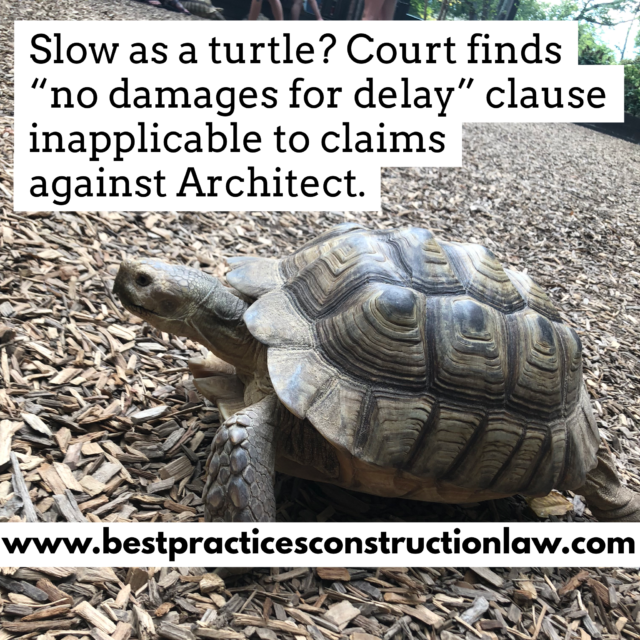
When we think of delays on a construction project, the first inquiry is to identify the turtle—the one party holding up progress or causing the delay. Many times, the parties’ contract will dictate whether the contractor can recover delay damages or will be limited to a time extension for delays beyond the contractor’s reasonable control. In Perez-Gurri v. McLeod, 238 So.3d 347 (Fl. Ct. App. 2018), the court examined whether a “No Damages for Delay” clause extended to parties other than the owner.
The general contractor in McLeod filed a malpractice action against the architect on a public contract for the City of Miami. The renovation project was located in the Caribbean Marketplace in an area known as Little Haiti. When the construction project was delayed, the general contractor filed suit against the numerous designers, architects, engineers and subconsultants.
The architect filed a motion for summary judgment, arguing that the general contractor’s delay claim was contractually barred by a “No Damages for Delay” clause in the contract between the general contractor and the City of Miami. The trial court granted summary judgment in favor of the architect. The appellate court reversed, finding that the owner-contractor agreement did not insulate the architect from liability.
The appellate court agreed with the trial—and so should you for that matter—that the general contractor waived any rights to seek delay damages from the owner. But the question is whether that waiver of delay damages extended to other parties such as the architect. The clause read as follows:
No claim for damages or any claim, other than for an extension of time, shall be made or asserted against City by reason of any delays except as provided herein. Contractor shall not be entitled to an increase in the Contract price or payment or compensation of any kind from City for direct, indirect, consequential, impact or other costs, expenses or damages, including but not limited to costs of acceleration or inefficiency, arising because of delay, disruption, interference or hindrance from any cause whatsoever, whether such delay, disruption, interference or hindrance be reasonable or unreasonable, foreseeable or unforeseeable, or avoidable or unavoidable . . .
The appellate court reasoned that the above emphasis language expressly state that the City is protected from delay damage claims, and there was no language that extends that protection to other parties. The court concluded: “If M2G2 Architects were intended to be protected by the no delay damages provision, one would expect some reference to that idea in this provision which otherwise precludes any third party beneficiaries to the contract.”
The McLeod decision reiterates yet one more time that “words have meaning.” More importantly, it is always advisable to think about and negotiate key provisions at the start of the project, rather than litigating the meaning of the provision during a dispute after the project is complete. Take a look at my Top 20 series where I blogged about key contract clauses and their meanings.