This post is authored by Fox Rothschild partner Christopher P. Beall:
Sabrina Spellman, she of the twitchy, witchy Archie Horror comic world in the Netflix reboot The Chilling Adventures of Sabrina, released last month with two 10-episode seasons, already has her hands full, what with teen angst, lust, occult powers, and a coming of age quandary.
Now, though, she also has those hellhounds known as lawyers on her trail.
The case, United Federation of Churches v. Netflix, was filed last Thursday (11/9/2018) in Manhattan federal court, asserting claims of copyright infringement and trademark dilution, on the basis of the television show’s use of a Baphomet sculpture as part of the set of the Academy of Unseen Arts, a prep school for witches that Sabrina attends.
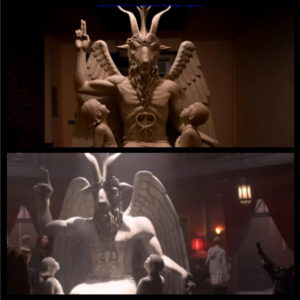 The sculpture in the show bears striking similarities with a sculpture created by the plaintiff, which operates under the name The Satanic Temple, when the Temple battled for equal rights for its monument in Oklahoma after a court fight involving a monument of the Ten Commandments. When the Oklahoma Supreme Court held that the Ten Commandments display at the Oklahoma State Capitol was prohibited as an unconstitutional establishment of religion on public property, the Temple dropped its effort to install its Baphomet sculpture there. It has, however, indicated it wishes to install one of its sculptures at a similar display in Arkansas. The Temple’s Baphomet sculpture attracted worldwide attention when it was unveiled at ceremony in Detroit in 2015 (https://www.bbc.com/news/magazine-33682878).
In the new case, the copyright claim here presents important questions focused on the intersection of free speech and copyright rights. The Baphomet figure is itself an occult image that dates back at least 160 years, and in that sense, the original source of both the Temple’s sculpture and the Sabrina set is in the public domain and free for anyone to use. However, the Temple’s sculpture – and the Sabrina set – use a unique composition of two children, a white girl and a black boy, staring fawningly up at the godhead. (The public domain version of Baphomet is also different in that it is a hermaphrodite with female breasts, whereas the version created by both the Temple and for the television show depicts a well-muscled male chest.)
Because it appears that at least significant parts of the television show’s version of the Baphomet figure imitate the Temple’s sculpture, and because the originality of the Temple’s sculpture has been confirmed, at least at a prima facie level, through a copyright registration obtained by the Temple, the resolution of this case likely will come down to the notoriously flexible standards of the Fair Use Doctrine. In that regard, the court will have to wrestle with the conundrums of whether the television show’s depiction of Baphomet is a critique or commentary on the Temple or the Temple’s sculpture, whether the Sabrina version is transformative because of its setting in a fictional school for witchcraft, and whether this latest version harms the market value of the Temple’s sculpture. Ironically, on that last factor of the fair use analysis, the Temple’s lawsuit itself may in fact undercut its own case because of the instant celebrity created for the Temple’s sculpture by virtue of the news coverage of the litigation.
The Temple also asserted trademark dilution claims. These do not appear to be viable for a variety of reasons including the fact that the Temple’s sculpture cannot be said to be “famous” nationally, or even in New York,
While Sabrina might have solved this challenge with one of her magic spells (or a production lawyer who pushed back on the clearance work for the show’s set design), the court here will now have to untangle a very interesting copyright riddle that goes to the core of just how much free expression is allowed when using copyrighted imagery.