

The Federal Court of Appeals for the Ninth Circuit recently affirmed a district court order requiring that the National Marine Fisheries Service, the Corps of Engineers, and the Bureau of Reclamation conduct spill operations and monitoring at dams and related facilities in the Federal Columbia River Power System in order to protect migrating salmon and steelhead. The district court issued the order after finding the continued low abundance of the species made them vulnerable to extinction from shock events such as climate change. National Wildlife Federation v. NMFS, 886 F.3d 803 (9th Cir. 2018).
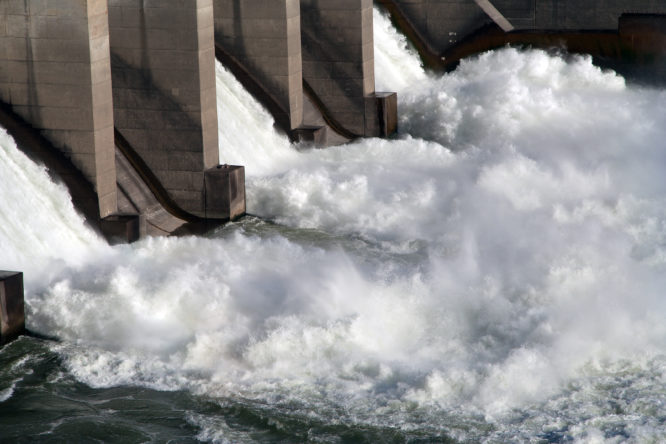
This appeal is the latest development in a long-running dispute regarding salmonids in the Columbia River listed as endangered or threatened species under the Endangered Species Act. The fish migrate up and down the Columbia and Snake Rivers every year, encountering the Columbia River dams. Turbines in the dams cause a high rate of mortality for the salmonid species that pass through or near them.
A 2014 Marine Fisheries Service biological opinion concluded that ongoing operation of the dams would jeopardize ESA-listed species and adversely modify their critical habitat. It proposed an alternative that included multiple actions over a 10-year period designed to (i) modify systems operations and structures at the dams to improve fish passage and migration conditions, and (ii) allow some spill from the dams to enhance the likelihood of survival for migrating juveniles. Two years later, the Oregon District Court found that the biological opinion violated the ESA because it had not adequately considered climate change. The federal agencies responded by preparing a new biological opinion for dam operations.
Meanwhile the State of Oregon and a coalition of environmental organizations filed a lawsuit and obtained an injunction ordering the Corps to increase spring spill over the dams as well as to operate juvenile bypass facilities and tag detection systems. The federal agencies appealed.
The Court of Appeals upheld the district court’s injunction, ruling that the court was not required to find irreparable harm due to an “extinction-level threat” to the protected species before it could issue an injunction. Rather, the court’s finding a “definitive threat of future harm, beyond speculation,” was sufficient.
Reviewing the district court’s factual findings, the appellate court agreed they were sufficient to show irreparable harm. The court had found that the salmonids were in a “precarious” state and would remain there without conservation efforts beyond those in the 2014 biological opinion. Sustained low abundance of the species made them vulnerable to extinction, and the federal agencies should have analyzed how “climate change increases the chances of ‘shock events’ that would be catastrophic for the listed species’ survival.”