
LIENING IN: Best Practices for Suppliers Navigating CIMLA – Part 2
This post is the second installment in a series examining the elements suppliers of maritime goods or services must prove to establish and enforce the supplier’s potential maritime lien under the Commercial Instruments and Maritime Liens Act (“CIMLA”), 46 U.S. Code § 31342 et. seq. Previously, we discussed examples of goods or services that constitute “necessaries.” This installment examines the requirement that the necessaries be provided “to a vessel.” Suppliers should pay particular attention to this element because it often turns on something that is wholly or partially within the supplier’s control: sales and invoicing practices.
Explicit designation of each vessel supplied is particularly important in bulk contracts or when services are provided to a fleet of vessels. Merely showing that the necessaries ended up on a particular vessel is insufficient to establish that the necessaries were provided to the vessel by the supplier, rather than by the vessel owner. A supplier who fails to document the specific vessel for which services or supplies are intended risks a finding that the services or goods were provided to the vessel owner or charterer personally rather than to a particular vessel. In that situation, no lien attaches. See Silver Star Enterprises, Inc. v. Saramacca MV, 82 F.3d 666, 670 (5th Cir. 1996) (A supplier furnishing containers to a fleet of vessels was not entitled to a maritime lien because the containers “were leased in bulk and not earmarked for use on board the M/V SARAMACCA”); Itel Containers Int’l Corp. v. Atlanttrafik Express Serv. Ltd., 982 F.2d 765, 769 (2d Cir. 1992) (The container supplier “did not ‘furnish’ the containers ‘to any vessel’” as required by CIMLA).
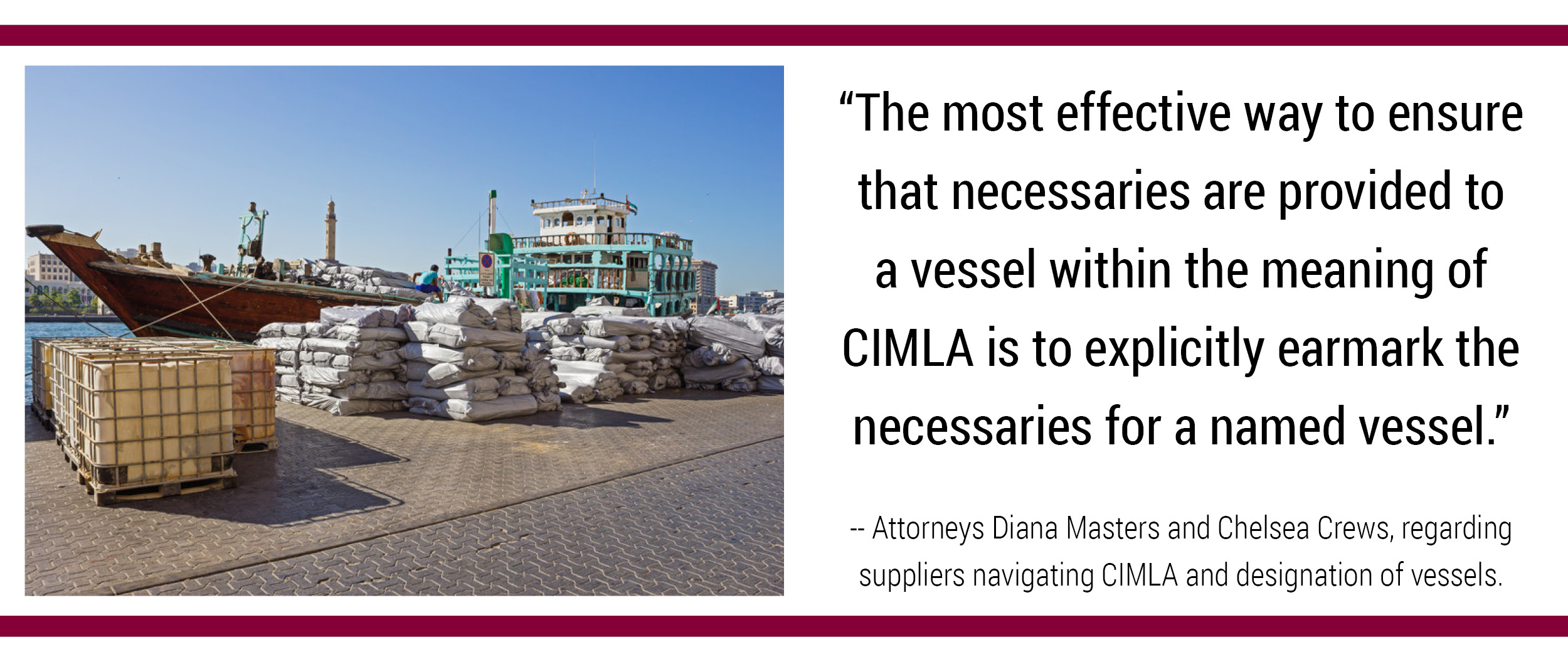
The most effective way to ensure that necessaries are provided to a vessel within the meaning of CIMLA is to explicitly earmark the necessaries for a named vessel. This can be accomplished (1) in instruments generated prior to the actual contract, such as quotes, RFPs, or bid proposals; or (2) in sales order confirmations. Courts also view invoices and receipts naming the vessel to which goods or services were provided as evidence that the supplier delivered the necessaries to the named vessel. If necessaries are furnished to multiple vessels, the supplier may issue a separate invoice for each vessel. Alternatively, an invoice may be itemized by vessel to ensure that the specific vessel to which particular necessaries were provided is clearly identifiable.
In the next installment, we will discuss on whose order necessaries must be provided to a vessel to give rise to a maritime lien under CIMLA. Future installments will analyze the remaining substantive requirements for a necessaries lien under CIMLA as well as defenses to and priority of the maritime lien for necessaries.
Read Part 1: What Qualifies as Necessaries Under the Commercial Instruments and Maritime Liens Act?