

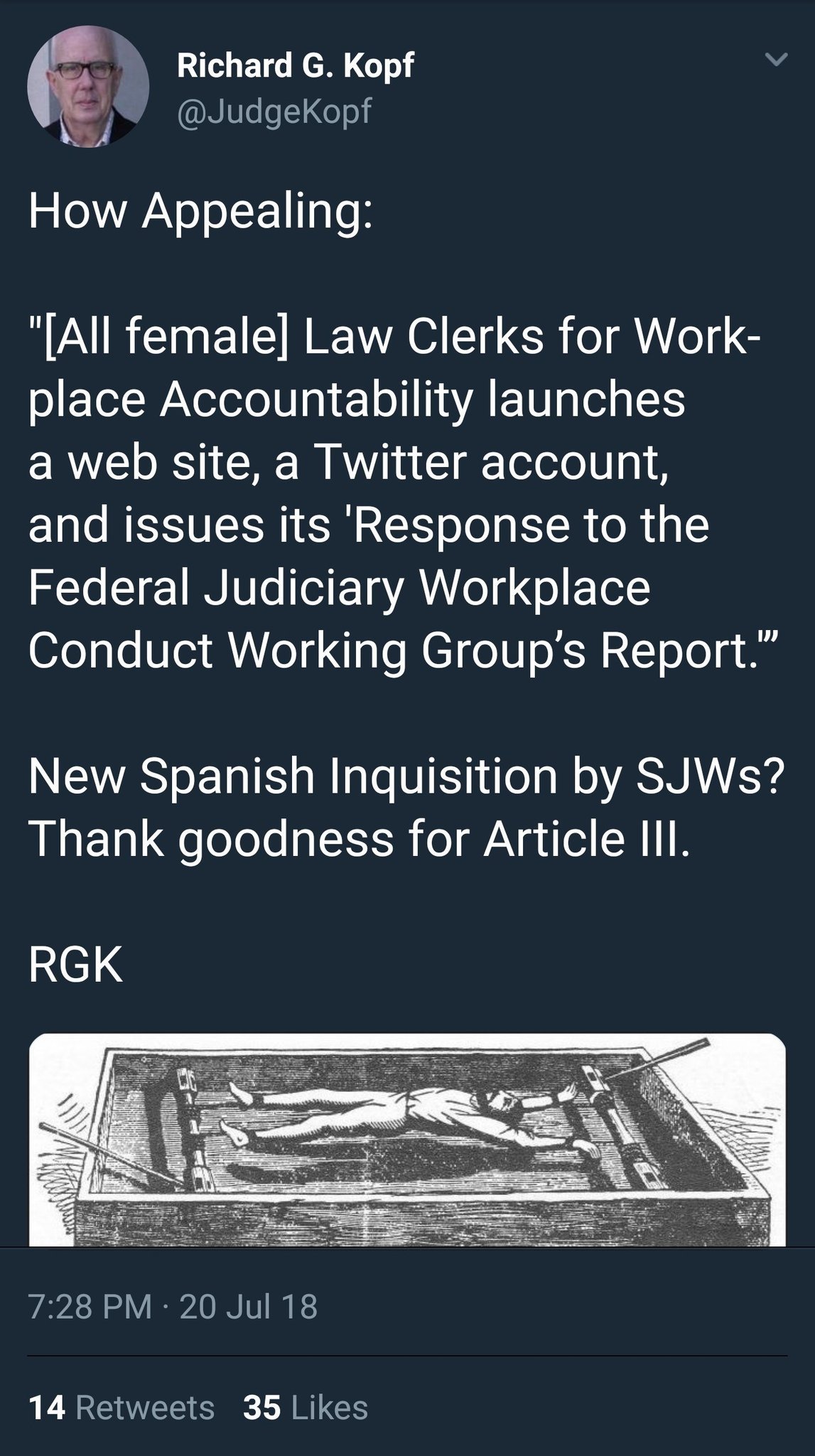
The oddity, that was only lost on the people doing the preaching, was that none of the @ClerksForChange who spoke at the hearing on changes to the rules of conduct for federal judges suffered a scintilla of harassment, sexism, misogyny, any of the evils about which they complained. Each proclaimed their judge to have been wonderful, a paradigm of propriety.
But they had stories. Other people’s stories. Where these other people were, what they were complaining about was unclear. There were the Koz clerks, who only managed to shift from their adoration and appreciation of judge Alex Kozinski to their ripping him to shreds after they served out their clerkship and enjoyed the huge benefits of having been a Koz clerk. Ironically, the only example given was of one senior judge from flyover land whose one twit was proof of the particular speaker’s being sexually harassed. By a twit. One twit. Not to her.
The new rules have now been formulated and were announced by judge Merrick Garland.
The changes to the disciplinary system were adopted following sexual misconduct claims against a once prominent appeals court judge in California, Alex Kozinski.
Kozinski stepped down from the bench after The Washington Post reported that 15 women had accused him of a range of misconduct.
The Koz scandal raised two issues, the first being what he did, but the second was the outrage over the end of the investigation upon his resignation. That Koz was bad was ended with his tenure, but that wasn’t nearly enough for those who wanted his conduct put on display for all to hate.
The thrust of their complaint was that Judge Kozinski’s sexual harassment and assault wouldn’t be available in disgusting detail to point to as proof that female clerks who never personally endured an iota of impropriety were nonetheless survivors by proxy. The end of the investigation into Koz denied them of their moment of glory. They were mad and demanded changes.
At a press briefing Tuesday at the Supreme Court, Merrick Garland, the chief judge of the federal appeals court in Washington, announced the adoption of the new system for handling workplace harassment complaints. Under the new rules, judges and court employees are required to report likely misconduct, and retaliation against individuals who disclose bad behavior also constitutes misconduct.
The reporting misconduct is not precluded by chambers confidentiality and protected from retaliation is both appropriate and uncontroversial, even though it was the excuse for why clerks whose stories were told long after the fact never resulted in complaints at the time. But what constitutes “likely misconduct,” or as the new rules characterize it, “cognizable misconduct,” is the question.
(2) Abusive or Harassing Behavior. Cognizable misconduct includes:
(A) engaging in unwanted, offensive, or abusive sexual conduct, including
sexual harassment or assault;
(B) treating litigants, attorneys, judicial employees, or others in a
demonstrably egregious and hostile manner; or
(C) creating a hostile work environment for judicial employees.
There is no further definition of what constitutes sexual harassment or hostile work environment, though as as subsection (B) states, harassing behavior of “judicial employees, or others in a demonstrably egregious and hostile manner” seems directed to the concerns that federal judges will be the target of newly-minted law clerks roaming the back hallways of the courthouse in search of a judge uttering a word or idea they were taught in their “Gender and the Law” class is traumatic, triggering and conclusive proof of misogyny.
So what is “harassment”? What is a “hostile work environment”? The Codes of Conduct fail to offer any cognizable definition. Presumably, it’s the same as set forth for employment discrimination under Title VII, that it must be severe and pervasive, but it’s peculiar that these changes were made and yet there is no attempt to define the word “harassment,” as meaningless a word as exists in the law. Is harassment an objective thing, or whatever the “survivor” of words or ideas chooses it to be, as has become the popular definition among the deeply sensitive?
Still, the new rules were sufficient to soothe the savage clerks, who could take comfort in there being new rules at all even if they didn’t quite achieve the public inquisition and flaying at the whim of the most passionate transitory employee in the courthouse.
Jaime Santos, an appellate attorney who helped found Law Clerks for Workplace Accountability, said she is pleased that judges who become aware of misconduct are now obligated to report it.
Santos, whose organization has worked with the judiciary to combat workplace harassment, said the judiciary should hire independent investigators to handle complaints and that any allegations made against judges should be automatically be referred to a different circuit. “These measures would better ensure actual neutrality and increase employee confidence that they will receive a fair and impartial investigation and adjudication if they are brave enough to come forward and report harassment if they experience or witness it,” she said.
To the extent the new rules clarify that misconduct in chambers isn’t subject to confidentiality, that there should be no retaliation against anyone complaining and that clerks should not be subject to some of bizarre and egregious conduct that apparently occurred in Judge Kozinski’s chambers, they are appropriate and a positive step forward.
To the extent they blunt the demand that every Article III judge be subject to whatever the latest fashion trend in social justice purity by the most woke law clerk in the courthouse, then subject to scrutiny by outside inquisitors, the new rules are appropriate as well. Judges shouldn’t engage in sexual misconduct, and the fact that this needs to be said is, frankly, shocking. But going beyond misconduct into the realm of the most sensitive clerk’s feelings about political correctness was a step too far.
There should be confidence that federal judges, given the enormity of their authority, behave properly and in accordance with law. There should also be confidence that they aren’t cowed by the fear that any new clerk in the courthouse can dictate the words they use or the ideas they express. The rules seem to do a fairly good job of maintaining this balance, even if the word “harassment” remains as much of a mystery as ever.