

President Trump today signed the Bipartisan Budget Act of 2019 (“BBA-19”), which will (1) avoid bumping up against the federal debt ceiling in early September and (2) reduce the prospect of a federal government shutdown just a few weeks later. But there is still work to do.
Debt Limit. BBA-19 suspends the federal debt ceiling (established under 31 U.S.C. § 3101) until July 31, 2021, nearly nine months after the next Presidential election. On August 1, 2021, the debt ceiling will be increased to the level of federal debt existing on that date.
Discretionary Spending Limits. In 2011, Congress enacted and President Obama signed the Budget Control Act (“BCA-11”). The legislation established binding, statutory caps on discretionary federal spending (blue line in the table below). These caps run through 2021. BCA-11 also created the Joint Select Committee on Deficit Reduction, which was charged with producing a $1.5 trillion deficit reduction package by the end of 2011. If this process failed, then further cuts would be triggered by reducing spending caps and also cutting mandatory spending (a process called “sequestration”). Congress failed, and the statutory caps were lowered (red line in the table below). However, on five separate occasions since 2011, Congress has passed additional legislation to add amounts back to the spending caps (green line in the table below). BBA-19 is the latest increase in these spending limits. In the aggregate, these five additional bills have added back more than $800 billion in additional discretionary spending, with $324 billion of that amount coming from BBA-19.
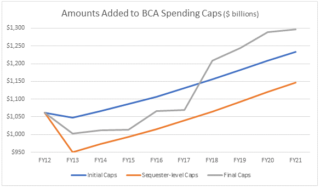 Breaking Through the Original Spending Caps. As the table shows, the amounts added back to the spending caps have increased significantly over time. In fact, for the last four years, the amounts added back have not only erased most of the deficit reduction planned in 2011, but they have increased caps to levels beyond the initial, pre-sequester spending levels. BBA-19 increased the spending limits by $171 billion for fiscal year 2020 and $153 billion for fiscal year 2021.
Implementing the New Caps. For fiscal year 2020 (which begins on October 1, 2019), the BBA-19 increases have reset the total spending levels at $666.5 billion for defense spending and $621.5 billion for non-defense spending. To avoid a federal government shutdown, Congress must now finish the hard work of passing 12 separate appropriations bills that count toward the new spending caps. These bills must be signed into law by President Trump before existing funding expires.