

Our most viewed post was on the topic of bananas. Strange fare for a law blog, but yes, there is law on bananas that are on my neighbor’s tree but that are on my side of the property line. Good fences make good neighbors (Mr. Frost may disagree), but free bananas mean banana bread!
My bananas post discusses the very famous (and short) decision from the brand new Intermediate Court of Appeals in the case of Whitesell v. Houlton.
In Whitesell, the Intermediate Court of Appeals had to opine on the legalities associated with a banyan tree near the property line. In resolving the case, the court said:
We hold that non-noxious plants ordinarily are not nuisances; that overhanging branches which merely cast shade or drop leaves, flowers, or fruit are not nuisances; that roots which interfere only with other plant life are not nuisances; that overhanging branches or protruding roots constitute a nuisance only when they actually cause, or there is imminent danger of them causing, sensible harm to property other than plant life, in ways other than by casting shade or dropping leaves, flowers, or fruit; that when overhanging branches or protruding roots actually cause, or there is imminent danger of them causing, sensible harm to property other than plant life, in ways other than by casting shade or dropping leaves, flowers, or fruit, the damaged or imminently endangered neighbor may require the owner of the tree to pay for the damages and to cut back the endangering branches or roots and, if such is not done within a reasonable time, the damaged or imminently endangered neighbor may cause the cutback to be done at the tree owner’s expense.
However, we also hold that a landowner may always, at his own expense, cut away only to his property line above or below the surface of the ground any part of the adjoining owner’s trees or other plant life.
In Whitesell, the ICA did not define what it meant by “noxious”, but just last week, the ICA went back to Whitesell to do just that.
The case is Spittler v. Charbonneau and arises from Kapoho on the Island of Hawaii. In this case, the boundary between the neighbor’s properties was disputed. One owner had planted several trees on the wrong side of the property line. The trees were ubiquitous in Hawaii: the Ironwood, the Loulu Palm and the Coconut Palm. After a tree branch fell and caused property damage, the neighbor relationship failed and litigation ensued.
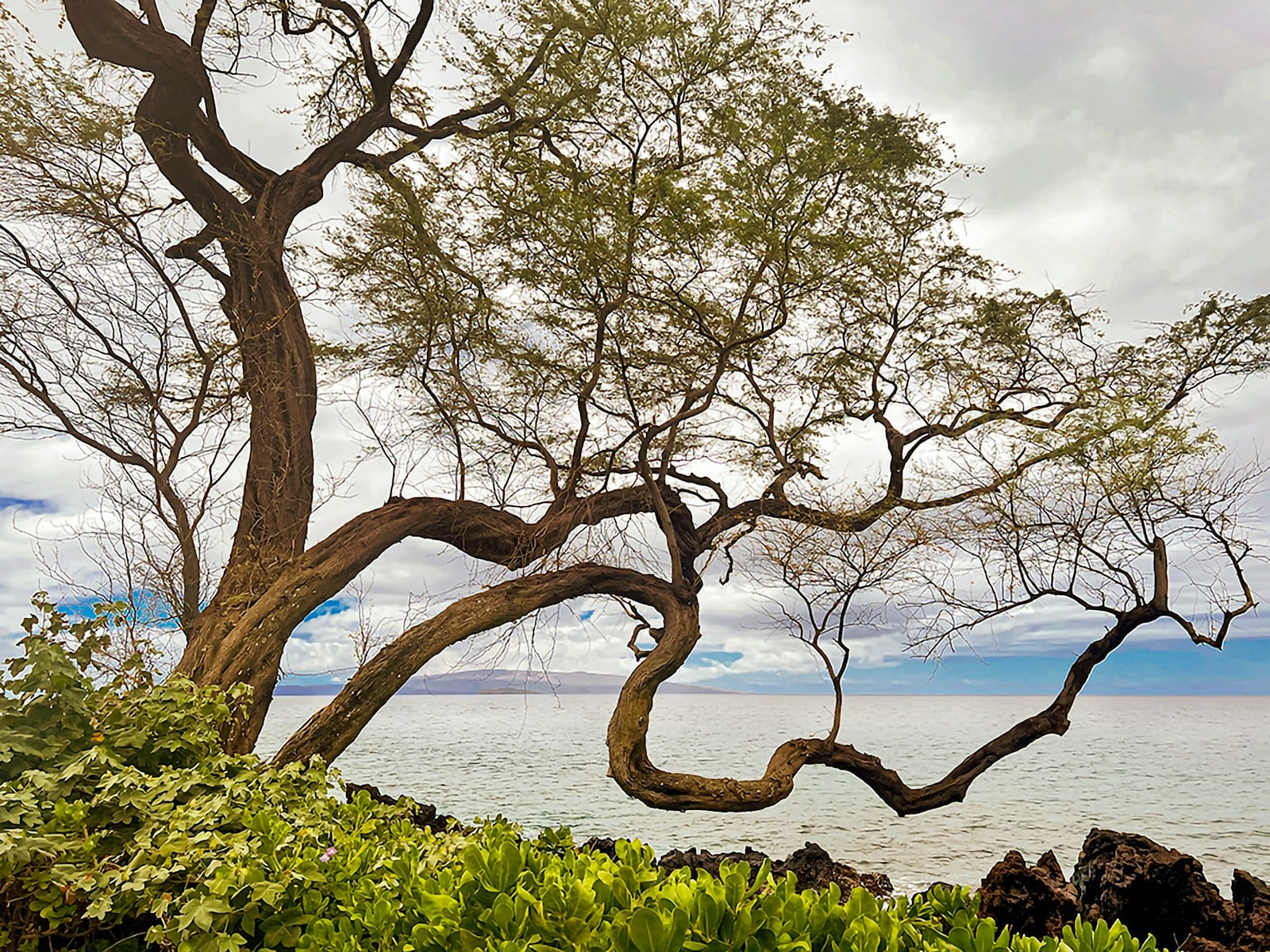
First, the Ironwood (pictured below):

The complaint led to a counterclaim with claims of trespassing, killing trees, loud music, gunfire and profanities exchanged on the disputed border. Ultimately, all the claims were settled except for the trespass claim and the nuisance claim.
Under Whitesell, non-noxious plants were not nuisances, so the appeals court had to decide whether the Ironwood was noxious. Without a definition, the ICA turned to Old Mr. Webster, the Hawaii Administrative Rules, the Hawaii Pacific Weed Risk Assessment website. The Ironwood is not listed as a “noxious weed” in the Hawaii Administrative Rules. But, the failing of the term “noxious” is that it didn’t accurately label the problem: risk to humans. So, the ICA said:
Our use of the word “non-noxious” in Whitesell was superfluous. A noxious plant – i.e., one that is “physically harmful or destructive to living beings” – is one that actually causes, or that could pose an imminent danger of causing, material harm to persons or to property other than plant life; conversely, a plant that actually causes, or that poses an imminent danger of causing, material harm to persons or property other than plant life may be considered noxious. We note that certain plants, such as coconut palms, are capable of causing material injury to persons or to property other than plant life just by dropping fronds or nuts. We also note that tree roots can, under some circumstances, pose imminent trip hazards without damaging property other than plant life. We therefore modify our holding in Whitesell for when a plant can be considered a nuisance. Plants whose overhanging branches cast shade or drop leaves, flowers, or fruit, or whose roots interfere only with other plant life, are not nuisances. Overhanging branches or protruding roots constitute a nuisance when they actually cause, or there is imminent danger of them causing, material harm to a person or to property other than plant life. When overhanging branches or protruding roots actually cause, or there is imminent danger of them causing, harm to a person or to property other than plant life, the damaged or imminently endangered neighbor may require the tree’s owner to pay for the damage and to cutback the endangering branches or roots and, if that is not done within a reasonable time, the damaged or imminently endangered neighbor may cause the cutback to be done at the tree owner’s expense. And as we stated in Whitesell, “a landowner may always, at [their] own expense, cut away only to [their] property line above or below the surface of the ground any part of the adjoining owner’s trees or other plant life.” 2 Haw. App. at 368, 632 P.2d at 1079.
So, a nuisance (which carries the remedial power of injunction) can flow from an overhanging plant when there is actual harm to body or property or imminent danger of the harm.
So, what to do about that pesky ironwood.

[Photo courtesy of Professor Gerald Carr]
On trespass, the court began with an acknowledgement that no Hawaii appellate court had ever adopted the elements of the tort of trespass, so, after referencing the Restatement, it did so. Under Hawaii law (now):
Restatement§ 158 states: One is subject to liability to another for trespass, irrespective of whether [they] thereby cause[] harm to any legally protected interest of the other, if [they] intentionally
(a) enter land in the possession of the other, or cause[] a thing or a third person to do so, or
(b) remain on the land, or
(c) fail to remove from the land a thing which [they are] under a duty to remove.
Restatement§ 161 states:
(1) A trespass may be committed by the continued presence on the land of a structure, chattel, or other thing which the actor has tortiously placed there, whether or not the actor has the ability to remove it.
(2) A trespass may be committed by the continued presence on the land of a structure, chattel, or other thing which the actor’s predecessor in legal interest therein has tortiously placed there, if the actor, having acquired [their] legal interest in the thing with knowledge of such tortious conduct or having thereafter learned of it, fails to remove the thing.
Restatement§ 6 (Am. Law Inst. 1965) states:
The word “tortious” is used throughout the Restatement of this Subject to denote the fact that conduct whether of act or omission is of such a character as to subject the actor to liability under the principles of the law of Torts.
Finally, Restatement§ 166 (Am. Law Inst. 1965) states:
Except where the actor is engaged in an abnormally dangerous activity, an unintentional and non-negligent entry on land in the possession of another, or causing a thing or third person to enter the land, does not subject the actor to liability to the possessor, even though the entry causes harm to the possessor or to a thing or third person in whose security the possessor has a legally protected interest.
Applying this law to the facts of this case, the court held:
Accordingly, we hold that a person whose plant, located on the person’s property, drops leaves, flowers, or fruit onto neighboring property, or whose plant’s roots interfere only with other plant life on neighboring property, is not liable to the neighboring property owner for trespass.
So, leaves, flowers and fruit falling onto your neighbor’s property is NOT common law trespass. If they cause damage to person or property on the way down, the court noted that you could be liable in “tort”.