

In response to outcry from educators in and outside of Illinois about the legitimate need to use prone and supine restraint for certain diverse learners and the lack of notice to allow teams to identify alternative techniques, the Illinois State Board of Education amended its recent emergency rules to allow the practices on a limited basis if certain conditions are met. What are our initial insights from the amended rules?
Under the amendment, prone and supine restraint can only be used if the following requirements are met:
- Consider Contraindicating Factors. The school district or school has determined that no medical or psychological limitations contraindicate the use of the restraint methods.
- Existence of “Emergency.” There is “an emergency,” defined as “a situation in which immediate intervention is needed to protect a student or other individual from imminent danger of causing serious physical harm to himself, herself, or others.”
- Other Options Tried and Failed. Less restrictive and intrusive interventions have been tried and proven ineffective in stopping the imminent danger.
- No Restrictions on Breathing or Communication. The restraint used does not restrict or impair a student’s breathing or communication.
- Qualified Personnel. The personnel executing the hold have “required credentials” and the training required by these rules.
- Other Options Insufficient. No less restrictive and intrusive intervention would be sufficient to address the emergency.
- Supervising Personnel. A school staff person “trained in identifying the signs of distress” and not involved in the restraint of the student observes the student during the entire incident.
- Reasonable Number of Personnel. The number of staff involved in physically restraining the student does not exceed the number necessary to safely hold the student.
- Stop When Threat Ends. The restraint ends immediately when the threat ends.
- Time Limits. The restraint lasts no longer than 30 minutes and not more than once in any one school day, unless a school administrator, in consultation with a psychologist, social worker, nurse, or behavior specialist, authorizes the continued or additional use.
The amendment also provides that school personnel involved in prone or supine restraint of a student on more than one occasion during a 30-school-day period must initiate a review of the effectiveness of the procedures use, and that the review must include a psychologist, social worker, nurse, or behavior specialist if one was not among those involved in the restraint of the student. The review must include the following:
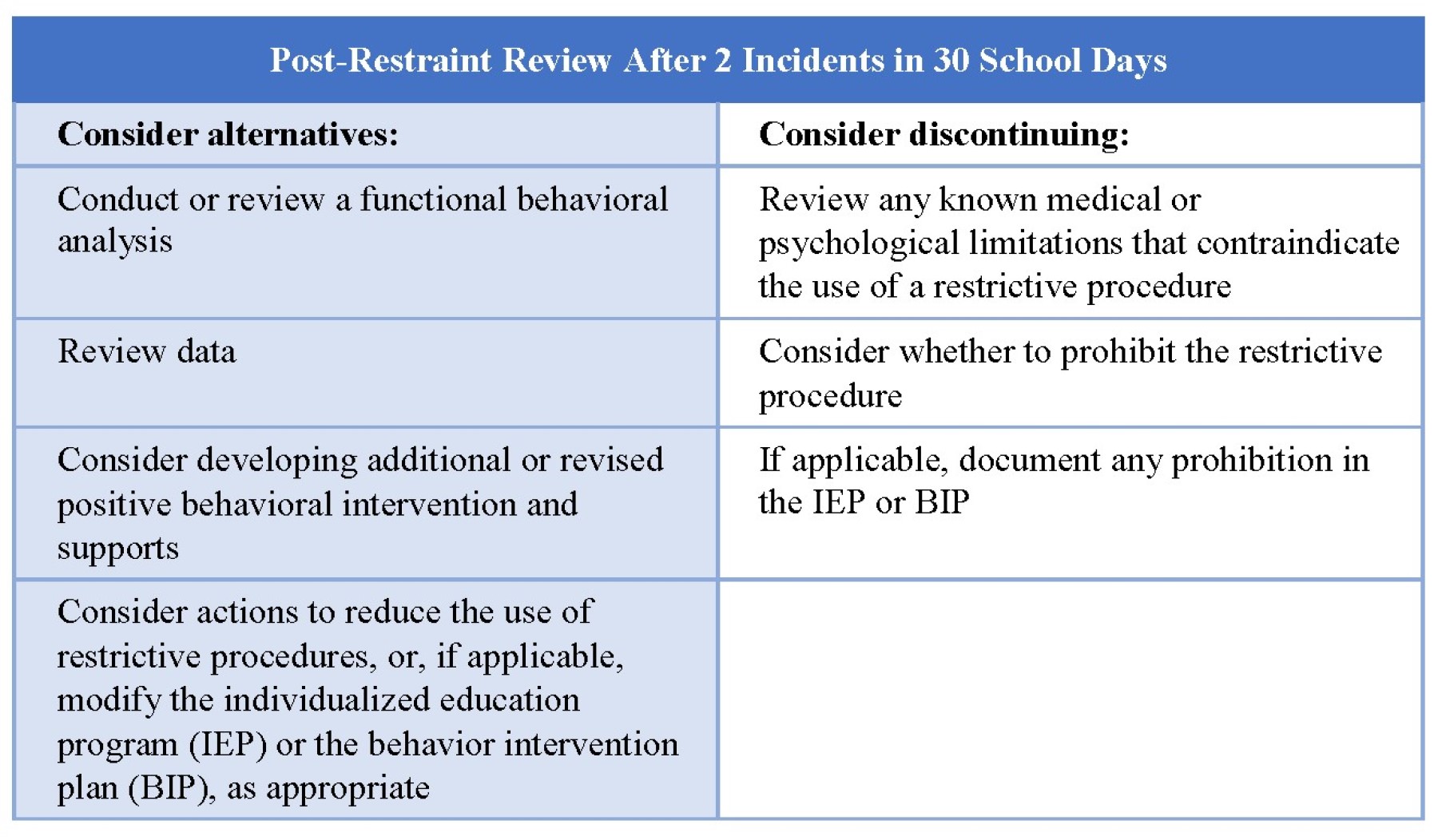
Perhaps the most notable takeaway from the amendments is ISBE’s willingness to respond to concerns raised from the field with respect to the restraint and seclusion rules. Members of our special education team at Franczek P.C. have provided suggestions to ISBE based on the many concerns that you have raised with us over these past weeks. Although ISBE has expressed its belief that prone and supine restraint should never be used with students, and may still include a total ban in its final rules, ISBE’s flexibility with respect to this issue makes a cooperative approach in the final rulemaking process promising. As we discussed in our recent webinar (which you can stream on our website), the emergency rules raised many questions and have had challenging practical implications in the field. This same is true of this most recent amendment. For example, what suffices to prove other interventions are ineffective in an emergency? Is the review of contraindications following two prone or supine restraints the same as the analysis undertaken at the time of the restraint, or is something additional contemplated during the review process? What are the required credentials referenced in the emergency regulations? These are just some of many questions that we will continue to work through with the rules generally and these amendments specifically.