

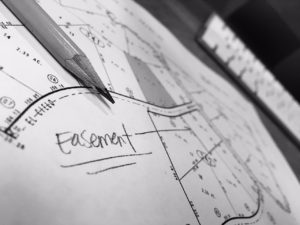
Our former colleague and now Land Court Judge Robert Foster recently decided Neily v. Gray. That case concerns the rights of various owners in Lydia’s Island Road, a private way in Wareham leading to Onset Bay. Judge Foster determined that different owners had different rights in that way, depending on their chain of title. In doing so his decision provides a helpful review of the various means by which easements — to the beach and otherwise — may be created.
Express Easements. We often think of easements as being granted by language in deeds. Here, deeds to some of the parties (or their predecessors) contained express language granting them rights to use Lydia’s Island Road: “together with the right of way over the road along the easterly side of said premises to and from the public highway and the beach.” This is as good as it gets–as long as the person granting the easement also owns the way!
Easements by Estoppel. An easement by estoppel is not expressly granted. As explained in Neily:
Massachusetts recognizes two forms of easement by estoppel…. The first form of easement by estoppel arises when land is conveyed according to a recorded plan…. Under this classification, when a grantor conveys land located on a street according to a recorded plan on which the street is shown, the grantor is estopped to deny the existence of the street for the entire distance as shown on the plan. In the second classification, an easement by estoppel is created when land bounded by a street or land bounded on or by the side line of a street is conveyed…. Under this second classification, the grantor [or a party claiming under the grantor] is estopped to deny the existence of such street or way, and the right thus acquired by the grantee (an easement of way) … embraces the entire length of the way, as it is then laid out or clearly indicated and prescribed…. [A] grantor or a successor to a grantor cannot claim an easement by estoppel.
Again, certain of the parties in Neily benefited from an easement by estoppel, whereas others did not.
Implied Easements. Implied easements are a bit more loossey-goosey.
[A]n easement by implication is a term more commonly applied to an implied grant derived from an established pattern of prior use rather than from the necessity to access a newly landlocked parcel…. An implied easement arises when no easement appears in the record of a conveyance, but there is evidence tending to show an intent of the parties at the time of the conveyance that such an easement be then created…. Thus, an implied easement must be found in a presumed intention of the parties, to be gathered from the language of the instruments when read in the light of the circumstances attending their execution, the physical condition of the premises, and the knowledge which the parties had or with which they are chargeable.
Judge Foster concluded that, ” based on the language of the various deeds granted by Burgess and his heirs [the original owners of all of the parcels], viewed in light of the circumstances of their execution, the physical condition of the various granted parcels and Lydia’s Island Road, the reasonable necessity to use Lydia’s Island Road, and the knowledge of the parties as reflected in the deeds, Burgess and his heirs intended to and did create an implied easement in all of the property owners along Lydia’s Island Road to use Lydia’s Island Road in common for its entire length from Great Neck Road to the pedestrian easement” leading to the water.
This decision does not address two other types of easements: easements by necessity or prescriptive easements. Generally speaking (and there are a lot details to consider), the latter arises as a result of 20 or more years of adverse use of someone else’s land. An easement by necessity is presumed to arise when someone conveys a portion of his or her land without granting an easement, but necessity to use the land retained by the grantor arises, most frequently because the conveyance creates a landlocked lot. The thinking is that neither party could have intended to create a new, inaccessible parcel.
Easements are complicated and the cases considering them are driven by the facts and the title. In other words, generalities will get us only so far. However, we hope that this overview sets out different routes to consider when assessing whether an easement exists.