

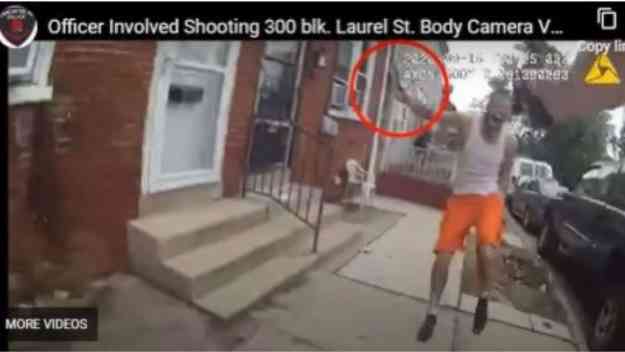
The first night included the vandalism and destruction that a great many words have been murdered to excuse elsewhere, to no avail. The second was more peaceful. But there was a disconnect the first night. The call to the wild was that the cops killed another black man. That was all it took, since no one bothers to ask why it happened, as if there were any possibility that the cops couldn’t be the bad guys.
The guy with the knife wasn’t necessarily a bad dude, but a sick dude.
[Ricardo] Munoz, 27, was mentally ill — diagnosed with bipolar disorder and schizophrenia — and hadn’t been taking his medications, his sister told Lancaster Online.
Then again, he could have been a sick dude who was also quite dangerous.
Rulennis Munoz, 33, said she had called a crisis intervention organization and a police non-emergency number to get her brother involuntarily committed.
“He had an episode. He was just incoherent and acting out,” she said. “I called to find out what the procedure was to get him some help.”
Authorities did not immediately explain why an officer was dispatched, although Munoz was facing four counts of aggravated assault after he was accused last year of stabbing four people, including a 16-year-old boy in the face, following a fight.
Facing Munoz, a police officer fired his gun while running back. Munoz fell to the ground, dead.
Protesters gathered outside the police station and, in video posted to social media, they chanted, “Hands up, don’t shoot,” “No justice, no peace” and “What do we want? Justice! When do we want it? Now!”
Did the protesters know what happened? They didn’t appear to care. Cops killed a guy and that meant they had to protest.
Messages and broken windows. A tough morning for Lancaster. @CBS21NEWS pic.twitter.com/VAbGbOQLK6
— Ryan Eldredge (@RyanEldredgeTV) September 14, 2020
Police used tear gas to disperse the protesters, turning the issue from Munoz attacking the cops with a knife and the cops shooting him, to the use of “chemical munitions” to end the protest. And the destruction.
In the aftermath, local officials addressed the situation as they’re wont to do.
“I grieve for the loss of life and know that there are more questions to be answered as the investigation continues,” Mayor Danene Sorace said in the statement.
City officials called for calm and stronger social services to help avoid deadly confrontations with police.
It’s understandable that Munoz’s sister wanted some sort of mental health intervention rather than the police to show, even though her brother had some history with knives. It’s not that he was undiagnosed. It’s not that he lacked for medication. He didn’t take his medication, a very common theme, and she wasn’t able to either make him do it or manage him when he was off his meds. These are also very common themes.
The city council president, Ismail Smith-Wade-El, said that more long-term investments must be made in crucial human services, such as mental health care support for adults, housing, crisis intervention and social workers.
“I cannot help but wonder, if Mr. Munoz got all the care he needed years ago, could we possibly be in a different place, could his family and could that officer all be in a different place,” Smith-Wade-El said in a news conference Monday.
She wanted him involuntarily committed, which may have been possible or not, but what she wanted doesn’t dictate the response. Had a social worker shown up, would the social worker be dead from a knife wound in the face instead?
It’s always possible that had things been different, the tragic outcome of a dead mentally ill person might not have happened. It’s also possible that there is no combination of good intentions and governmental interventions that could have changed anything. Munoz might have been given “all the care he needed” and still, after his necessary release from custody, chosen to stop taking his meds and gone on a violent rampage.
People want so desperately to believe that there are simple solutions to tragic problems.
But at the moment that the cops were faced with Munoz coming at them with his knife, the options were limited. This wasn’t the instance where they reacted pre-emptively, before they knew they were facing an actual threat to their life. This was the moment where it was him or the cop.
The locals who protested the killing say that the violence, destruction and looting wasn’t being done by locals, who protested peacefully, but outside agitators.
What remains unclear is what they were protesting. What any of them were protesting. What was it that they would have had the cop do, die rather than shoot? What would they have done if Munoz had attacked these well-intended young people with a knife? It wouldn’t have been the first time.
City council member Janet Diaz said social media played a big role in spreading false rumors and fanning the flames of anger based on misunderstandings of the facts of the case.
Yet, the protests continue in Lancaster, and its mayor is stymied.
“I need help. We need help,” Sorace said, calling on leaders across Pennsylvania to help forge a solution to shootings involving police officers. “I am clear beyond a doubt that we lack the tools, the resources, the expertise and the capacity to do this on our own here in the City of Lancaster.”
“We need an evidence-based protocol for responding,” she said. “What is that protocol?”
“Additionally, how do we create and staff a system that can respond 365 days a year, 24 hours a day and within minutes? These are just a few of the questions that need to be answered to create a countywide plan,” she said.
Inexplicably, there is an expectation that there is a cure for every horrible scenario mankind can create, and with that “evidence-based protocol for responding,” no mentally ill person will ever attack a cop with a knife and no police officer will ever shoot him dead. Maybe there is, but it still doesn’t explain what they’re protesting in Lancaster.