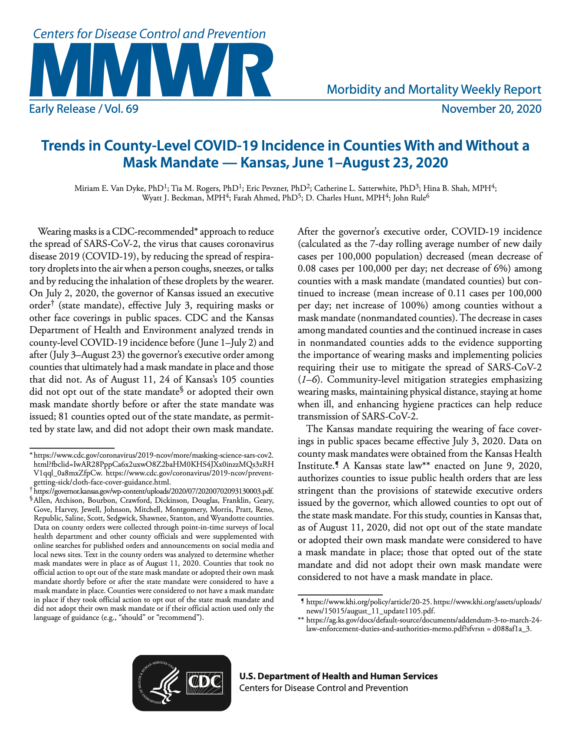
Wearing masks is a CDC-recommended* approach to reduce the spread of SARS-CoV-2, the virus that causes coronavirus disease 2019 (COVID-19), by reducing the spread of respira- tory droplets into the air when a person coughs, sneezes, or talks and by reducing the inhalation of these droplets by the wearer. On July 2, 2020, the governor of Kansas issued an executive order† (state mandate), effective July 3, requiring masks or other face coverings in public spaces. CDC and the Kansas Department of Health and Environment analyzed trends in county-level COVID-19 incidence before (June 1–July 2) and after (July 3–August 23) the governor’s executive order among counties that ultimately had a mask mandate in place and those that did not. As of August 11, 24 of Kansas’s 105 counties did not opt out of the state mandate§ or adopted their own mask mandate shortly before or after the state mandate was issued; 81 counties opted out of the state mandate, as permit- ted by state law, and did not adopt their own mask mandate.
After the governor’s executive order, COVID-19 incidence (calculated as the 7-day rolling average number of new daily cases per 100,000 population) decreased (mean decrease of 0.08 cases per 100,000 per day; net decrease of 6%) among counties with a mask mandate (mandated counties) but con- tinued to increase (mean increase of 0.11 cases per 100,000 per day; net increase of 100%) among counties without a mask mandate (nonmandated counties). The decrease in cases among mandated counties and the continued increase in cases in nonmandated counties adds to the evidence supporting the importance of wearing masks and implementing policies requiring their use to mitigate the spread of SARS-CoV-2 (1–6). Community-level mitigation strategies emphasizing wearing masks, maintaining physical distance, staying at home when ill, and enhancing hygiene practices can help reduce transmission of SARS-CoV-2.
Here is the full story : https://www.cdc.gov/mmwr/volumes/69/wr/pdfs/mm6947e2-H.pdf