

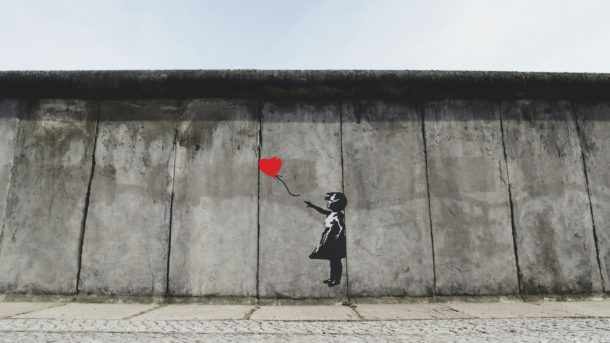
 The Cancellation Division of EUIPO has recently issued a resounding decision declaring the invalidity of the figurative trademark representing the “Flower thrower”, one of the most iconic Banksy’s mural paintings.
The motivations on which the decision is based are questionable since it seems to be willing to take a punitive stance against the British street artist due to his commonly known distaste for intellectual property rights.
Basically, the declaration of invalidity is justified on grounds of bad faith, assuming that the trademark applicant had never had the intention to use it on the market since the time of its application filing.
In the opinion of the Cancellation Division, the application for the relevant EU trademark was only aimed to obtain an exclusive trademark right, as such capable of outlasting the protection afforded by copyright, and to prevent third parties from making any commercial use of the artwork image. That conclusion is corroborated by the fact that only in 2019, after the beginning of the invalidity proceeding, did Banksy open his branded shop in London. Moreover, Banksy always allows the free download of high-resolution images of his artworks from his website and as of today has never taken any legal action against the unauthorized use of the images of his artwork made by third parties on any kind of goods.
However, the reasoning of the Cancellation Division appears to be inaccurate due to its overstepping the relevant circumstances of the case. Indeed, the way an artist desires to manage and enforce the copyright on his artworks should not have been weighed up in the invalidity proceeding, if only because Banksy has always allowed the sole non-commercial use of the images of his artwork, which fact clearly does not fall within the functions of a trademark.
It must be also noticed that according to EU trademark regulation, the owner of an EU trademark has to put it to use in the five years following its registration. Only if that period expires and the trademark has not been used is it possible to apply for a declaration of invalidity. And in the Banksy case, the use of the contested trademark was made for the first time in 2019 in full compliance with the law considering that it was registered in 2014.
The Cancellation Division also supports its argumentation by assuming that Banksy registered the image of his artwork as a trademark with the aim to try to enforce his copyright taking advantage of the alternative protection offered by the trademark system. Indeed, in the opinion of the Cancellation Division, to claim copyright protection is very difficult for Banksy both for his
anonymity and for the way of expression of his artworks which are mural paintings illegally realized on walls owned by third parties.
However, such an approach is unconvincing. First of all, it would be more appropriate to refer to Banksy as an artist using a pseudonym instead of defining him as “anonymous”. In addition, the author’s decision to be anonymous cannot affect his economic and moral rights in his artworks. That is generally recognized at the European and international level and clearly stated by copyright law of countries like Italy and the United Kingdom, among others, which allow anonymous or pseudonymous authors’ right to reveal their identity and provide also a specific term for copyright duration on their works. Moreover, anonymous or pseudonymous authors are accorded the resale right, i.e. the right of visual artists to receive a share of the resale price of their original artworks after the first sale.
Actually, the only circumstance where an anonymous author could be obliged to reveal his name or identity is when he would bring a lawsuit for copyright infringement before a Court. That because in such a case the author identification is necessary for purposes of authorship verification or of ownership verification in the presence of a copyright assignment or license as well as for purposes
of works made for hire.
On the contrary, no mandatory identification is required in proceedings related to trademark issues where the subject entitled to claim the protection of a trademark is the owner of the registration, whose name is publicly available on the trademark register. That is what happened in front of the Court of Milan at the end of 2018 when Pest Control, the company that usually manages Banksy’s copyright, in order to enforce its trademarks rights over the artist’s name and the images of “Girl with Balloon” and “Flower thrower”, sued the Italian company which had organized and promoted the exhibition “The art of Banksy. A visual protest” for the unauthorized reproduction of Banksy’s name and artworks on merchandise.
Furthermore, equally inaccurate is the statement of the Cancellation Division that graffiti and mural paintings are not eligible for copyright protection. In this regard, a distinction should be made between the subject entitled of the property right on the artwork, who according to the accession principle is the owner of the wall, and the subject entitled of the copyright on the artwork, who is
the author.
That is confirmed by the landmark judgment of the Court of Appeals for the Second Circuit of the United States of America which, in the famous case of “5Pointz” building demolition, recognized the violation of street artists’ authorship moral rights.