

 There have been recent calls for Congress to re-visit H.R. 2211, the “Stop Tip-overs of Un-stable, Risky Dressers on Youth Act” also known as the “STURDY Act.” Sponsored by Janice Schakowsky (Dem-IL 9th District), the bill was introduced in Congress last session and passed by the House on September 17, 2019 but never passed by the Senate. It would require the U.S. Consumer Product Safety Commission (“CPSC”) to promulgate a consumer product safety rule for free-standing clothing storage units to protect children from tip-over related death or injury.
As we indicated in our May 2020 analysis of dresser tip-overs, tip-overs have been a main focus for the CPSC and consumer advocacy groups in recent years. A CPSC report indicates that 571 people died from furniture tip-overs between 2000 and 2019, and 82% of those were children (ages ranged from 1 month to 14 years). A survey conducted by the CPSC showed that 41% of respondents did not anchor furniture in their homes.
Currently, there is no mandatory standard requiring manufacturers to test furniture to specific stability and safety standards. The current voluntary standard, ASTM F2057 – 19, is recognized by industry and the CPSC as required best practice in order to prevent tip-overs from dressers and other clothing storage units.
H.R. 2211 makes it much easier for the CPSC to get to a final rule to prevent deaths from furniture tipovers. Normally, CPSC rulemaking is initiated by the CPSC under section 9 of the Consumer Product Safety Act (15 U.S.C. § 2058), which requires the CPSC to publish proposed rules with preliminary analysis containing: (1) a cost benefit analysis; (2) a description of any reasonable alternatives to the proposed rule, together with a summary description of their potential costs and benefits, and a brief explanation of why such alternatives should not be published as a proposed rule; and (3) the CPSC’s reasoning regarding why other rules/voluntary standards already in place are insufficient to address the issue. If this bill passes, the CPSC will be allowed to initiate the rulemaking process under the Administrative Procedure Act (5 U.S.C. § 553) (“APA”), a much more streamlined process. The proposal in the STURDY Act aligns with CPSC’s Acting Chairman Robert Adler’s recent remarks commenting on his desire for “. . . less cumbersome rulemaking of the sort that was added to the agency’s statutes some 40 years ago. Despite the claims that these extra procedures and mandatory findings would produce better rules, 40 years of history show that all they’ve done is produce fewer rules, with no discernible quality improvement, and at a great cost to consumer safety.” (Acting Chairman Robert Adler’s ICPHSO 2021 Keynote Address, Feb. 24, 2021.)
If enacted, the new mandatory standard would increase the weight used in testing to mimic the force of heavier children and take into consideration real life conditions, like the fact that dressers can be placed on different types of floor coverings. Here is a close look at how the newly proposed bill, H.R. 2211, compares to the current voluntary standard ASTM F2057-19:
| ASTM F2057-19 – Existing Standard | STURDY Act – Proposed Legislation | |
| Scope | This safety specification is intended to reduce injuries and deaths of children from hazards associated with tipover of free-standing clothing storage units, including but not limited to chests, chests of drawers, drawer chests, armoires, chifferobes, bureaus, door chests and dressers, 27 in. (686 mm) and above in height. |
This bill would require the CPSC to promulgate a final consumer product safety standard for clothing storage units to that includes: 1. tests that simulate the weight of children up to 60 pounds; 2. objective, repeatable, and measurable tests that simulate real world use and account for any impact on clothing storage unit stability that may result from placement on carpeted surfaces, drawers with items in them, multiple open drawers, or dynamic force; 3. testing of all clothing storage 16 units, including those under 30 inches in 17 height; and warning requirements based on ASTM F2057–17, or its successor at the time of enactment, provided that the CPSC shall strengthen the requirements of ASTM F2057–17, or its successor, if reasonably necessary to protect children from tip-over related death or injury. |
| Clothing Storage Unit Definition | This standard defines “clothing storage unit” as “furniture item with drawers and/or hinged doors intended for the storage of clothing typical with bedroom furniture.” | This bill defines “clothing storage unit” as “any free-standing furniture item manufactured in the United States or imported for use in the United States that is intended for the storage of clothing, typical of bedroom furniture.” |
| Products to be tested | This safety specification does not cover shelving units, such as bookcases or entertainment furniture, office furniture, dining room furniture, Jewelry armoires, underbed drawer storage units, occasional/accent furniture not intended for bedroom use, laundry storage/sorting units, nightstands, or built-in units intended to be permanently attached to the building, nor does it cover “Clothing Storage Chests” as defined in Consumer Safety Specification F2598. | All Clothing Storage Units (see definition above). |
| Age of Children (for testing purposes) | Up to age 5. | Up to 72 months (6 years). |
| Performance Requirements | With the unit empty and without the tipover restraint, test the unit in accordance with 7.1 and 7.2. During the test, the unit shall not tip over or be supported by any component unless that component was specifically designed for that purpose. | The bill requires the CPSC to develop objective, repeatable, and measurable tests that simulate real world use and account for any impact on clothing storage unit stability that may result from placement on carpeted surfaces, drawers with items in them, multiple open drawers, or dynamic force. |
| Testing Weight | Testing uses two 25-pound weights; total is 50 pounds. |
Tests should simulate the weight of children up to 60 pounds. Also noted in the Act: update standard to “include tests that simulate the weight of children up to the 95th percentile weight of children 72 months in age” after CDC completes its work. |
| Real-World Use Testing | No; “Position the empty unit on a hard, level, flat surface. The unit shall be level during testing unless specifically designed otherwise.” | Yes; “objective, repeatable, and measurable tests that simulate real world use and account for any impact on clothing storage unit stability that may result from placement on carpeted surfaces, drawers with items in them, multiple open drawers, or dynamic force.” |
| Considers Flooring Differences during Testing | No. | Yes. |
| Considers Contents of the Clothing Storage Unit during Testing | No; unit is empty during testing. | Yes; testing includes “drawers with items in them” as a variable. |
| Minimum Height for Testing? | Yes; “including but not limited to chests… 27 in. (686 mm) and above in height.” | No; “testing of all clothing storage units, including those under 30 inches in height.” |
| Tipover Restraints |
Tipover restraints shall be included with each item of furniture covered under the scope of this safety specification for attachment by the consumer.
The tipover restraint provided shall meet the requirement of Specification F3096. |
The bill does not mention tipover restraints. |
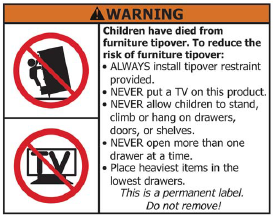
| Warnings |
Each clothing storage unit shall be permanently marked in at least one place with the warnings from this section. The warnings shall be in a conspicuous location when in use; the back of the unit intended to be placed against the wall is not considered conspicuous when in use.
Children have died from furniture tipover. To reduce the risk of furniture tipover: · ALWAYS install tipover restraint provided. · NEVER allow children to stand, climb, or hang on drawers, doors, or shelves. · NEVER open more than one drawer at a time. · Place heaviest items in the lowest drawers. · This is a permanent label. Do not remove!
Manufacturers should also include warns related to whether or not TV should be place on the product.
|
This bill requires CPSC to draft warning requirements based on ASTM F2057–19, or its successor at the time of enactment. The CPSC shall strengthen the requirements of ASTM F2057–19, or its successor, if reasonably necessary to protect children from tip-over related death or injury. The final language has yet to be determined.
|
As H.R. 2211 has yet to be passed, it is important that manufacturers follow the current voluntary furniture safety standard, test furniture for stability, educate consumers about the risk of tip-overs, and provide strong and tested anchors for securing furniture with clear instructions on how to do so properly.