

 In In re Breland, __ F.3d __ , 2021 WL 910657 (11th Cir., March 10, 2021) (click here for .pdf) the individual Debtor filed a voluntary Chapter 11 petition. After it was determined that he was transferring assets and defrauding his creditors a Chapter 11 Trustee was appointed.
[Debtor] protested that the trustee’s appointment violated his Thirteenth Amendment right to be free from “involuntary servitude”— because, he said, under the trustee’s direction, all of his postpetition earnings would be put into the bankruptcy estate for the benefit of his creditors. The bankruptcy court dismissed [Debtor’s] Thirteenth Amendment claim as unripe, and, on review, the district court similarly held that [Debtor] couldn’t show an injury-in-fact sufficient to confer Article III standing…
The Eleventh Circuit panel disagreed with the District Court, finding that “[Debtor’s] loss of authority and control over his estate, which he suffered as a result of his removal as the debtor-in-possession, constitutes an Article III-qualifying injury-in-fact that is both traceable to the bankruptcy court’s appointment of the trustee and redressable by an order vacating that appointment...” Accordingly, the Panel held that Debtor had standing to pursue his Thirteenth Amendment arguments.
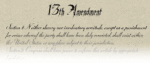
The Thirteenth Amendment to the United States Constitution provides the following:
Neither slavery nor involuntary servitude, except as a punishment for crime whereof the party shall have been duly convicted, shall exist within the United States, or any place subject to their jurisdiction.
Of course, this Amendment is most notable for abolishing slavery rather than protecting individuals who have filed voluntary Bankruptcy petitions. Nevertheless, the Panel left a small opening for the Debtor to make his case.
Both the bankruptcy court and the district court held that [Debtor’s] Thirteenth Amendment claim was nonjusticiable in the absence of a reorganization plan requiring [Debtor] to work and devote his income to paying off his creditors —the bankruptcy court because the claim wasn’t ripe, and the district court because Debtor had suffered no injury-in-fact. Whatever the merits of [Debtor’s] Thirteenth Amendment challenge—and we are skeptical—we hold that the appointment of the trustee sufficiently diminished [Debtor’s] ability to control the assets in his own bankruptcy estate to satisfy Article III’s standing requirements…
Before the appointment of a trustee—i.e., while he remained the debtor-in-possession—[Debtor] could, even without the bankruptcy court’s approval, hire professionals whose work is “necessary in the operation” of his business, id. § 327(b); use, sell, or lease the property of the estate in the ordinary course of business, id. § 363(c)(1); and obtain unsecured credit in the ordinary course of business, id. § 364(a). Likewise, before the
trustee’s appointment, [Debtor] could do any of the following, so long as he obtained the bankruptcy court’s approval: hire professionals to assist in the reorganization, id. § 327(a); use, sell, or lease estate property or obtain unsecured credit outside the ordinary course of business, id. §§ 363(b)(1), 364(b); accept and reject executory contracts and unexpired leases to which he was a party, id. § 365(a); and bring most avoidance actions on his own behalf, id. § 544, 548.When the bankruptcy court appointed a trustee, and thereby deposed [Debtor] as the debtor-in-possession, it stripped him of the ability to do—or to seek permission to do— any of those things. The consequent loss of authority over his estate constitutes an Article III-qualifying injury-in-fact. And to round out the standing analysis, [Debtor’s] injury is “fairly traceable” to the appointment of the trustee, and it is “redress[able],” in the sense that an order removing the trustee would have the effect of restoring him to debtor-in-possession status, with all its attendant rights and responsibilities. [See Friends of the Earth, Inc. v. Laidlaw Envtl. Servs., Inc., 528 U.S. 167, 180–81, 120 S.Ct. 693, 145 L.Ed.2d 610 (2000)]. We thus hold that [Debtor] has Article III standing to pursue his Thirteenth Amendment challenge.
The Panel not-so-subtly expressed skepticism about the Debtor’s 13th Amendment challenge in the Order and concluded:
It’s oh-so tempting to forge ahead and address the merits of [Debtor’s] Thirteenth Amendment claim, but our hands are tied. It’s true, of course, that we can affirm a district court’s judgment based on any ground supported by the record… But when the district court here held that [Debtor] lacked standing to sue, it dismissed his claim for lack of subject-matter jurisdiction—and thus without prejudice… Were we to range beyond the jurisdictional issue here and reject [Debtor’s] claim on the merits, we would, in effect, be directing a dismissal with prejudice—and thereby altering the district court’s judgment. That, we cannot do.
Reversed and remanded. Perhaps we will see this case again.
Scott Riddle’s practice focuses on bankruptcy and reorganization. Scott has represented businesses and other parties in Chapter 11 cases for almost 30 years. You can contact Scott at 404-815-0164 or scott@scottriddlelaw.com. For more information, click here.