

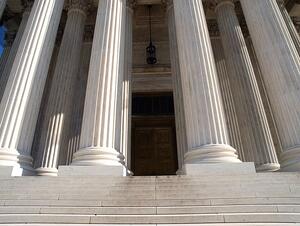
 The “well-worn yet enduring standards” of Article III standing – constitutionally required to bring a case in federal court — are (1) the plaintiff suffered an injury in fact, (2) caused by the defendant, and (3) that is redressable by a judicial decision. In 2016, the Supreme Court of the United States decided Spokeo v. Robins, 136 S.Ct. 1540, 1547 (2016), in which it addressed the “injury in fact” element of standing, and it held that a plaintiff seeking redress for a statutory violation must show a “concrete injury” as opposed to a purely procedural or technical violation of the statute. To have standing, a plaintiff cannot simply allege that the defendant violated the statute and that alone caused injury. Instead, the plaintiff must allege some injury that is “real, not abstract, actual, not theoretical, concrete, not amorphous.” Huff v. Telecheck Servs., 923 F.3d 458, 462 (6th Cir. 2019) (citing Spokeo, 136 S.Ct. at 1548). Further, while an injury in fact can be tangible (e.g., economic loss or physical injury) or intangible (e.g. loss of free speech, increased risk of harm), that “does not mean that a plaintiff automatically satisfies the injury-in-fact requirement whenever a statute grants a person a statutory right and purports to authorize that person to sue to vindicate that right.” Spokeo at 1549. Rather, lower courts are to look to congressional judgment and historical practice for guidance in making the assessment of whether the plaintiff’s alleged intangible harm is a concrete injury in the context of a statutory violation.
