


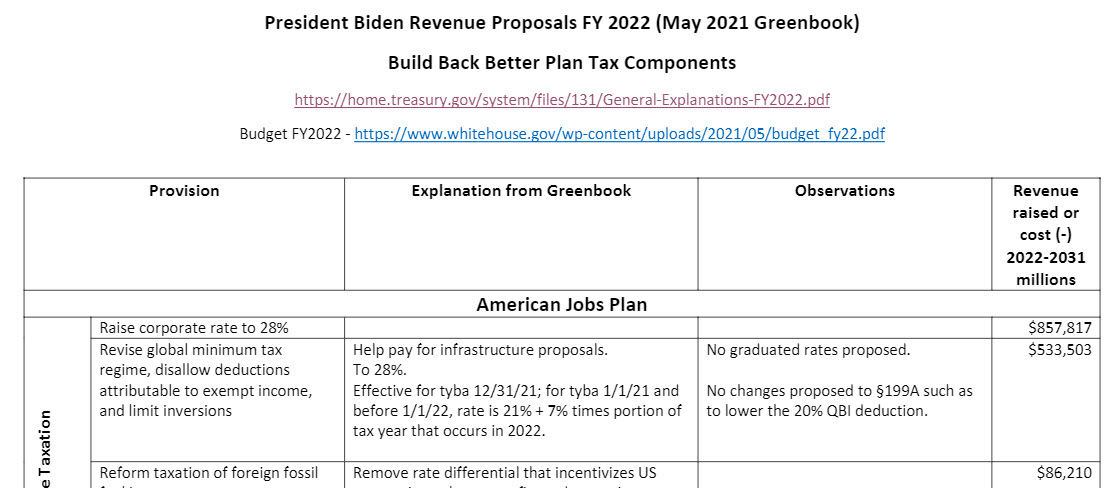
The tax provisions included in President Biden’s Build Back Better plan are mostly similar to what he campaigned on, such as repealing tax preferences for fossil fuels and providing tax breaks for most families.
I have posted a table listing the tax provisions in the Administration’s FY2022 Greenbook. There is a lot there relevant to all individuals, wealthy people with lots of appreciated assets, alternative energy companies, oil companies,and more.
I think it is also interesting what is not there such as:
- Limiting the QBI Section 199A deduction for individuals with income above $400,000. I guess this is because 199A automatically goes away after 2025 so why waste political capital trying to reduce it for less than 1% of individuals.
- Capping the benefit of itemized deductions at 28%.
- No change to the estate tax exemption or tax rate. Again, this is likely because we automatically revert to the lower exemption and higher rate after 2025 (one of a few built-in tax increases in the Tax Cuts and Jobs Act, the temporary 199A).
- Fixing Section 174 so we don’t start using the TCJA provision after 2021 that R&D must be capitalized and amortized rather than expensed. Expensing has been in the law since 1954. While the BBB plan mentions helping R&D, there isn’t anything specific to fix the TCJA change.
- Reducing the over 100 special rules that don’t need to be in the law such as the mortgage interest deduction, various education provisions, the exclusions for employer-provided health insurance, and more. These provisions are called tax expenditures and result in reduced revenues of about $1.8 trillion per year. Now would be a good time to phase out the mortgage interest deduction because only about 11% of individuals itemize deductions today and not all of them have a mortgage. This subsidy for higher income individuals doesn’t belong in the tax system. If there is desire to use the tax law to help individuals purchase a home, a first-time homebuyer credit would be better. (more on this another time)
- An increase to the gasoline excise tax that has been at 18.4 cents/gallon since 1993. Of course, this would represent a tax increase on individuals with income below $400,000, but with the outdated figure and a desire to reduce greenhouse gas emissions, seems like an oversight (and a reason why the campaign promise of no tax increases for those with income under $400,000 should have had some caveats). And no mention of initiating efforts to shift from the gasoline excise tax to a vehicles miles travelled tax so that all vehicles contribute to the Highway Trust Fund rather than only gas-powered vehicles.
- Numerous simplifications and improvements. I started listing some of these in a recent blog post and will continue to and hope readers will add in their ideas in the blog comments.
What do you think?