


Will Smith, right, slaps presenter Chris Rock on stage at the Oscars (CNN).
By: Ruby Aliment
The Los Angeles Police Department has confirmed that Chris Rock has chosen not to press criminal charges against Will Smith for the slap heard around the world. Since the Academy Awards aired, much of the world has discussed whether Smith was morally right to use violence to defend his wife and what it might mean for standup comedians who often target sensitive subjects during their shows. Another question on people’s minds is whether Rock can (or should) bring personal injury claims for this incident.
Can you seek a civil injury claim if it did not result in criminal charges?
While physical assaults can result in criminal charges or convictions, they are not pre-requisites to bringing a personal injury claim. Criminal and civil cases serve different purposes. A criminal case focuses on punishing the offender, while a civil case focuses on compensating the victims. (In California, juries can also choose to punish civil defendants by ordering punitive damages).
While a criminal conviction can be evidence in a civil case, a civil lawsuit’s success does not depend on a criminal conviction. For example, while O.J. Simpson was famously acquitted for murdering Nicole Brown Simpson and Ron Goldman, a civil jury found him liable for their deaths and ordered that he pay $33.5 million to their families in damages.
Can Chris Rock sue Will Smith?
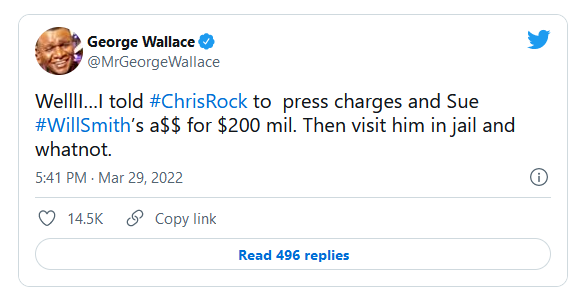
Since LAPD’s announcement, multiple celebrities have come forward and suggested that Rock bring a civil lawsuit against Smith for the slap.
In every personal injury action, the injured party—the plaintiff—must prove liability (which refers to blame and wrongfulness), causation, and damages. There can be little doubt that Rock could bring and win claims against Smith for battery, which is the legal term intentional and unpermitted contact with the plaintiff’s person. Under the law, a person like Smith is liable for battery if:
-
he acts intending to cause a harmful or offensive contact with the plaintiff or a third party, or places that person in imminent apprehension of such contact, and
-
harmful or offensive contact with the plaintiff directly or indirectly results.
The law considers bodily contact to be offensive under these standards if it offends a reasonable sense of personal dignity, which means Rock did not have to be physically injured by Smith’s slap to have a claim against him. Instead, a jury would be asked to evaluate Rock’s total harm, which includes the physical assault and any emotional pain, suffering, humiliation, or economic loss that accompanied it.
What About the Academy?
A more challenging question is whether the Academy and its agents bear any responsibility for Smith’s conduct and Rock’s harm. These types of claims fall under premises liability law, which holds property owners or operators liable for injuries customers or visitors experience due to their negligence.
In many settings, negligent security claims might involve:
-
broken or malfunctioning security cameras,
-
blocked emergency exists,
-
inadequate lighting, or
-
poorly trained or managed security guards
In this case, some have suggested that the Academy may have negligently managed security for the event by permitting uninvited people on stage. There is also some suggestion that Rock’s jokes were previewed for Smith (and others) the day before, but the joke about Pinkett Smith was kept from him. (Pop culture buffs know that Smith and Rock have a history when it comes to jokes about Pinkett Smith that dates back to the 1990s). Against this backdrop, Rock would need to allege that a reasonable events operator would have done something differently.
So far, we have heard nothing from Rock’s team about whether he intends to pursue civil claims against Smith, the Academy, or any third-party associated with the event. Under California law, Rock has two years from the date of the slap to bring these or other claims.