
Many of us love optical illusions. It’s a safe thrill to know we’re being tricked, and yet are still unable to tell our brains to “get real” and stop the illusion.

When you’re doing an investigation, the same kind of thing can take over your brain: You want to look at facts in one way, but your brain won’t let you. That can lead you to the wrong conclusions. There’s a great explanation for the evolutionary reasons optical illusions work on us, at the American Museum of Natural History site.
I wrote about illusions in my book, The Art of Fact Investigation, and was recently reminded again of their power when viewing a wonderful retrospective of the paintings of Bridget Riley, at the Yale Center for British Art.
Sometimes in Riley’s work, what you know to be a static picture looks as if it’s moving (scroll quickly as you look at the section of the work above). As the AMNH site explains, we evolved to focus attention on movement because it can be a sign of danger.
“Even when you stare at a still object, your eyes dart around. Normally, your brain can tell the difference between your eyes moving and an object moving. But because of the strong contrasts and shapes in the illusion, your brain gets confused. Your motion sensors switch on, and the image seems to turn.”
Or take a look at the picture to the left. It’s the famous “Duck-Rabbit” with a duck looking left and a rabbit to the right.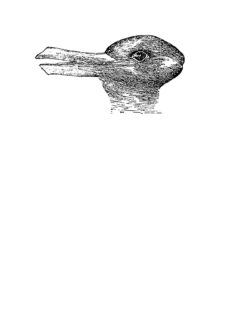
Even after we know that we are looking at something unusual, this image is fascinating. While the information on the page never changes, we can see only a duck or a rabbit, but not both at the same time. It’s very hard to take in simultaneously two facts that we know to be mutually exclusive.
Investigation can feel like that too. In forming theories as we investigate, we gather evidence that may end up supporting what appear to be incompatible or contradictory conclusions. Our instinct is to favor the evidence that supports the conclusion we think is more likely, but we must resist that tendency. We will not find a man who is/is not bankrupt at the same time in the same jurisdiction (impossible), but we may find someone who was extremely wealthy in January and is broke in March.
Looking at the duck-rabbit takes more energy than looking at a conventional picture of a duck or a rabbit, because it clashes with our understanding of what kinds of animals exist on earth. A man who goes from riches to rags in six weeks will, similarly, be harder to investigate because we will have to overcome our own skepticism before we can consider the entire picture of events.
The tendency to find evidence to confirm the case we are trying to win is called confirmation bias, and lawyers are bursting with it. Lawyers are competitive by nature. Evidence they need is something they will naturally want to believe they have uncovered.
Consider the scope of the investigation. Since we “know” Robert Jones is strictly a “New York guy,” we will not even look outside New York to see what else he may have done or acquired outside the state. That’s a mistake.
In screening witnesses, we see that an expert witness has testified dozens of times, so we “know” he has no embarrassing personal history that could affect his credibility since “someone” is bound to have found it by now. Wrong again. At least, wrong not to check.
Optical Illusions in Finance
As for a static picture that appears to be moving, think about Bernie Madoff’s scam. Talk about bold colors and contrasts: He was a leading light in finance, apparently very wealthy, and highly exclusive about who would be allowed to invest in his apparently successful funds.

The movement in the Madoff picture was something now known as FOMO (fear of missing out). So much was apparently going on in his universe that you were a fool to pass up a chance to give him money.
In the end, it was an illusion. An accountant in a shopping mall, no independent custodian, and SEC filings that showed just a few million (not billions) under management.
Bridget Riley’s illusions are enjoyable, thought provoking and sometimes disturbing, but the fact that they are illusions is not a secret.
They are worth keeping in mind the next time your investigator comes back with a “sure thing.”