


Link to Report Focuses on Travel Rule Implementation – or Lack Thereof Report Focuses on Travel Rule Implementation – or Lack Thereof
The Financial Action Task Force (“FATF”) recently issued an updated review of the implementation of its anti-money laundering (“AML”) and counter-terrorist financing (“CFT”) standards to financial activities involving Virtual Assets (VAs) and Virtual Asset Service Providers (VASPs), entitled Targeted Update On Implementation Of The FATF Standards On Virtual Assets And Virtual Asset Service Providers (“Report”).
This post highlights the three main takeaways from the Report – with a focus on the FATF’s Travel Rule. Condensed, the FATF Travel Rule requires the private sector to obtain and exchange beneficiary and originator information with VAs transfers valued at $1,000 or more. The Report also suggests that some DeFi arrangements are not truly “decentralized.”
Link to Background Background
In October 2018, the FATF revised its Recommendation 15 in order to extend its AML/CFT standards to financial activities involving VAs and VASPs, to respond to the threat of criminal and terrorist misuse. In June 2019, the FATF adopted an Interpretive Note to Recommendation 15 to clarify how the FATF standards should apply in relation to VAs and VASPs. The FATF has published in 2020 and 2021 global reviews of implementation of the FATF standards (available here and here, and as we previously blogged on here).
As we previously blogged, in late October 2021, the FATF issued its long-awaited updated guidance on VAs and VASPs (“Updated Guidance”), a lengthy and detailed document setting forth how VASPs and related VA activities fall within the scope of FATF standards for AML/CFT.
Link to Three Primary Takeaways Three Primary Takeaways
Jurisdictions have made only limited progress in implementing the FATF’s Recommendation 15 and Interpretive Note 15.
The Report finds that of the fifty-three jurisdictions that have been assessed by the FATF’s Global Network since June 2021, the majority still require major or moderate improvements on Recommendation 15. The Report assigns four rating criteria: “compliant”, “largely compliant”, “partially compliant,” and “non-compliant.” Since June 2021 not a single jurisdiction has received a fully “compliant” rating with Recommendation 15. The table below from the Report shows a breakdown of the results across the specific FATF criteria regarding VAs and VASPs across the fifty-three jurisdictions.
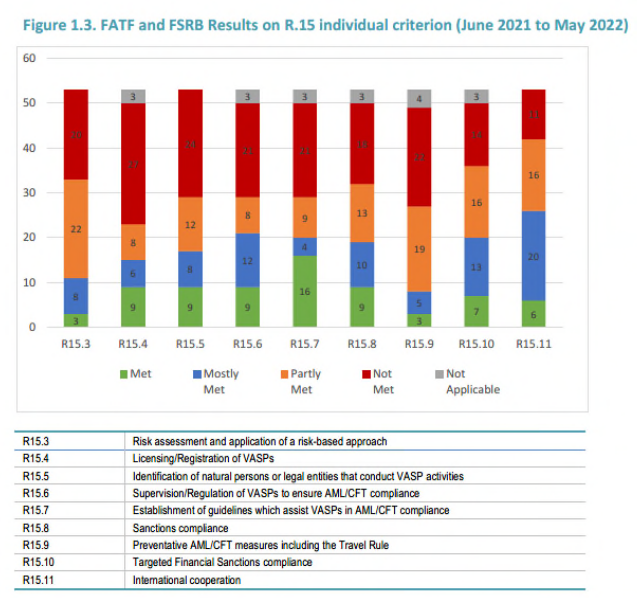
Nonetheless, the Report finds there has been an overall increase in the number of countries that have introduced a licensing or registration regime for VAs and VASPs (43% at present, up from 39% in June 2021).
Many countries are failing to implement FATF’s Travel Rule guidance for virtual assets, which undermines international AML/CFT efforts.
The Report finds that there has only been a marginal increase in jurisdictions implementing and enforcing the Travel Rule and, thus, there is an immediate need for progress in this area. This finding is reinforced by the following data, cited to in the Report:
- Only twenty-eight jurisdictions reported having passed Travel Rule legislation.
- Only eleven of those jurisdictions reported that these requirements were being enforced.
- About a quarter of jurisdictions reported that they are currently in process of introducing Travel Rule legislation.
- About a third of jurisdictions reported that they had not yet started introducing Travel Rule legislation.
Essentially, three years after the FATF extended the rule to virtual currency transfers, most jurisdictions still lack Travel Rule legislation.
Of the many challenges detailed in the Report on implementing Travel Rule regulation, of particular importance are “sunrise issues” involving implementation between jurisdictions that regulate VAs and VASPs, and those that that do not. According to its survey, most FATF survey states have not yet made a decision whether to allow transactions between VASPs and foreign un-regulated counterparties. Additionally, the vast majority of states have not yet made a decision whether VASPs are required to submit Travel Rule information to foreign unregulated counterparts. Another key item of interest is the approach to unhosted wallets: according to the Report, most jurisdictions have decided to follow the approach outlined in the FATF’s Updated Guidance, to require VASPs to collect relevant beneficiary information on unhosted wallets from their own customer. In the U.S., the Financial Crimes Enforcement Network proposed similar requirements in late 2020 regarding unhosted wallets.
To address the regulatory shortcoming in the global scheme, some jurisdictions introduced temporarily flexibility for domestic requirements and provided guidance on how to interact with non-regulated parties. The Report recommends broad and rapid introduction of Travel Rule legislation to remediate “sunrise issues.”
The FATF will continue to monitor guidance for virtual assets, including NFTs and stablecoins, which can undermines international AML/CFT efforts.
The Report outlines several additional trends and emerging risks associated with virtual assets:
- DeFi markets have grown significantly over the last year, including an increased use of stablecoins and cross-chain bridges. The Report notes that some DeFi arrangements are not truly “decentralized” and jurisdictions will need to evaluate which DeFi entities require regulatory oversight.
- NFT markets have continued to grow and are, similar to DeFi, susceptible for misuse to further illicit financial activities. The Report points out that there has been an increase in non-financial corporations in NFT market.
- The FATF will continue to monitor risks associated with peer-to-peer transactions and stablecoins.
Link to Next Steps Next Steps
The Report concludes that jurisdictions should accelerate compliance with the FATF’s Recommendation 15 and Interpretive Note 15 and introduce Travel Rule legislation as soon as possible to close regulatory gaps. Further, as the FATF continues to monitor emerging market trends the Report anticipates future guidance on DeFi, stablecoins, and NFTs.
If you would like to remain updated on these issues, please click here to subscribe to Money Laundering Watch. Please click here to find out about Ballard Spahr’s Anti-Money Laundering Team.