

The Chicago Bar Association created a CLE opportunity about how to improve your legal reputation through podcasting. I participated in a panel with Thinking Like a Lawyer co-host Joe Patrice, Lunch Hour Legal Marketing co-host Conrad Saam and Chicago Bar’s @theBar co-host Trisha Rich to share some research and best practices about legal podcasting with CBA’s members. Following is my script for the talk and the slides.
I’m new to legal, but long in media experience. My role at LTN is primarily sponsorship sales and working with show partners (like the CBA and ABA) to produce and deliver legal podcasts. I end up having a lot of conversations with attorneys like you who want to start their own podcasts.
And I say ‘no’ to them. A lot. There are some issues that come up repeatedly and I want to share a few of these with you. Perhaps with this session, our experience can save you all some frustration.
I have a few items about what works, what doesn’t…
First some Don’ts…

Rather, don’t talk and talk and talk and talk.
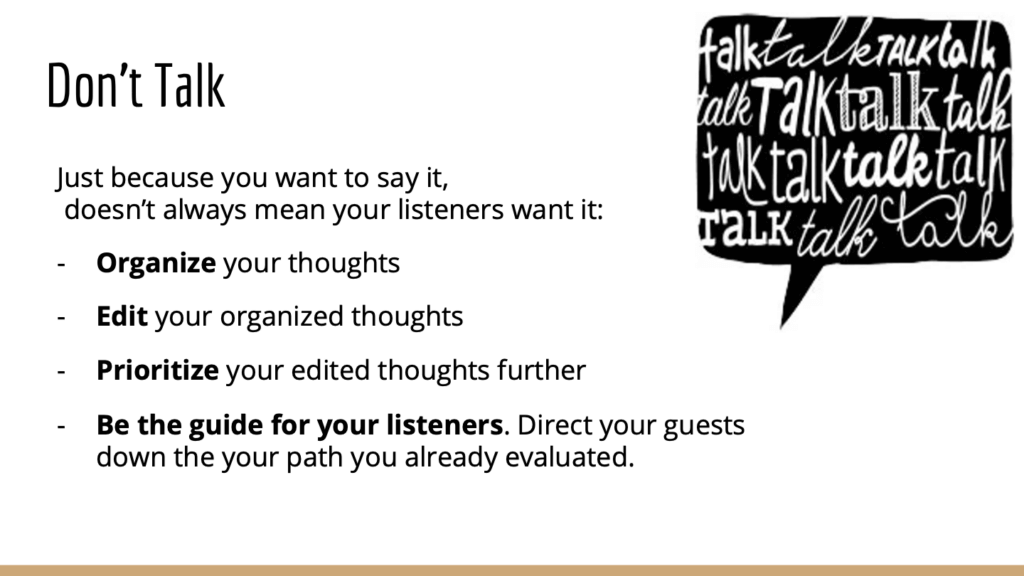
Just because you have a microphone does not mean people have to, or want to, listen to you.
Organize your thoughts so people can follow the structure of your point or the progression of questions to a guest,
Edit your thoughts. That means Take stuff out, don’t polish it like your acceptance speech. Less is more.
Conrad and his co-host Gyi Tsakalakis work with a tight show plan. They are deeply knowledgeable about these marketing tools so there are tons more things they might say about the marketing tools. But for the sake of the listener, the hosts take that extra minute to step back, so they can prioritize the most important ideas the listeners care about.
It’s your ability to filter and curate the subject matter, or share a specific point of view that creates value to the listeners, and builds your reputation as a thought leader worth listening to.

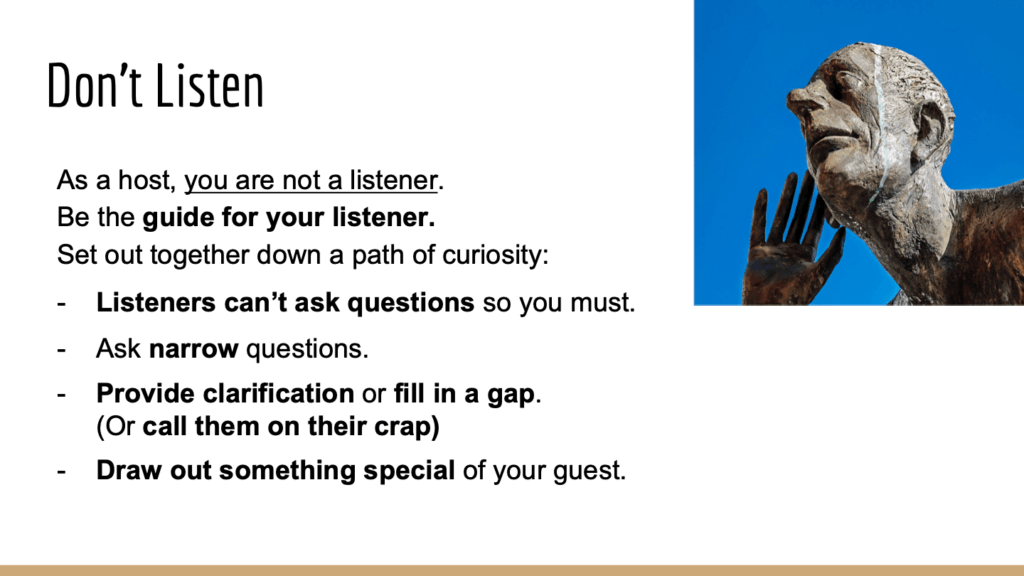
Meaning, don’t just sit back and listen to your guest’s answers. As a host, you are not a listener. Ask the guests meaningful questions.
Our team recently worked with a podcasting client who was good at getting good guests and then sat back and let them talk. They said “we didn’t want to get in their way.”
They would ask a broad question and then sort of take their hands off the wheel. The guests rambled on and on and on.
Then the guests started to sound desperate. You can almost hear them thinking “am I saying the right stuff? Is this what you wanted? This can’t be right. Should I keep going?“
The host is the proxy for the listener. The host can and should do things the listener CANNOT do!
- Interrupt a long, off-track ramble.
- Stop to provide clarification or fill in a gap.
- Or call them on their crap.
- Draw out something special from your guest
As host, you can create a reason to knock them off-script. Make them laugh or say “huh, I never thought about that.”
- We have a host, Jared Corriea of Legal Toolkit, who always plays a dumb game with his guests.
- Adriana Linares of New Solo wants to show another side of her guests and often asks them about wine or gardening or their hobbies. After that exchange, the listener gets to learn something special about the guest they wouldn’t have gotten anywhere else.
- Managing a guest builds YOUR bond with the audience.
Ask narrow questions so you can keep the guest to one, trackable idea.
You can always ask follow-up questions. But if you start with a broad question, it can be hard to get to the heart of what you really want out of them. Worse, it can be hard to stop them once they’ve set out.
Here is a specific question to avoid because it’s overly-broad: “Before we start, tell us a little about how you got into the area of this-that-and-the-other.” I heard a host let a guest ramble on for NINE minutes with his resume rundown in a recent show. That gives the guest carte blanche on your listener’s dime. A guest is never going to edit themselves without you guiding them to what’s important.
The guest did not make the same promise you did to deliver relevant info that’s consistent with your show’s brand. You as the host are the only one who can keep the conversation on track.
Instead, ask about a specific element of their work, or ask a question that sounds like a statement such as “I thought it was really interesting how you were in this area but then moved over to that area. Tell us about how your experience in this informs your work in that.”
You make an implied promise to your audience when you send a podcast out into the world.
Just like hosting a party, it’s implied you’ll have refreshments at things you invite people to. And it is implied that you will not be a rambling, incoherent, self-indulgent mess. That sort of poor hosting doesn’t build your reputation. In this analogy, you don’t need the extra food or drinks – but the people you invite in do. They need the structure and curation that good host provides.
The audience is what makes your show real. If you don’t engage their interest and provide some structure to the discussion, you’re just a guy in a closet talking to himself.

Don’t Ignore Your Promise
Promise – I keep using that word. Your promise is what you do to use the audience’s time well and provide something relevant and a little predictable. You can do it in your own way, but do that consistently to retain your audience.
Your Promise to listeners drives the way you organize your show:
- Brand imaging
- Your guests
- How you frame your questions
- How you reflect back what you understand your audience wants from your show
Delivering on your promise, just like in real life, builds your reputation.
To test if something is part of your Promise to listeners and will build your reputation, keep asking yourself:
“What do I want my audience to come away with from listening to my show?”
Your Promise holds your show together around that question.
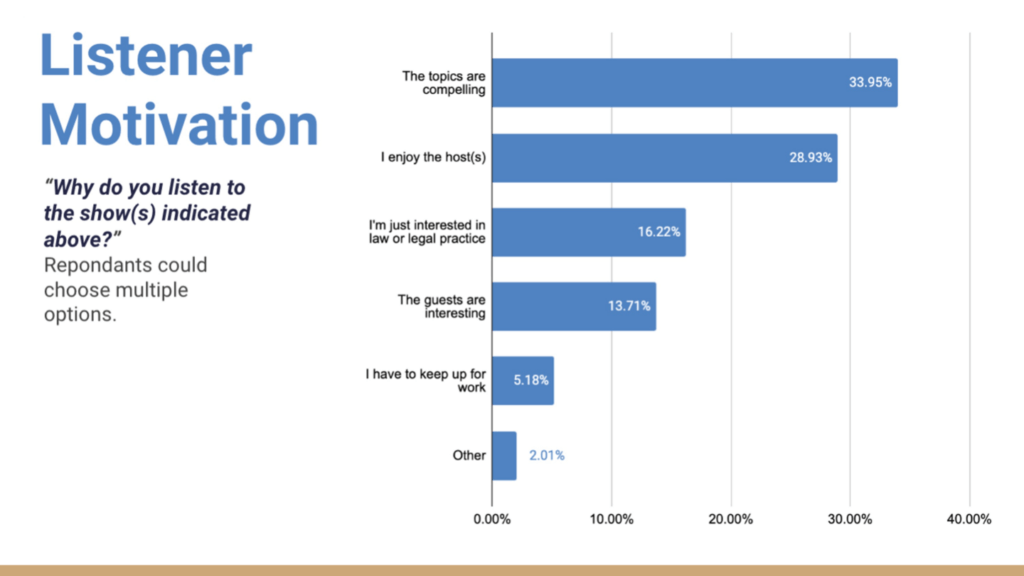
Motivation: Here’s what we found out about what attracted listeners to the shows on Legal Talk Network.
- Our recent listener survey showed that people tune in because the topics are interesting.
- They want you to curate the world through the filter you promised them
- They are out in the world, curious about something and your show may have a possible answer.
- This curiosity is the beginning of your relationship.
Do a few specific things to help them find you:
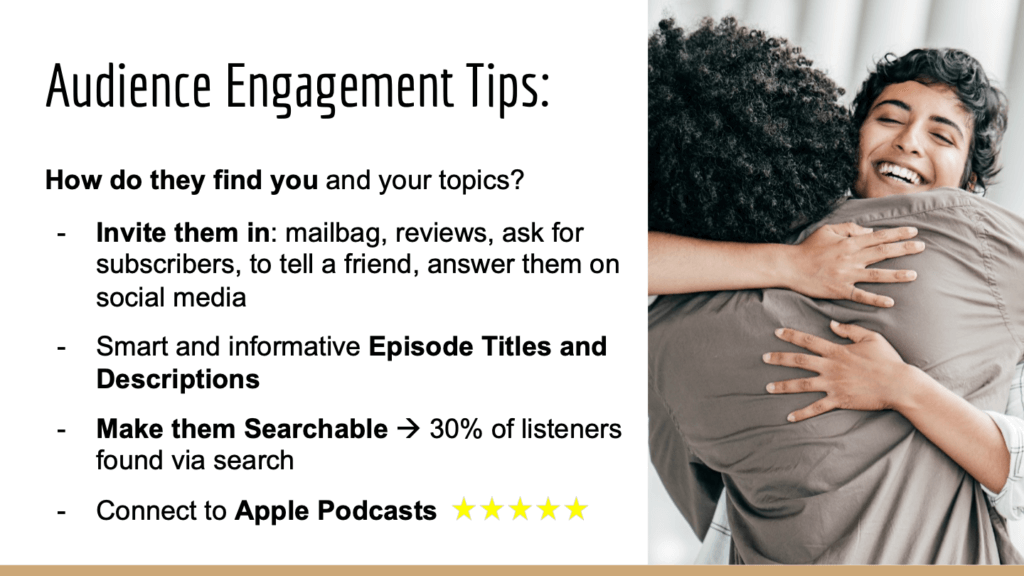
- Episode Titles: Be specific about what you’re going to cover. Guest name, and what you’re going to talk about. It’s ok to be a little long (not lawyer-long but…):
- Google Analytics for Your Law Firm…? (whatevs)
- Using Google Analytics to Help You Make Business Decisions (better)
- Searchable: Write your titles in an interesting and possibly provocative way. But:
- don’t be so cute the search engines can’t find your relevant episode and deliver your episode to someone interested.
- Write for both humans and search robots.
In the industry as a whole, 30% of listeners, according to Edison’s Infinite Dial, report finding their favorite shows on a search engine.
- For us, it’s 18% of listeners found us through search. We had another 18% who knew about us already so that’s the nature of a small industry – we’re all friends and forgot where we met.
- This is not a small suggestion. Hear me now and believe me on the next slide. Connect your show to Apple Podcasts so you’re findable in the legal space.
Even though Spotify says they’re the #1 podcast distributor, 90% of our legal audience comes through Apple.
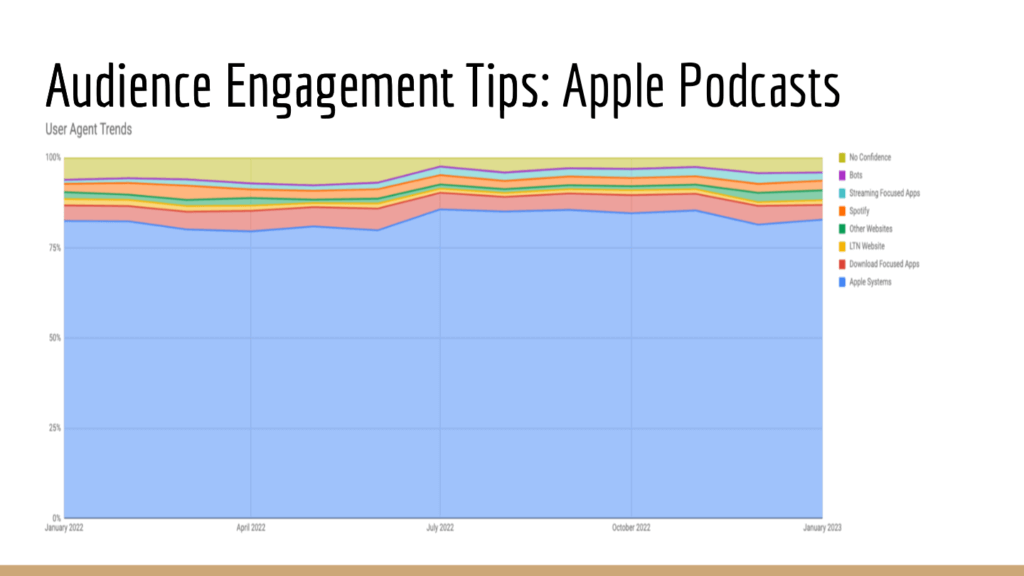
This is our chart over time user agents… the robots in your podcast player that ask for an episode. The user agents tell us where people come from.
The blue is Apple. There’s no second place. Legal industry seems to have a strong preference for Apple. Over 90% of OUR downloads come through Apple users. Take the time to work through the process to get your show on Apple Podcasts.
Listeners are motivated to listen ONCE because of the topic.
Then they STAY with a show because they like the hosts.
All three shows represented on this panel are ones that people tend to stay with – their subscriber to download ratio is high, implying these three have established a rapport with their audiences.
This chart about “What’s Important?” is really saying The audiences trust that time with these hosts will be spent in an entertaining way, as long as the hosts remember their promise and bring their personalities to the conversation.

Know your audience. Test your choices by asking “what you want your audience to come away with” from your show.
Big or small, understand that your audience won’t include “everyone.”
Podcasting is very niched. That’s exciting to me because of all the choices. Niche is great. It gives you the opportunity to be you and not have to please EVERYONE. You can get as deep and wonky as you want. As you’re developing your shows, think about who else wants to do that with you – and be consistent in what you deliver.
Think about it: How do inside jokes work? They are special BECAUSE they don’t translate to a wide audience.
I’ll give you a new idea to try. If you say “my audience is everyone,” you’ll please nobody in your effort to attract everyone. Podcasting, unless you’re Joe Rogan, isn’t about having the biggest audience, but in creating something interesting, well-formed, and valuable to a certain set of listeners.
In contrast, broadcast content has to please a lot of people, or rather, not antagonize audiences, so it ends up being mediocre. I am new to legal, but I’ve been in broadcast media in TV and radio for over 20 years. I was in for so long that they gave me a trophy. So you can imagine it broke my heart when I realized a few years ago that I didn’t listen to my radio any more. I didn’t watch network TV anymore. I’d seen everything they were putting out, and I wanted more interesting content.
Podcasts have a special kind of freedom that comes with not having to maintain (and appease) a massive audience. That allows us to go deep and narrow on a topic to pursue things that interest us, and get weird.
My fellow panelist Joe Patrice here has the biggest audience among our shows, and while he appeals very much to me, Thinking Like a Lawyer doesn’t appeal to everyone. Their tone is snarky, the vibe is distinctly ‘insider.’ There are sponsors I steer away from his very popular and fun show because that sponsor wouldn’t be consistent with the promise that show makes to its audience.
Don’t talk to everyone. Identify your listeners… talk to them about stuff you’re both interested in.

As much as we talk about niche and small audiences, there is desire for your content. You might recognize this, but lawyers are voracious learners. You are a hungry bunch. This is good. There is audience for you. The legal market is NOT saturated.
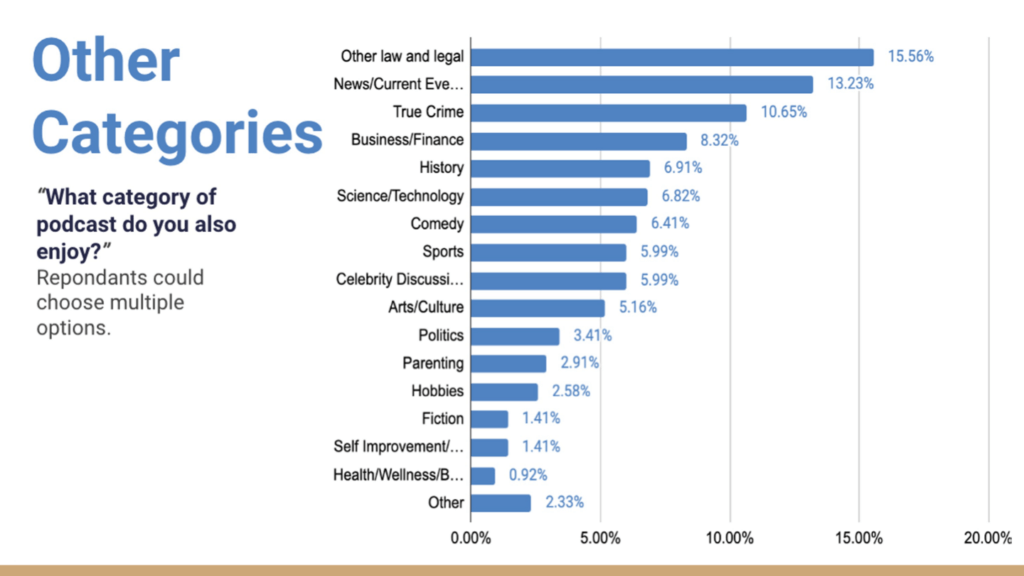
When we asked our listeners what else they listen to besides Legal Talk Network, I expected to see all the other genres that are popular in the consumer space like comedy or news, sports or politics.
Here’s where we embrace the niche… OUR listeners, made up of over 75% attorneys, practicing or otherwise, told us their #1 other interests is “Other Law and Legal.”
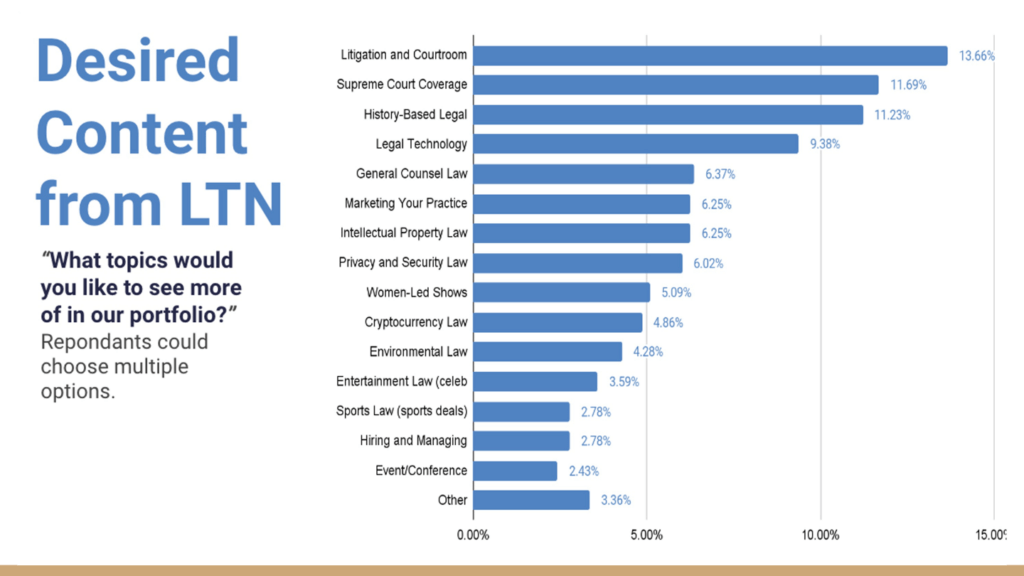
Hmmm? OK, so what kind of Other Law and Legal would you like specifically?
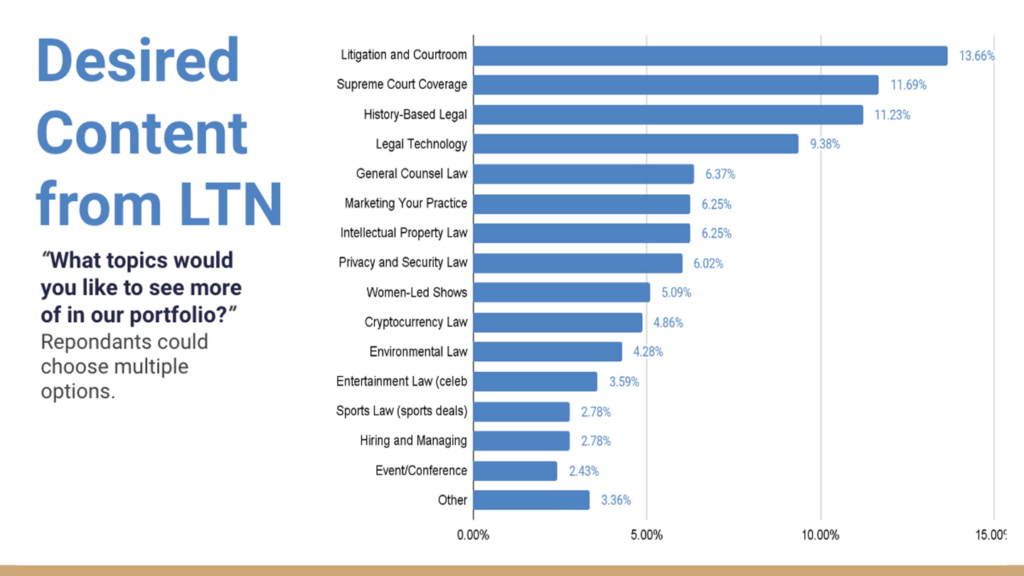
We dug in… 13% wanted Litigation and Courtroom, then Supreme Court Coverage, then History-based Legal, then Legal Technology…
This is a sushi menu of what to put together in your show. This is what your potential listeners are interested in. There is room in the podcast marketplace for you.
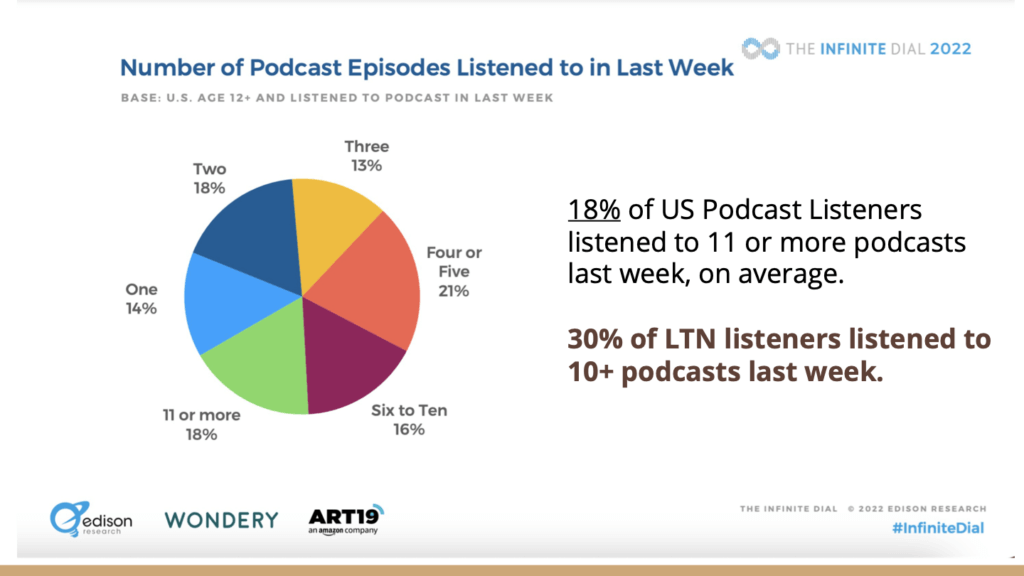
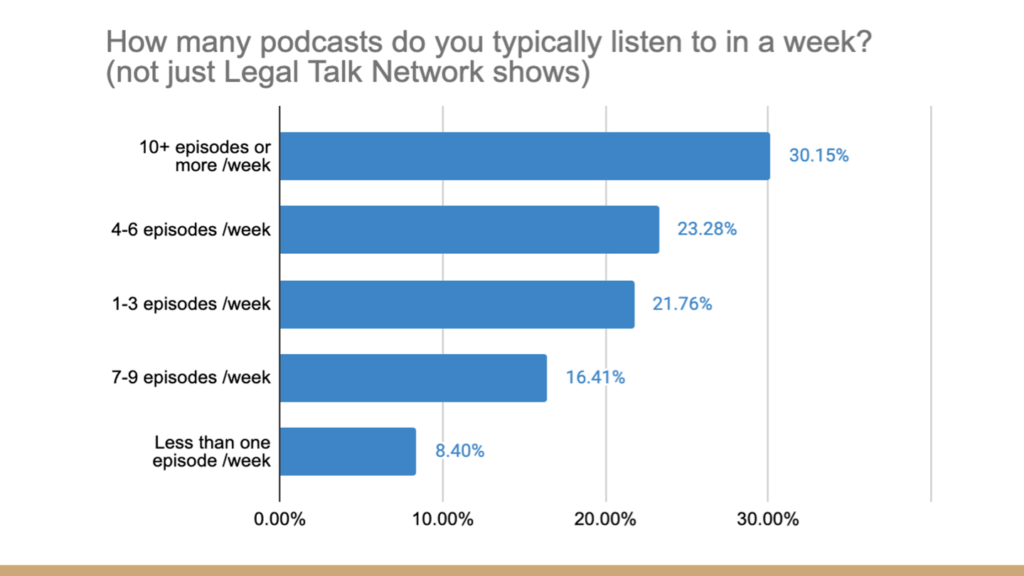
As listeners, the legal community somehow has capacity to take in a remarkable volume of content. When we asked how many podcast episodes our listeners consumed in a week… 30% listen to 10 or more episodes of SOMETHING per week. 30%.
Compare that to the consumer audience…
…only 18% listened to that many in a week. Amateurs.
Just a few more Don’ts…
Audio quality does matter. Like I said at the beginning, I get a lot of submissions from legal podcasters like you.
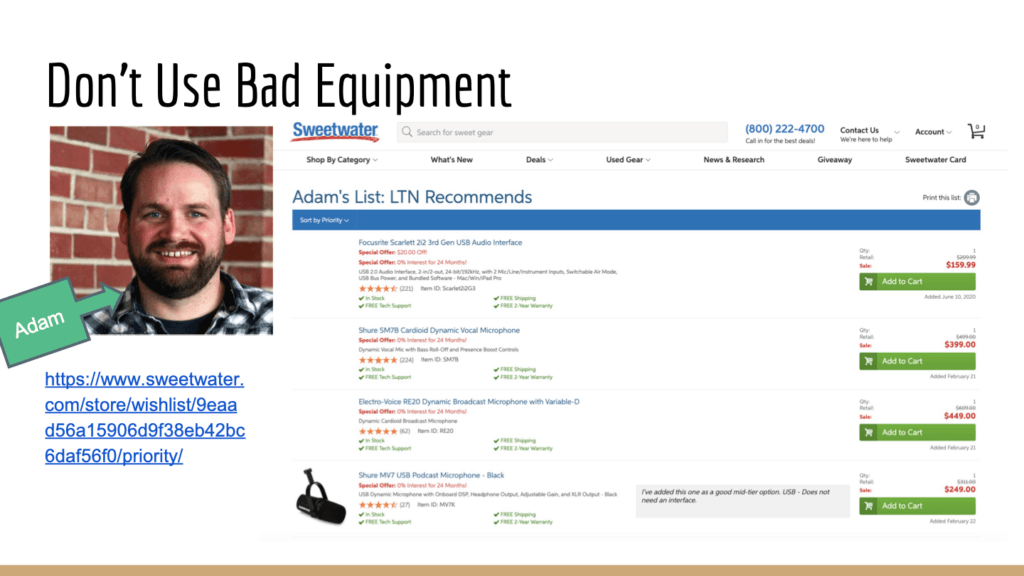
I know you would never do this, but if when I hear a host sound like he’s a mile away, or a washing machine in the background, or traffic noise, I’m hearing “this person isn’t serious.”
Simple equipment upgrades takes your podcast up to the next level. It won’t make your questions better, or think through your show outline, but it will help you cross a basic criteria.
Everyone asks… so here is Adam the Audio Engineer’s Shopping List.
Don’t Be a Stranger
Let’s chat!
Lisa Kirkman
Director of Partnerships
Legal Talk Network
lkirkman@legaltalknetwork.com