


The USPTO’s Trademark Trial and Appeal Board (“Board”) recently ordered the cancellation of two trademark registrations for product configurations of safety helmets, shown below and both directed to “… a three dimensional configuration of two ridges located along the center of a safety helmet….”
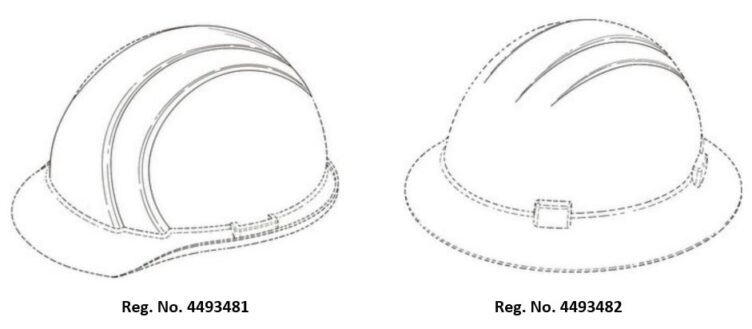
In its decision, the Board first dispensed with the Petitioner’s arguments that the registrations should be cancelled on the grounds that the product configuration marks at issue were functional. The Board was persuaded, however, by the Petitioner’s argument concerning a lack of evidence of acquired distinctiveness of these product configurations as source identifiers.
The Supreme Court of the United States has held that product designs themselves can never be inherently distinctive as indicators of source, and accordingly can only be properly registered as a mark upon a showing of acquired distinctiveness. For a product configuration to acquire distinctiveness, it must be proven to have gained a “secondary meaning” to relevant consumers, i.e., it must come to identify the source of the product configuration instead of the product configuration itself. While there is no bright-line rule for what constitutes “sufficient” evidence to demonstrate acquired distinctiveness in this context, it is generally much harder to establish for product configurations as compared to more traditional marks such as literal elements, logos, or even other non-traditional symbols such as packaging configurations.
Under the Federal Circuit’s precedent in Converse v. ITC, the following six factors are to be considered in determining whether a product design has acquired secondary meaning:
(1) association of the trade[mark] with a particular source by actual purchasers (typically measured by consumer surveys);
(2) length, degree, and exclusivity of use;
(3) amount and manner of advertising;
(4) amount of sales and number of customers;
(5) intentional copying; and
(6) unsolicited media coverage of the product embodying the mark.
In the present proceedings, the Board found that the Respondent had failed to rebut the Petitioner’s prima facie case that the registered marks lacked acquired distinctiveness due, in no small part, to discovery sanctions levied against the Respondent which resulted in adverse factual inferences that the Respondent had never advertised its products in a manner that specifically directed intended recipients to the dual ridge designs as source indicators.
The outcome of these cancellation proceedings demonstrates the importance of the manner of advertising, and specifically the use of targeted “look for” advertising, in establishing acquired distinctiveness for product configurations, which the Board characterized here as being “critical.” “Look for” advertising is advertising that specifically directs a potential consumer to look for a given feature of a product to confirm the source of that product, and it is characterized by the Board as being “particularly probative” of whether a product configuration or design identifies the product’s source. Accordingly, if you or your business are looking to protect the design or configuration of your products via trademark registrations, you would be well-served to create special promotional materials that instruct your potential customers to “look for” those design elements or configurations to identify your products.
The Quarles design rights legal team is nationally-recognized for its extensive knowledge and practice experience in this complex and important field. For questions about this article or on how to incorporate design-related legal rights into your intellectual property portfolio, please contact the author(s) of this post directly or send a message to the team via our Contact page.