

This week, the Federal Trade Commission (FTC) announced a Proposed Stipulated Order with lead generator Response Tree LLC and its president, resolving allegations that the company violated the Telemarketing Sales Rule (TSR) and Section 5 of the FTC Act. The complaint alleged that the company operated “consent farm” websites that misled consumers into providing their telephone numbers, falsified lead data, and obtained leads without requisite consent, resulting in unlawful prerecorded calls and calls made to telephone numbers on the Do Not Call Registry.
First, the complaint alleges that defendant’s websites duped consumers into providing their telephone numbers by misrepresenting that they were consenting to receive calls about home mortgage financing quotes. According to the complaint, the defendant sold the lead to partners who marketed products or services completely unrelated to home mortgages or lending.
Second, the complaint alleges that the defendant concealed key disclosures by presenting them in “small text that was barely legible to the naked eye and hiding these disclosures behind a hyperlink” and using disclosures that contained confusing and contradictory language. The complaint alleged that these websites used “dark patterns” to obscure or mislead consumers into providing their consent by concealing key disclosures in hyperlinks or using hard-to-read text. The complaint alleged the following disclosure was insufficient:
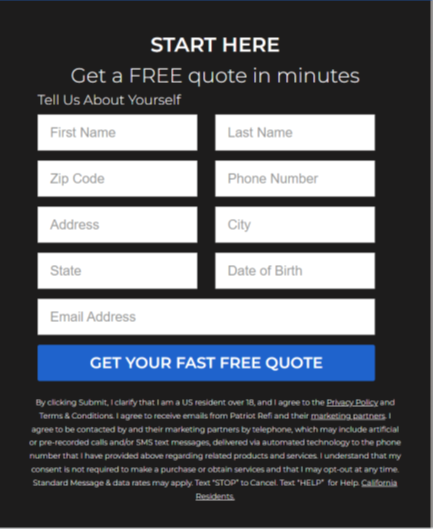
The language below “GET YOUR FAST FREE QUOTE” states: By clicking Submit, I clarify that I am a US resident over 18, and I agree to the Privacy Policy and Terms & Conditions. I agree to receive emails from Patriot Refi and their marketing partners. I agree to be contacted by [sic] and their marketing partners by telephone, which may include artificial or pre-recorded calls and/or SMS text messages, delivered via automated technology to the phone number that I have provided above regarding related products and services. I understand that my consent is not required to make a purchase or obtain services and that I may opt-out at any time. Standard Message & data rates may apply. Text “STOP” to Cancel. Text “HELP” for Help. California Residents.
The complaint alleged this disclosure was insufficient because the call to action stated, “GET YOUR FAST FREE QUOTE,” not “submit.” Furthermore, the embedded hyperlinks in the consent language “hid material terms” behind various hyperlinks, such as the Privacy Policy, which were lengthy and contradictory to the statements made on the website.
Third, the complaint alleged that the defendants sold falsified leads that they misrepresented as having been obtained through their consent farm websites, which had been obtained through other sources and falsified metadata to make it look like the consumer data was obtained through their websites.
Interestingly, the complaint alleges that consent obtained on Response Tree’s website would be invalid because the TSR requires that, before any outbound telephone call that delivers a prerecorded message is initiated, “the seller [must have] obtained from the recipient of the call an express agreement, in writing, that: . . . (iii) [e]vidences the willingness of the recipient of the call to receive calls that deliver prerecorded messages by or on behalf of a specific seller.”
The TSR defines “seller” as any person who, in connection with a telemarketing transaction, provides, offers to provide, or arranges for others to provide goods or services to the customer in exchange for consideration. Similarly, the TSR provides that outbound telephone calls may be made to telephone numbers registered with the National Do Not Call Registry when it can be demonstrated that “the seller has obtained the express agreement, in writing, of such a person to place calls to that person. Such agreement shall clearly evidence such person’s authorization that calls made by or on behalf of a specific party may be placed to that person.
The complaint alleges that Response Tree did not receive consent from consumers to deliver prerecorded messages “by or on behalf of a specific seller, and did not clearly evidence that “the seller obtained the express agreement” to place calls “by or on behalf a specific party” to consumers whose telephone numbers are registered with the National Do Not Call Registry, as required by the TSR.
Given the long lists of entities presented as marketing partners on their websites, defendants purport they obtained consent on behalf of numerous and various entities, not a specific seller or party. Further, the complaint alleges that Response Tree, a lead generator, is not a “seller” or legal agents of a “seller,” as defined by the TSR, and therefore the website forms cannot satisfy the TSR’s requirements.
The settlement sets forth a $7 million suspended penalty. It also bans the defendants from initiating, or assisting others in initiating, any prerecorded calls or calls made to numbers on the DNC registry. It also prohibits the defendants from collecting any consumer’s information, or selling, transferring, or otherwise disclosing consumer information in connection with lead generation.
The government’s position mirrors the Federal Communication Commission’s new rule “closing the lead generator loophole,” in which the FCC has stated that consent must be given directly to a specific seller. The case against Response Tree demonstrates the government’s position that lead generators might not constitute “sellers” under the TSR, raising fundamental questions about the ability of lead generators to both collect consent and contact consumers on behalf of third parties.
Interested in learning more? Schedule a meeting with Venable attorneys at Affiliate Summit West on January 15-17. We look forward to connecting with you!