

On September 5, 2024, the U.S Food and Drug Administration (“FDA”) and Centers for Diseases Control and Prevention (“CDC”) released data from the 2024 National Youth Tobacco Survey (“NYTS”), which shows the most remarkable decline in youth vaping to date. Specifically, the most recent NYTS, an annual, cross-sectional, web-based survey of U.S. middle school (grades 6-8) and high school (grades 9-12) students, indicates that the number of middle school (“MS”) and high school (“HS”) students reporting use of e-cigarettes or electronic nicotine delivery systems (“ENDS”) has declined to the lowest level in a decade. The 2024 NYTS was conducted among 29,861 HS and MS students from 283 schools between January 22 and May 22, 2024.
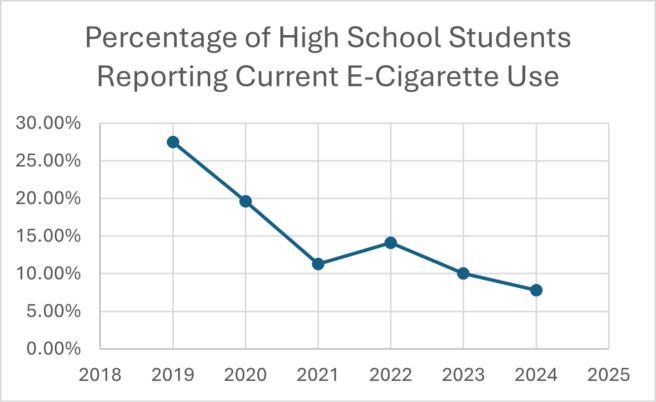
| NYTS Survey (Year) | Percentage of High School Students Reporting Current E-Cigarette Use | Estimated Weighted Number of High School Students Reporting Current E-Cigarette Use (Million) |
| 2024 | 7.8% | 1.21 |
| 2023 | 10.0% | 1.56 |
| 2022 | 14.1% | 2.14 |
| 2021 | 11.3% | 1.72 |
| 2020 | 19.6% | 3.02 |
| 2019 | 27.5% | 4.11 |
- The recent NYTS data show that the number of middle and high school students reporting current use of e-cigarettes in 2024 (1.63 million) constitutes only a fraction of the 2019 numbers (over 5 million – a large portion of which has been attributed to the rise of JUUL’s popularity at the time). See JUUL’s statement on the 2024 NYTS results here.
- This trend has not slowed down in the past year, as the 2024 NYTS continues to demonstrate a downward trajectory for e-cigarettes. Significantly fewer middle school and high school students reported current e-cigarette use – from 2.13 million (7.7%) in 2023 to 1.63 million (5.9%) in 2024.
- It is important to note that “current use” is defined by the NYTS to mean use on ≥1 day during the previous 30 days. In other words, a HS or MS student who vapes only once in the past month would be defined as a current user, regardless of their actual use or intention to use (or not use) the ENDS product in the future. Significantly, these numbers do not reflect daily use (i.e., use during all of the previous 30 days) or frequent use (as use on ≥20 days during the previous 30 days). In the NYTS publication, the authors include a disclaimer that these frequency of use estimates are not mutually exclusive. It is reasonable to assume that daily or frequent use would be a fraction of these “current use” numbers.
- All in all, the data point to a continuing decline in youth use of the ENDS product category, given that half a million fewer youth are using e-cigarettes compared to last year’s data. FDA Center for Tobacco Products (“CTP”) Director Dr. Brian King described the “continued decline in e-cigarette use among our nation’s youth” as a “monumental public health win,” with an acknowledgment of the progress that has been made over the past half decade.
- Youth use of oral nicotine pouches was also highlighted in FDA’s press release, in which the Agency acknowledged that the numbers remained steady and low, with 1.5% of HS and MS students reporting current nicotine pouch use in 2023 and 1.8% in 2024. While the numbers are low, this comes with a caution that nearly half a million middle and high school students have still reported current nicotine pouch use. In fact, CDC makes it a point to state that, “[y]outh use of tobacco products in any form—including e-cigarettes and nicotine pouches—is unsafe,” quoting Deirdre Lawrence Kittner, Ph.D., M.P.H., director of CDC’s Office on Smoking and Health. This appears to be the first FDA NYTS news release that focuses its discussion of both e-cigarettes and nicotine pouches together as youth appealing tobacco products. In addition, FDA’s statement includes both a sub-title specifically addressing nicotine pouch results, as well as a dedicated paragraph on oral nicotine pouch numbers and brands used. Indeed, even the 2024 NYTS publication includes nicotine pouches in the publication title (“Notes from the Field: E-Cigarette and Nicotine Pouch Use Among Middle and High School Students — United States, 2024”).[1] All these factors suggest that pouches are top-of-mind for FDA when it comes to youth use.
We will discuss the potential impact of these data and enforcement trends and more at Keller and Heckman’s 2025 Annual E-Vapor and Tobacco Law Symposium on January 27-28, 2025, in Las Vegas, Nevada. Details and registration information can be found here.
[1] Park-Lee E, Jamal A, Cowan H, et al. Notes from the Field: E-Cigarette and Nicotine Pouch Use Among Middle and High School Students — United States, 2024. MMWR Morb Mortal Wkly Rep 2024;73:774–778. DOI: http://dx.doi.org/10.15585/mmwr.mm7335a3.