The outlook for federal antitrust enforcement remains murky, at best, with uncertainty about whether the new federal HSR rules, merger guidelines, and existing enforcement actions.
The forecast for state antitrust enforcement, however, is much clearer, particularly with respect to the healthcare industry.
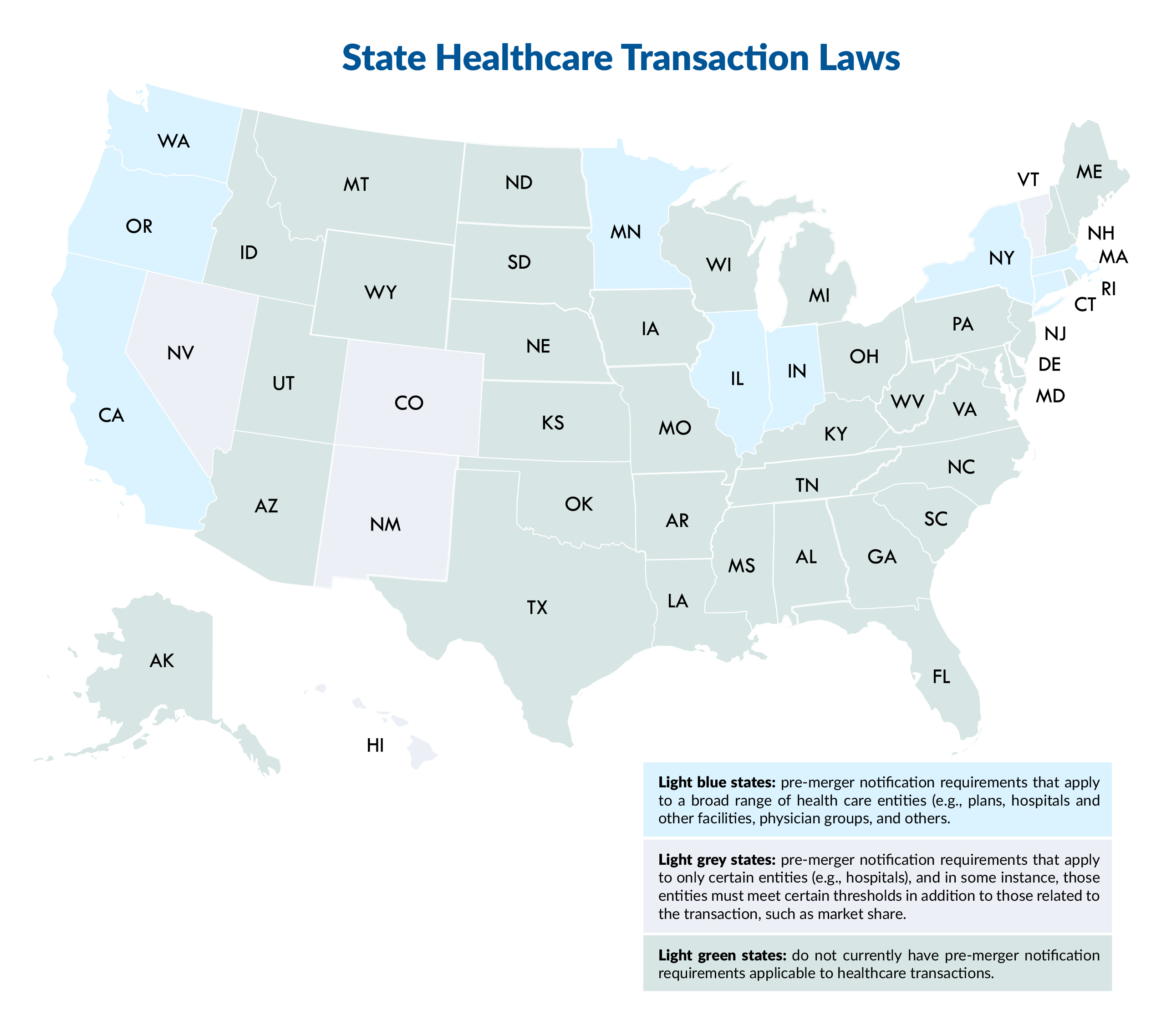
State antitrust enforcers have taken a more active role in recent years, less willing to sit back while the Federal Trade Commission (FTC) or the Antitrust Division of the Department of Justice (DOJ) takes the lead in investigating potential anticompetitive conduct or corporate consolidations whose effects will be felt at the state level. Given the local nature of healthcare delivery and the sector’s importance to the well-being of a state’s citizens, it is no surprise that the healthcare industry has been a particular focus of state antitrust enforcement efforts. For example, in the past few years, several states have passed laws establishing state-level transaction notification regimes – often specifically targeting healthcare transactions – based on the federal HSR Act. These notification regimes, often referred to as “Baby HSRs” or “Mini HSRs”, can impose burdens on parties to transactions that otherwise fall below HSR Act reporting thresholds or involve transactions that have limited direct connections to the state. Moreover, these state-level reporting regimes often impose different requirements on transacting parties – some more onerous – than the HSR Act itself.
Unlike the HSR Act, these state-level regimes sometimes impose additional burdens and a higher level of scrutiny when one of the transacting parties is a private equity sponsor or is private equity backed. The rationale usually given for this private equity focus is that states are suspicious of private equity’s involvement with healthcare delivery – i.e., the profit motive will lessen the quality of the care delivered. These concerns about the profit motive lessening quality of care are also reflected in the states that have or are considering legislation to curb the friendly PC model.
The rise of state antitrust enforcement regimes in the healthcare industry is not new, with states implementing or considering new laws and regulations requiring additional approvals for healthcare transactions.
These emerging state-level reporting regimes are tracked in our interactive map available here, which identifies states with reporting regimes and provide a high-level indication of the types of requirements that may be imposed on healthcare transactions captured by the regimes. We encourage you to bookmark the page as we will continue to update the matrix as more states adopt reporting regimes or pass new laws to expand existing ones.