


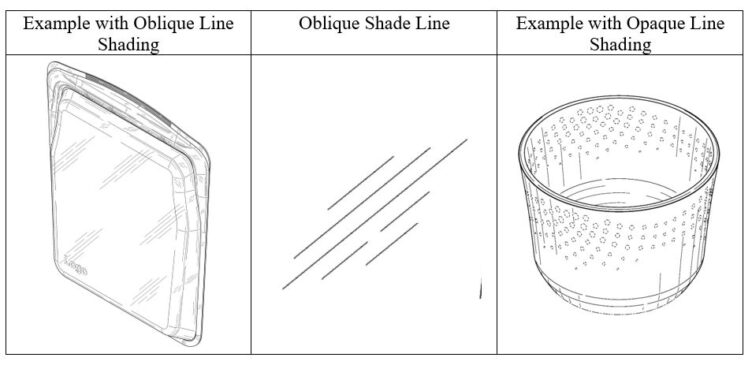
Design patents in the U.S. typically include two types of shading. The first and most common type of shading used in U.S. design patents is opaque shading, which illustrates a non-transparent or non-translucent surface of an article of manufacture. The second type of shading used in U.S. design patents is oblique shading, which illustrates a transparent or translucent surface of an article of manufacture. Specifically, MPEP § 1503.02(II) states that “[o]blique line shading must be used to show transparent, translucent and highly polished or reflective surfaces, such as a mirror.” Therefore, if the article of manufacture is intended to have some level of transparency or translucency, the USPTO requires that oblique shading be used.
When preparing design figures that are transparent or translucent, it is important to consider how the figures will be shown in the design application. In particular, the design can be drawn as see-through or the design can be drawn as non-see-through, i.e., drawn without lines shown that would be visible through a surface. Both images in the table directly below illustrate the same container but with two different drawing styles.
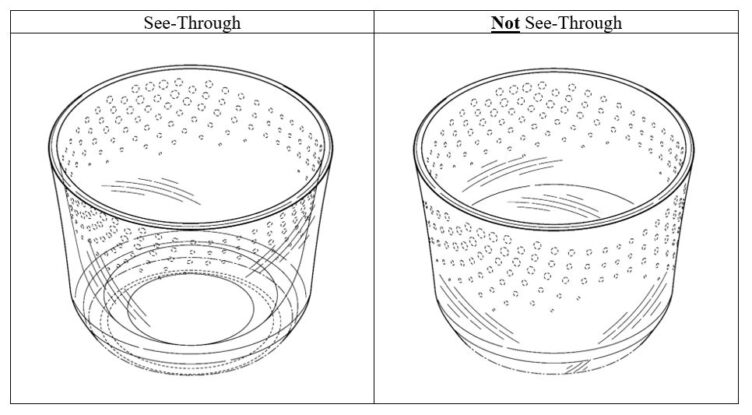
See-through drawn designs can provide further clarity regarding the overall appearance of the underlying article of manufacture and what is inside of the transparent/translucent surface. See-through drawn designs can also make it clear that the design is transparent. Thus, if the interior of the design or the area behind the transparent or translucent surface is important for protection, it may make sense to file the drawings as see-through drawings.
While see-through drawn designs can be beneficial in some cases, see-through drawn designs can also add a lot of complexity and “noise” to the drawings, which can lead to more problems during prosecution. For example, all lines within the transparent portions need to be shown correctly and consistently throughout the figures. Further, see-through drawn designs may end up having too many lines that limit the clarity of the drawings.
Due to the limited case law in the U.S. regarding transparency and translucency in design patents, it may make sense to file transparent or translucent designs as non-see-through (drawn as opaque) with oblique shade lines along the surface(s), unless the features behind the transparent/translucent surface(s) is/are important to the design. It can also be beneficial to include an embodiment within an appendix (or other part of the application) that illustrates the transparency/translucency of the product. This additional embodiment can include the article of manufacture drawn as see-through, photos of the physical product, or color or greyscale computer images of the article of manufacture illustrating the translucency or transparency. The additional embodiment can be used as a backstop in case any issues arise during prosecution.
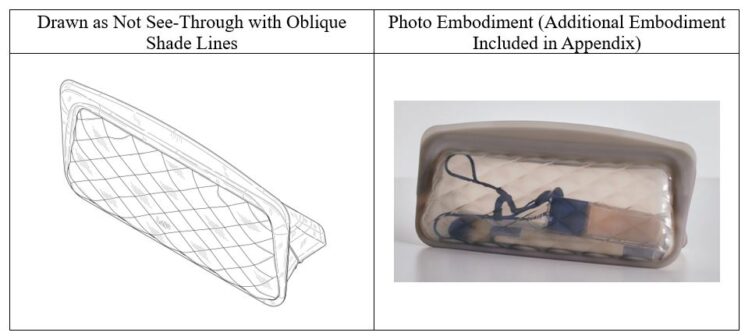
It is very important for Applicants and patent practitioners to accurately depict the physical product in design applications. Therefore, Applicants and patent practitioners should be thoughtful when preparing design patent applications for an article of manufacture that is transparent or translucent.
The Quarles design rights legal team is nationally recognized for its extensive knowledge and practice experience in this complex and important field. For questions about this article or how to incorporate design-related legal rights into your intellectual property portfolio, please contact the author(s) of this post directly or send a message to the team via our Contact page. To subscribe to our mailing list and receive updates that highlight issues currently affect the design rights legal field, click here.