

Nearly every profession has been disrupted by the ability to “Google” the answer to a question. How do I fix a faucet leak? Google a how-to video instead of calling the plumber. How can I stop my knee from hurting? Ask Google instead of your doctor. The same scenario happens in law, any lawyer will tell you. And now with generative artificial intelligence widely available, the online answer can be much more comprehensive than a traditional Google search was only a couple years ago. AI can draft entire contracts. But are such AI-drafted contracts any good?
Here is an example in agricultural law. I recently asked Chat GPT: “Draft a lease for 80 acres of farmland in Marion County, Indiana at $250/acre for 1 year.”
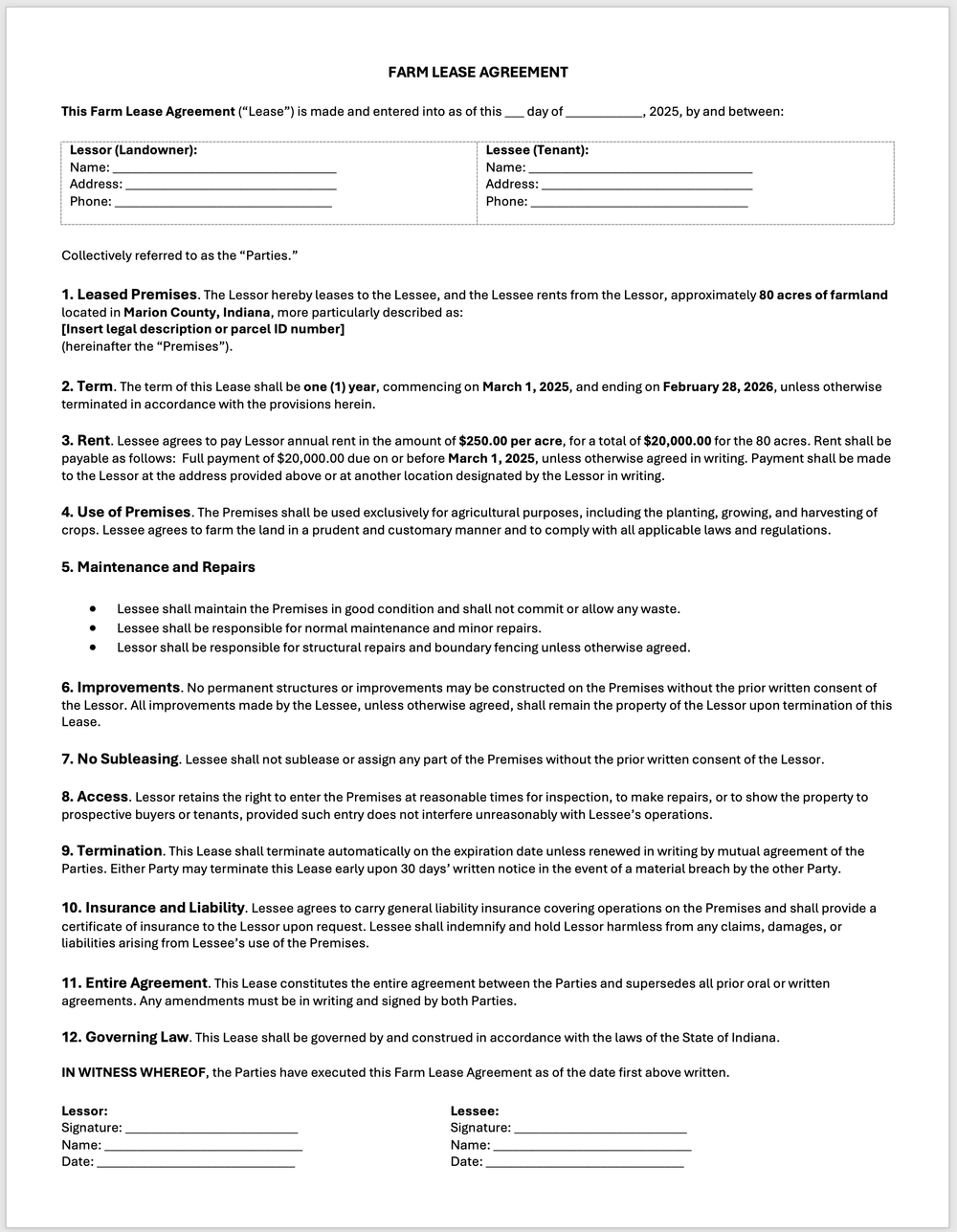
Chat GPT responded with 12 paragraph Farm Lease Agreement, which I have included below. The lease included the basic provisions, such as a description of the land, the term, rent provisions, insurance requirements, and some boilerplate provisions, such as integration clause and governing law. Most of these provisions are straightforward and easy to understand.
Admittedly, this was a relatively easy legal task for an AI tool because so many examples of farm leases exist for free on the web. Chat GPT pulled the data to generate the lease from Purdue University Extension (which publishes draft leases), as well as other land grant university websites, such as Illinois, Iowa State, and Kansas State. These are all good, reliable sources for training data.
Still, there were some misses in the lease. Chat GPT assumed that a farmland lease also included a structure of some sort, and therefore included provisions requiring the tenant (lessee) to perform “normal maintenance and minor repairs,” leaving the landlord (lessor) to perform “structural repairs.” Of course, this makes no sense for unimproved farmland.
Similarly, the document allows either party terminate the lease early “upon 30 days’ written notice” in the event of a material breach by the other party. Landlords typically cannot terminate a farmland lease early due to the presence of growing crops, which are owned by the tenant under Indiana law.
Overall, I would give the AI-drafted lease a “B” grade. Answering the question posed by this post, I would agree that this lease is better than having no written lease at all. But this lease is even more useful as a starting point, providing a list of discussion items for a landlord and tenant prior to entering a leasing arrangement. If you are considering using AI as contract drafting tool, make sure to spend some time going through the provisions with the other party. And of course, having a lawyer review your contract prior to signing is nearly always money well spent.