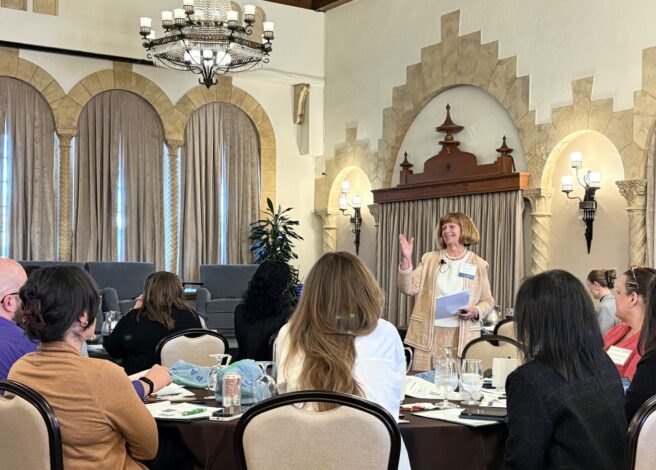
I do a fair amount of public speaking. So, when my Dean, Danielle Conway, asked our faculty at Penn State Dickinson Law to consider volunteering for an upcoming PACLE conference on “Strategies for Impactful Continuing Legal Education,” I thought, “well, this should be educational for me as a perpetual student.”
An important part of the October conference for me was a terrific panel of thoughtful and caring professionals speaking about “Attorney Well Being,” including Laurie Besden, Executive Director for Lawyers Concerned with Lawyers in Pennsylvania; Patrick Krill, involved in ground breaking studies of lawyers who need and seek assistance, Brian Quinn, Education and Outreach Coordinator for Lawyers Concerned with Lawyers, and Lauren Chavey, the Communications Director for the Pennsylvania Disciplinary Board for the legal profession. Plus, the closing speaker, PACLE Board Chair and Villanova Law Professor Tuan Samahon provided homework and inspiration with his closing remarks.
As it turned out, I ended up having a major speaking role, which of course meant I had to think — and rethink — about what works and what doesn’t in programs I’ve attended, whether as a speaker or member of the audience.
In doing my planning, I put a lot of time into conversation and listening with people who have great reputations as engaging speakers under a wide range of circumstances. I decided to go back to a topic I’ve used a couple times in the past, what I call “The Tale of an Irish Family Pub.” But this time, rather than simply tell the story of how a family was torn apart by a flawed legal plan, I recast the tale as an opportunity to look for larger lessons.
I used as back up materials an article I published in 2010 for a symposium issue of Stetson Law Review. See The Lesson of the Irish Family Pub: The Elder Law Clinic Path to a More Thoughtful Practice. There, I contrasted events illustrated by news stories and published cases detailing what happened in the Irish Family Pub, with my experiences in creating and supervising an Elder Protection Clinic at our law school.
For this month’s uber CLE program, I decided to organize my lessons with the help of 6 framing questions:
- What is the Mission of Continuing Education?
- What Works — What Doesn’t?
- Is there Power in Narrative “Stories”?
- Does Technology work “For or Against” Continuing Education?
- What Delivery Platforms work Best?
- What is our (Unacknowledged) Audience?
There is a payoff at the end of the Irish Family Pub story that definitely suggests that narrative stories can work, even in a large audience in a large room and especially if the speaker is willing to multi-task by walking the room and conversing with the audience. As one attendee said, “I recognized in my own family what could happen.” As another person said, “I was so caught up in the story I confess I had tears in my eyes, forgetting this was just CLE.”
Best of all for me, I was able to reconnect with several of my formal students from Dickinson, including June Hahm, who is manager for legal training and development for one of the largest law firms in the country, and Ana Paulina Gomez, who is Chief Counsel for “Pennie,” the Pennsylvania Health Insurance Exchange, and who serves as a member of the Board for PACLE. My thanks to all of you, including the important person who kept me on the path to an organized presentation, Katie Buggy, Associate Administrator for PACLE. Plus, photo credit and thanks to Jessica Seretti, Penn Dickinson Law Director of Alumni Relations.