

I grew up in a religious community where a small but vocal chorus saw every major headline as a potential verse in an already-written script. The Soviet nuclear threat was not just geopolitical. Mikhail Gorbachev had a birthmark on his forehead, and certain members of that community said it with the quiet certainty of someone who had done the math: that was the mark of the beast, and we were watching the Books of Daniel and Revelation unfold on the evening news. Then came the ozone layer. Then Y2K. Then the financial crisis. Each one arrived with its own prophets and its own conviction that this time the math was finally right.
The current version of that feeling is secular. But the structure is identical.
None of this is happening in a vacuum. There are real wars being fought, real instability in the global economy, and a general atmosphere that does not make it easy to be measured about any new threat, real or projected.
A few years ago, the consensus view was that we would all be driving electric vehicles within a decade, and that hydrogen fuel cell technology was right behind it. Battery range anxiety would be solved. The internal combustion engine was finished. Gas stations would become relics. Some of that has come to pass, partially in some markets, for some buyers. Most of it has not, and the timeline projections have been quietly revised several times over. Before that it was the paperless office, which was going to eliminate physical documents by the mid-1990s. Before that, videoconferencing was going to end business travel. The pattern is consistent: a genuine technological capability arrives, projections run well ahead of what the real world will tolerate, and the technology eventually settles into something more partial and more uneven than the original forecast suggested.
The warning now sounds something like: artificial intelligence is coming for your job, your profession, your economic future. Every month brings a new data point recruited into the narrative. A soft jobs report. A round of tech layoffs. A law firm that replaced a paralegal team with a software subscription. The pieces are real. The picture being assembled from them is distorted.
I wrote this piece to push back on some of that distortion. Not to dismiss the concern, which is grounded in something genuine, but to slow the conversation down long enough to look at what the numbers actually say. The threat is real. But it is not what the warning labels say it is. The displacement is happening, and it is not happening at the speed or scale that most of the coverage suggests. And the things that make human judgment and relationships valuable in professional life are not going away because a language model can now draft a first pass at a contract.
We are not on the verge of economic annihilation. We are in the early stages of a long transition that will, over years and in uneven ways, reshape what organizations pay people to do. That distinction matters, both for how individuals think about their careers and for how organizations plan their workforces. Getting it wrong in either direction is expensive.
The Jobs Report Is Not Telling You What You Think It Is
The February 2026 BLS report came in at roughly 92,000 jobs lost, well below expectations. Within hours, the interpretation machine had done its work: AI is finally coming for the middle class. The narrative stitched together tech layoffs, a few automation announcements, and the jobs number into something that felt like a trend.
It was not, particularly.
Construction lost jobs. Retail lost jobs. Manufacturing contracted. These are sectors with genuine exposure to interest rates, consumer demand, and global supply dynamics. They are not sectors that woke up in February 2026 and decided generative AI had finally made their workers redundant. The cooling labor market has more to do with the business cycle than with Claude or Copilot or whatever tool your associates are using when they think no one is watching.
Goldman Sachs estimates that AI is displacing jobs at the rate of thousands per month in the United States. That is a real number. It is also a small fraction of normal labor market churn in an economy that generates tens of millions of gross new jobs annually. If every AI system in production vanished tonight, we would still be looking at a soft jobs market. AI is a contributor. It is not the primary story.
This matters because the misread is expensive. Organizations that respond to a macro slowdown as if it were an AI-driven structural shift will make different decisions than organizations that understand both forces are present and need to be addressed differently. Panic is not a workforce strategy. It is just a faster way to make expensive mistakes.
Tasks and Jobs Are Not the Same Thing
The more useful way to think about AI and labor is to separate tasks from jobs. Most of the coverage conflates them, which is how we end up with projections that are technically accurate and practically misleading.
At the task level, change is already moving quickly. Routine writing, data processing, customer triage, scheduling, first-pass document review: all of these are being partially or substantially automated in current corporate deployments. If you manage a team that does significant volumes of any of those things, your headcount math will look different in three years.
At the job level, the story is slower, and the numbers are worth sitting with for a moment. Goldman Sachs research puts roughly 2.5 percent of U.S. jobs directly at risk from AI-related efficiency gains today, rising to perhaps 6 to 7 percent over a longer horizon. Bureau of Labor Statistics projections through 2033 embed AI exposure and show that highly affected roles, customer service representatives, medical transcriptionists, are expected to shrink by about 4 to 5 percent over the decade. Total U.S. employment, by those same projections, is expected to grow by about 4 percent. Those are not the numbers of an economy being hollowed out. They are the numbers of an economy in transition.
That is not nothing. Entry-level knowledge workers and back-office staff in roles that are primarily patterned over digital inputs should take this seriously. But it is not the apocalypse. It is a transition that plays out over years, not quarters.
AI doesn’t replace whole jobs first. It replaces pieces of them. The gap between those two timelines is where most of the real workforce planning work lives.
Where De-Humanization Is Already Happening
The jobs that are actually disappearing tend to share a few characteristics: high volumes of digital, repeatable work, real cost pressure, and enough data infrastructure to run the tools without a two-year implementation project. If your industry checks those boxes, the change is not coming. It is already underway.
Finance has been automating back-office processing for years. Generative AI has extended that into memo drafting and issue-spotting, the kind of preparatory work that used to sit on a junior analyst’s desk at eleven at night. Contact centers in banking and telecom have handed substantial portions of routine customer interactions to AI agents. Healthcare administration is processing prior authorizations and reading routine imaging without a human touching the file. And in legal practice, which has been my primary focus, increased use of AI in research and document review continues at a rapid pace. Client counseling, negotiation, and anything that happens in a courtroom remain stubbornly human, for now, and I think for longer than most of the forecasts suggest.
The rough dividing line: if your job is mostly pattern-matching over data, you are exposed. If it requires judgment, political instinct, or accountability that cannot be handed off to a system, you have more runway than the headlines imply.
The problem is that a lot of people do not know which category their job falls into. Neither do many of their managers.
The Limits of the Technology
There is a tendency to treat AI limitations as temporary. The assumption is that the current weaknesses, hallucination, context failure, judgment gaps, are software problems the next release will solve. Some of them may improve. Others are architectural. They are not resolved by more compute or better training data.
State-of-the-art systems still fabricate plausible-sounding facts with enough confidence to fool a tired associate on a Thursday night. This is not a marginal edge case. It is a documented, persistent failure mode that has produced real professional sanctions in legal proceedings and real errors in medical contexts. The courts and ethics bodies that have addressed this have not suggested the solution is a better model. They have said the professional remains responsible, period, regardless of the tool.
I recently ran a research question through one of the leading language models, the kind of question I might hand to a junior associate. The answer came back in under thirty seconds, clearly written, well-organized, and wrong in two places that mattered. Not wrong in an obvious way. Wrong in the way that gets through a tired review. The tool was impressive. The judgment still had to be human. It always does, and that is not a temporary condition.
For the record, AI may be a highly accurate tool for reading a CT scan or an MRI. I don’t doubt the studies. But I am not having anything removed from my body until a human being has looked at the same images and agrees with the diagnosis. That instinct, I suspect, is widely shared. It is also not irrational.
I see a version of this in my own practice. More and more clients arrive having already consulted an AI before picking up the phone. In almost every case, the AI has given them something incomplete, misleading, or outright wrong, and usually not because the technology failed in some dramatic way. It failed because of how the question was framed. As I have written elsewhere on this subject, AI works best when you already know roughly what you are looking for and have some sense of what a reasonable answer looks like. That is a description of an experienced professional using a tool. It is not a description of a non-lawyer trying to understand whether they have a claim.
Context and institutional memory remain genuinely hard problems. A model can summarize a contract. It cannot tell you that this client will never accept that term regardless of how rational it looks on paper, because of something that happened three years ago in a deal that went badly. It does not know the history, the politics of the board, or the preferences of the regulator who handled the last examination. Anyone who has spent time advising clients knows that the last five percent of any problem is usually the part that actually matters. That five percent is still human work.
The Limits of Automation
There are also accountability constraints that are structural, not technical. Decisions about who gets a loan, who is denied coverage, whether to settle a matter: these carry legal and reputational risks. Current frameworks push that ownership to humans and organizations, not to systems. In practice, the question clients ask is simpler: who is responsible if this goes wrong? The answer is not the algorithm. It is the firm that chose to rely on it. Full automation of high-stakes decisions is not just imprudent in most regulated contexts. It is legally dangerous in ways that better software does not fix.
The Pushback Is Already Starting
Public attitudes toward AI in the workplace are more complicated than the technology press usually acknowledges. A 2025 Pew survey found that roughly 52 percent of U.S. workers were worried about how their employers planned to use AI. Only 36 percent described themselves as hopeful. The workforce has not embraced this transition.
More interesting is the pattern emerging in consumer-facing contexts. There are industries where AI deployment has moved faster than customer tolerance. Organizations that stripped human agents out of their contact center operations and replaced them with chatbots have, in a number of documented cases, experienced customer attrition and reputational damage when the AI could not handle anything outside the standard scenario. Some of those organizations have added human agents back. That is not a widespread reversal. But it is a signal.
The assumption that customers and clients will simply accept whatever experience the tool delivers, because it is efficient, is not supported by the evidence. There are contexts where the market is telling organizations that human contact is not overhead to be eliminated. It is part of what they are paying for.
The legal profession offers a narrow but useful illustration. Clients in high-stakes matters do not want to know that their representation was primarily AI-generated and lightly supervised. They want to know a senior professional read it and owns it. That preference is not irrational. It reflects a reasonable assessment of where error risk lives and who bears the consequences when something goes wrong.
I’ll offer a more personal example. I have spent a lifetime writing songs, with a large pile of unfinished recordings that never quite made it out of the drawer. I have been using AI to produce demos of them, and in some cases the quality is remarkable enough that the AI versions genuinely convey the meaning and emotion I was reaching for, something like the way 1980s synthesizers became a legitimate vehicle for a generation’s inner life rather than a pale substitute for real instruments. And yet. I have not met anyone, not one person, who thinks the gap between human musical expression and its AI imitation has closed. It has narrowed. The gap is still there. I suspect (and hope that) it always will be.
The Fear Is About Distribution, Not Totals
The macro projections do not actually support the narrative of a coming jobless future. The best current models cluster around a world where AI automates roughly a quarter of work hours but eliminates somewhere in the range of 6 to 7 percent of jobs outright, with most roles being reconfigured rather than eliminated. On a long enough timeline, AI-enabled growth is projected to generate job creation that more than offsets displacement, net.
The honest version of that story is that the gains are distributed very unevenly. Young workers entering AI-exposed fields, back-office staff in sectors with low retraining margins, people in knowledge work roles that look white-collar but are functionally patterned: these groups face real pressure in the near term. The new jobs AI is projected to create are not in the same places, do not pay the same way, and require skills the displaced workers do not currently have.
When a logistics worker in a mid-sized city loses a job to automation and the projected replacement is an AI infrastructure engineer in a data center suburb, the macro headline about net job growth is accurate and essentially useless to the person in the first category. The fear driving the public polling numbers is not innumerate. It is a recognition that aggregate outcomes and individual outcomes are different things, and that the gap between them can be very long and very painful.
Policymakers and organizations that treat the net projections as a complete answer to that concern are going to be wrong in ways that matter.
What Actually Happens Next
In the near term, three to five years, I would expect three things. Uneven pain in AI-exposed roles, concentrated among workers who have the least margin to retrain or absorb a disruption. A productivity dip in many organizations as adoption runs into integration costs and the very human friction of changing how work gets done. And governance drag in regulated industries, where compliance and legal constraints will keep humans meaningfully in the loop for longer than the technology alone would require. That last one is not necessarily a problem. It may be the right outcome.
Longer out, ten to twenty years, the labor market looks different but not empty. More demand for people who can supervise and interrogate AI systems. More premium on the skills the technology is genuinely bad at. More pressure on roles valued primarily for doing work AI can now do cheaper. The jobs that get created in that world are not the ones being eliminated today, which is the part of the projection that does not fit on a headline.
The transition is the hard part. Not the endpoint. The organizations that navigate it well will be the ones that treated AI as a capital investment requiring real change management, not the ones that announced an AI strategy in a press release and called it done.
The Actual Threat, Which Is Not the One Being Advertised
Return to that small but vocal chorus. Each warning they issued reflected a genuine anxiety about a real phenomenon. The Cold War was dangerous. Environmental degradation was real. Financial systems do fail. The pattern of genuine concern inflated into certainty of imminent collapse, and then partially corrected, is not a reason to dismiss what underlies it. It is a reason to be precise about what the concern actually is.
The actual AI threat to the workforce is this: a long transition in what organizations will pay people to do, concentrated among workers who do high volumes of patterned, screen-bound work with limited margin to retrain. That is a serious problem. It is a workforce policy problem and an organizational management problem. It is not an extinction event.
AI will de-humanize work in one narrow sense: routine tasks will increasingly be done by machines. The real question is what happens to the rest. If the drudgery disappears, judgment and relationships become more valuable, not less. That outcome is not automatic. It requires more honesty about this transition than most of the current conversation, with its warning-label cadence and appetite for alarm, has been willing to provide.
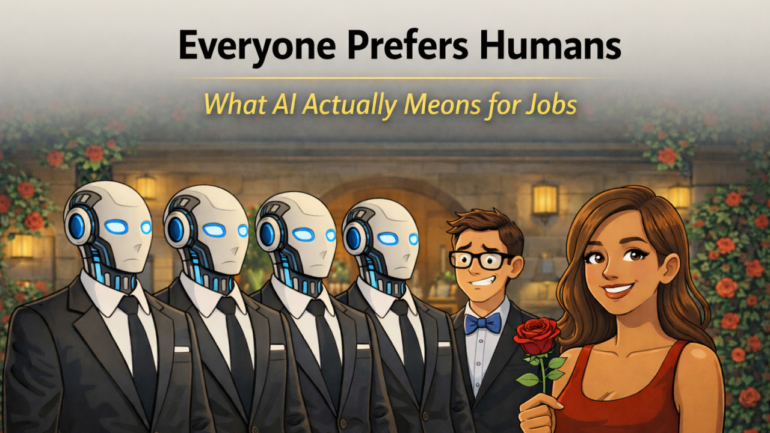
But the evidence so far suggests something simple. People still prefer a human.
Michael Simon Baker is an attorney and AI governance advisor. He writes at ArtificialIntelligence.Lawyer and practices business law at NYBusiness.Law. His work in AI governance draws on extensive study through programs offered by Harvard Business School, the Robert H. Smith School of Business at the University of Maryland, Google, and others. This article draws on publicly available labor market research and does not constitute legal advice