

For many small and midsize law firms, “financial reporting” means pulling numbers from multiple systems. Time tracking lives in one platform, invoices in another, payments elsewhere, and trust accounting may be maintained separately.
Individually, each system works, but collectively, they create gaps. When financial data doesn’t live together, your clarity disappears.
Link to Common blind spots in small law firm financial management Common blind spots in small law firm financial management
Financial management blind spots rarely appear as dramatic failures. They surface quietly:
- Time entered in days after work is completed
- Draft invoices not finalized before month-end
- Payments cleared but not matched to open invoices
- Trust balances requiring manual reconciliation
Consider a 12-person litigation firm reviewing month-end revenue. Work volume has been steady, but billing appears lower than expected. A closer look reveals delayed time entries, open draft invoices, and payments that haven’t been reconciled across systems. Nothing is broken, but nothing is fully aligned either.
The American Bar Association notes that delaying time entries can significantly reduce the amount of billable time captured—for example, entering time a week late has been shown to result in losing up to 20% of potential billable hours.
The result is uncertainty. Revenue appears softer than reality, and leadership hesitates on hiring or investment decisions.
Link to Financial visibility is a governance issue Financial visibility is a governance issue
For small law firm billing, financial clarity is fiduciary.
Trust accounting errors remain a common source of disciplinary action across jurisdictions. Most issues stem from process breakdowns rather than misconduct. When billing, payments, and trust ledgers exist in separate systems, reconciliation becomes manual, which introduces timing gaps and leads to higher risk.
Fragmented systems also mean longer hours for staff and more time away from clients as they work to match payments, adjust ledgers, and reconcile discrepancies.
Link to Embedding financial management into daily work Embedding financial management into daily work
The most effective way to improve visibility is to embed financial processes directly into case activity.
When time tracking occurs within the matter file, capture rates improve. When invoices are generated directly from tracked time, billing cycles shorten. When clients can pay electronically, and payments reconcile automatically, collection timelines decrease. When trust and operating balances update within the same environment, oversight is simpler.
Integration reduces the lag between work performed and revenue recognized.
Platforms that unify daily legal tasks like case management, billing, payments, and trust accounting reduce the need for manual reconciliation and provide financial data that updates alongside operational work.
For firm leaders, that alignment means fewer surprises at month-end.
Link to Better small law firm billing enables confident leadership Better small law firm billing enables confident leadership
Managing partners and administrators are asked to make forward-looking decisions like when to hire, whether to expand a practice area, how to adjust compensation structures, or when to invest in growth.
Those decisions require current information, not reports assembled weeks later.
When leaders can see real-time revenue by matter, track work-in-progress totals, monitor aging receivables, and review trust balances all in one place, decision-making becomes proactive.
With 8am™ MyCase managing your cases, billing, and firm finances in one place, you don’t have to cross-check spreadsheets, accounting software, and separate reports to understand your firm’s financial health. You get immediate visibility into performance across cases, clients, and cash flow, so you can make confident decisions about staffing, pricing, and growth.
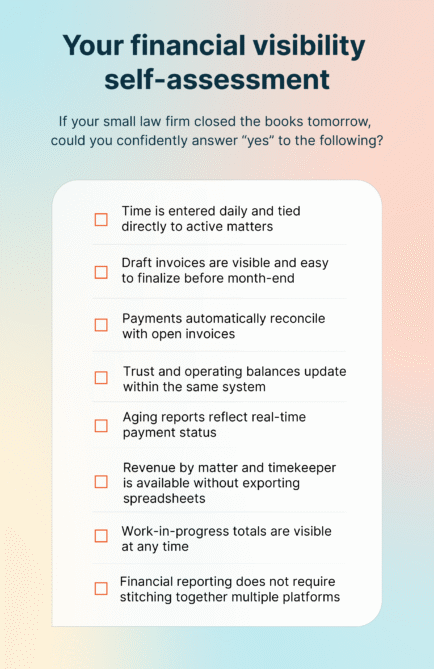
If you found yourself hesitating on any of these, your current technology may not be pulling its weight. 8am™ MyCase combines casework and law firm financial management, so you can organize matters, automate billing, and gain real-time financial visibility in one place.
Emily DiLaura is Director of Content Strategy at 8am, specializing in narrative strategy for legal, accounting, and professional service organizations. She works closely with firm leaders to shape positioning that reflects the complexity and credibility of their work.