

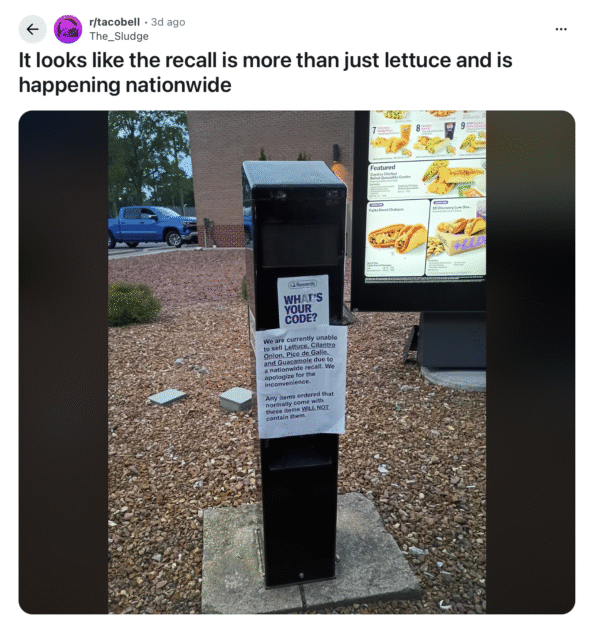
This week, printed signs went up at Taco Bell counters across Michigan and beyond telling customers the chain could no longer put lettuce, cilantro, onion, pico de gallo, or guacamole on their food — “due to a nationwide recall.” TMZ broke the story, WWJ Newsradio in Detroit confirmed the signage, and it moved fast from there through the Daily Caller and the wire pickups. Credit to those reporters for catching it, because here is the thing they all had to note in the same breath: there is no recall. Not a public one, anyway.
Go look for yourself. The FDA’s outbreak investigation table lists the open Cyclospora clusters as linked to a “not yet identified product.” No lettuce recall. No public advisory. And the CDC’s surveillance page still parks its national count at 145 cases and still tells the country there is “no evidence of a single, multistate Cyclospora outbreak.” Frozen. Meanwhile Michigan alone hit 1,251 cases this morning — up from 992 the day before, with at least 36 hospitalized — and Michigan isn’t even one of the CDC’s 17 states. Ohio, which is, has logged 177 across 43 counties: a single counted state larger than the entire national figure. Add Illinois at 141, North Carolina past 110, Indiana at 72, and Texas at 48, and the states posting their own current numbers are already well past two thousand people — against a federal total frozen at 145.
So, which is it? A recall, or nothing to see here?
The most likely answer is neither of the dramatic ones. What probably happened is that Taco Bell’s produce supplier or distributor quietly told its customers to stop selling certain product — a private withdrawal — and a store manager, handed that instruction, wrote the only word that fit on a door sign: recall. That is not an FDA action. It is not a public advisory. It is a company protecting itself, and a frontline employee translating corporate caution into plain English.
But notice what got pulled: lettuce, cilantro, and the ingredients that go into pico and guac — tomatoes, onions, jalapeños. Those are not random. Those are the usual suspects in a Cyclospora outbreak. Fresh herbs and leafy greens have been implicated over and over, from the 2020 bagged-salad outbreak that FDA traced to a Florida irrigation canal to the fast-food salads that sickened hundreds in 2018. Washing does not fix it. Freezing does not fix it. This is a field-and-water problem baked into the produce before it ever reaches the store. When a national chain yanks precisely those items across multiple states, that is not paranoia. That is a company reading the same map the rest of us are reading and deciding it does not want to be the headline. And credit where it is due: Taco Bell did the right thing. Pulling suspect produce before anyone forced it to, before a single case was tied to its counters, is exactly what I have spent thirty years wishing more companies would do. TMZ noted the chain has not been named as the source and that no one is known to have gotten sick eating there — good. A company that moves on a hunch and turns out to be wrong has lost a little money. A company that waits for proof and turns out to be right has poisoned people. I will take the first one every time, and so should you.
Which brings me to the part that ought to bother everyone. A private fast-food chain looked at this outbreak and used the word “recall.” The federal agencies whose entire job is to protect the public looked at the same outbreak and used the word “clusters.” One of those institutions is being straight with people, and it is not the one with a public health mandate. When a burrito company is more forthcoming than the CDC and FDA, the surveillance system is broken — and the people paying for it are the ones spending their summer with what the doctors politely call explosive, waxing-and-waning diarrhea that can drag on for a month.
I do not know yet whether Taco Bell is sitting on a positive test or simply moving defensively, and I am not going to pretend I do. Two things need answering, and both are answerable: whether that signage was corporate-directed or improvised store by store, and which supplier or distributor triggered it. Here is where Taco Bell can turn a good instinct into real public service. The company already did the hard part — it acted. Now it should say why and say it publicly. A short, plain statement explaining what prompted the decision, which supplier or distributor was involved, and what testing or notice it relied on would tell worried customers far more than a door sign ever could, and it would give every other operator staring at the same produce a reason to follow. That supplier notice — if it exists — is the document that matters, and it is exactly the kind of thing that surfaces in a courtroom long before it surfaces at a podium. Somebody knew enough to stop selling. The only question is when they knew it, and how many people got sick while the official CDC count sat frozen at 145.
When a company says “recall” and the government says nothing, the silence is not caution. It is a choice — and it is one more outbreak dressed up as bad luck.