

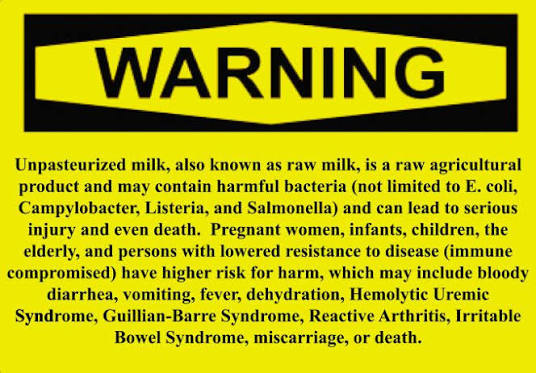
My preferred waring label above.
On July 10, 2026, the Idaho Department of Health and Welfare put out a notice telling anyone who got sick after drinking raw milk to see a doctor — fast, if they happen to be a child, pregnant, elderly, or immunocompromised. That’s the polite version. The blunt version is that at least three Idaho dairies have been feeding people Campylobacter since spring, more than 100 Idahoans have been sickened, and eleven have landed in the hospital. Idaho will tell you raw milk is legal and regulated here. Both things are true. Neither one kept a single person out of the hospital.
This is my lane. I’ve represented the people who get sick from what they eat since 1993, and I’ve watched raw milk sicken and maim children in state after state for thirty years. So when a health department frames an outbreak as one unlucky batch — a thing dressed up as bad luck — I go straight to the rules, because the rules are usually where the truth is hiding.
The current outbreak started with an illness dated May 19. By early June the state had counted 60 sick with 45 lab-confirmed for campylobacteriosis, and it refused to name the dairies, explaining that the risk applies to “any raw milk producer” — which is either an admission against interest or the single most honest thing a regulator has said about raw milk all year. By this week the number had passed 100 with eleven hospitalized, and the state finally named three operations: Paradise Grove in Jefferson County, Lolita Farms in Kootenai County, and Evans Farmstead in Twin Falls County.
Remember the name Paradise Grove. In 2024 that same dairy sickened 18 people with Campylobacter, seventeen of whom drank its raw milk, and it shut down “voluntarily” for ten days before going right back to selling. Two years later it’s on the list again. When the same operation turns up in two outbreaks two years apart, that isn’t bad luck. That’s a business model.
And it isn’t new. In 2015, Natural Farm Fresh Dairy in Kuna sickened eight people in southwest Idaho — four with Campylobacter and four with E. coli O157:H7, the strain that shuts down children’s kidneys. In the fall of 2025, Idaho counted 23 Campylobacter cases and three Shiga-toxin E. coli cases across multiple brands, six of them in children under twelve, with two more hospitalizations. Idaho’s own state veterinarian has said he’s seen five or six raw-milk outbreaks on his watch alone, in a state with roughly 170 raw milk producers. This is a pattern the state has been documenting, outbreak by outbreak, for a decade.
Here’s what “regulated” actually means in Idaho. Under IDAPA 02.04.13, a producer needs a permit, has to test the animals for tuberculosis and brucellosis once a year, has to submit routine milk-quality counts to the state every month, and has to put a warning label on the bottle. What’s missing from that list is the only thing that would have mattered: Idaho does not require raw milk to be tested for the pathogens that actually make people sick. Not Campylobacter. Not E. coli. Not Salmonella or Listeria. The state says so itself. A dairy can pass every count the rule requires and still ship a jug swimming with the bug that puts a toddler on dialysis — and because milk moves fast and outbreaks surface slowly, by the time anyone thinks to test the jug, it’s already gone. That’s not a loophole in the regulation. That is the regulation.
The most honest words in the entire Idaho raw-milk scheme are the ones the state forces onto the label: this product “has not been pasteurized or inspected and may contain harmful bacteria,” and “no matter how carefully produced, may be unsafe.” Idaho makes the dairy print the truth on the bottle — and then builds a regulatory system that does nothing to prevent it. Read that warning again and ask why a product that “may be unsafe no matter how carefully produced” is legal to hand to a child.
And here’s the tell: that label language isn’t Idaho’s. It’s the federal government’s. When the FDA banned raw milk from interstate commerce in 1987 — a ban still on the books today — it made a formal finding in the Federal Register in almost the exact words Idaho now prints on the bottle: raw milk, “no matter how carefully produced, may be unsafe.” Pasteurization went on to become one of the great public-health victories of the last century — milk-borne illness fell from roughly a quarter of all food- and water-borne outbreaks in 1938 to about one percent by 2005. The catch is that the 1987 ban stops at the state line. Inside it, each state writes its own rules, and the outbreaks pool exactly where you’d expect: of the raw-milk outbreaks the CDC logged between 1973 and 1992, 87 percent hit states that allowed the same intrastate sale Idaho allows today. Idaho isn’t wrestling with an unsettled scientific question. It’s re-litigating one the country closed in 1987.
Because that’s where this stops being an abstraction. A few years ago in Oregon, a levelheaded mom named Jill Brown did exactly what raw-milk advocates tell parents to do: she found a local farm, joined a herd share, got to know her farmer. Her 23-month-old, Kylee, loved the milk. Three months later Kylee was in pediatric intensive care with E. coliO157:H7 and hemolytic uremic syndrome. She had a stroke. Her heart stopped on the operating table and had to be restarted. She spent close to 200 days in the hospital and ultimately needed a kidney transplant — from her own mother. She still can’t walk or speak in words. Nineteen people were sickened in that outbreak; fifteen were under nineteen; four children went into kidney failure.
The farmer in that case, Brad Salyers, isn’t the villain. He fed the same milk to his own five children, four of whom got E. coli. He sold his cows and now pleads with other parents not to give raw milk to their kids, because, as he put it, children “don’t make the decision… they’re at the mercy of their caretakers.” And here is the part every legislature that “regulates” raw milk should sit with: those families couldn’t recover a dime for their children’s injuries, because the dairy had no insurance and no assets. Idaho doesn’t fix that either — nothing in IDAPA 02.04.13 requires a raw-milk producer to carry a penny of liability insurance, and the herd-share track (Idaho caps it at seven cows or fifteen goats) is the same “you own the cow, so you can’t be a customer” fiction that left Kylee’s family with nothing.
Let’s be clear about what Idaho actually has. A permit that tests cows for the wrong diseases. A monthly count that ignores the pathogens that hospitalize people. A warning label that tells the truth alongside a regulatory scheme that ignores it. No insurance requirement for a product the state itself calls unsafe. And a decade of outbreaks, one dairy showing up twice, and more than 100 people sick this summer alone. Raw milk isn’t a food. It’s a dare — and children are the ones being dared. I’ve said for thirty years that I’d love for the food industry to put me out of business by making food safe. Pasteurization did the hard part a century ago. Every state still selling raw milk to kids is choosing not to use it.