

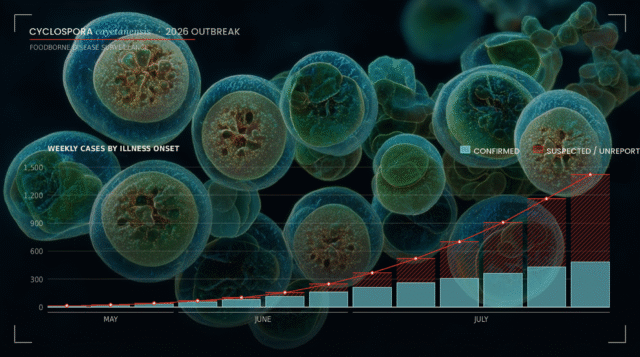
Lena Sun at the Washington Post asked the right question this week: why don’t we know what food is spreading the Cyclospora sickening thousands of Americans? Her answer — that this parasite is one of the hardest foodborne bugs to trace, with a long lag between the tainted bite and the first symptom, a genome too large for our fingerprinting tools to fully read, and a distribution system so tangled that one supplier feeds a hundred kitchens — is all true. I’ve watched investigators chase this ghost since the Guatemalan raspberries of the 1990s. It is genuinely hard.
But there’s a harder truth underneath the hard science, and it doesn’t show up under a microscope. We don’t know what’s making people sick partly because, last year, we decided we’d rather not know. In July 2025, the CDC quietly made Cyclospora reporting optional when it scaled back FoodNet, its foodborne surveillance network. Reporting optional — in the middle of a pathogen’s peak season. That’s a choice, dressed up as bad luck.
You can see the result in the numbers that don’t add up. As of July 9, the CDC counted 843 confirmed cases. Michigan alone was sitting on more than 1,500. When a single state’s tally is nearly double the national “official” count, that’s not a mystery of biology — it’s a mystery of accounting. Sun’s own reporting puts the real figure north of 2,000 across more than 30 states, with 80-plus people hospitalized. The parasite isn’t hiding. The data is.
And let’s retire the advice pasted into every one of these stories: wash your produce. You can’t rinse your way out of this one. Cyclospora shrugs off disinfectants and lodges in the crevices of a raspberry or a sprig of cilantro where water never reaches. Sun’s article runs a photo from 1998, when the FDA blocked Guatemalan raspberry imports, and the caption says it plainly: washing may not remove the germs hidden in the fruit. The only thing that reliably kills it is heat — 158 degrees.
Sun is right that a large outbreak, for all its misery, is the best shot investigators get at a source, because more sick people means more grocery receipts and restaurant tickets to cross-reference. But you only get that shot if you’re still counting. Make reporting optional and you don’t just lose a number on a dashboard — you lose the ability to find the farm, name the supplier, and pull the product before the next family orders the salad. You cannot trace what you refuse to count.